

Samsung Electronics revealed its largest-ever 3D-ready Onyx screen at Capital Cinema located in the Xicheng district in Beijing, China at a grand opening ceremony on December 7. This high-tech display installed at Capital Theater combines 4K resolution, HDR picture quality and peak brightness level of 88fL — almost six times greater than standard projector technologies. The Onyx LED technology is also 3D-ready and Digital Cinema Initiatives (DCI)-certified. “Our new Onyx display reflects a momentous step for the industry, as we usher in the next generation of cinema around the globe. We’re excited to partner with Capital Cinema to help showcase the new industry standard for picture quality on the big screen,” said Seog-gi Kim, Executive Vice President of Visual Display Business at Samsung Electronics. Read more for two more videos and additional information.

Not just a toy, the Looking Glass is a holographic display that not only showcases visual content in 3D, but lets you interact with the content without the need for special glasses or headsets. This is made possible with a proprietary lenticular display that combines 45 angles of any given 3D model into one, enabling you to view the model’s front, sides, top, and bottom. Continue reading for a more in-depth video preview and information.

Acer’s GN246HL Bbid 24″ 3D Gaming Display not only has a 1ms response time, but a blazing 144Hz refresh as well, all for $182.99 shipped. The 100 Million:1 contrast ratio radiates the brightest whites and deepest blacks giving you a crystal-clear viewing experience of all your content. NVIDIA 3D Lightboost provide immersive 3D imagery that’s twice as bright as other solutions. With advanced active shutter 3D technology, the Acer 3D experience is ideal for home entertainment, and multiple pairs of glasses can be used simultaneously for shared enjoyment. Product page. Continue reading for another video and more information.

Developed by researchers at Keio University in Japan, the RePro3D is basically a system that “allows the user to directly interactive with a 3D character through virtual touch; [it is] composed of a tactile finger interface, a glasses-free 3D display originating from a computer model, and an infrared camera that can recognize the movements of the user’s hand.” Video after the break.
[via Dvice]

Demonstrated at CES 2011, the HoloAd is essentially a holographic system that “uses three displays and reflecting glass plates that are strategically placed to give viewers a look at the moving video — comprised of multiple objects from multiple perspectives.” Video after the break. Click here for more pictures.

Researchers at Tohto C-Tech have developed a camera system that utilizes a GPGPU to reproduce 3D faces in real-time. Plus, “the camera setup actually captures the face from two different viewpoints, enabling the sides of the face to be shown in addition to the front.” Video after the break.
[via Engadget]

Have you ever wondered how 3D technology works? Well, look no further than this infographic. Did you know that for anaglyph technology, your visual cortex combines the two projected images (red/blue) into a when special glasses are worn? If not, continue reading to see those facts and more.
[via OnlineSchools]

Not only does The Masters Tournament 2010 mark the return of Tiger Woods, but it’s also the first to be shown in full 3D, at least to Bell TV subscribers in Canada. That’s right, “on Saturday, April 10 and Sunday, April 11, the Masters will be broadcast in commercial-free 3D HD from 5 pm to 7 pm ET.” Continue reading to watch some fan-shot footage. Click here to watch live.
Available coast to coast to all Bell TV subscribers with High Definition service, the Masters Tournament in 3D HD will be available on channel 1000 at no extra charge.
[via TMCNET]

MIT researchers have developed the BIDI (Bi-Directional) Screen, which brings interactive 3D holograms to life. In addition to multi-touch functionality, this system also features “hand movement recognition in the space in front of the screen.” Video after the break.
This differs from projects like Natal, which have the camera offset from the display and therefore cannot work at short distances.
[via Engadget]
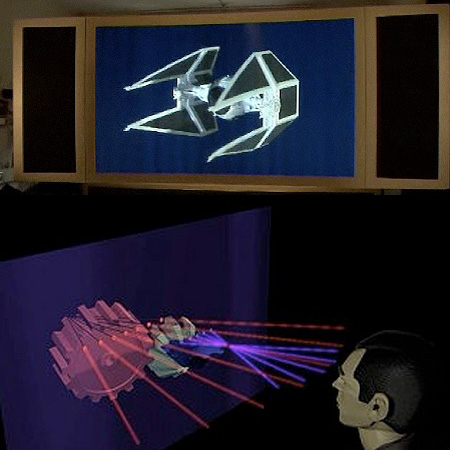
Unlike other 3D screens, HoloVizio uses voxels instead of traditional pixels. Put simply, “anyone standing around the monitor will actually see an object from a different perspective, with no need for goggles or other stereoscopic tricks.” Video after the break.
According to Holografika, there’s also no need for head tracking or positioning, so many people can see the objects at the same time, with no discomfort of any kind.
[via Gizmodo]