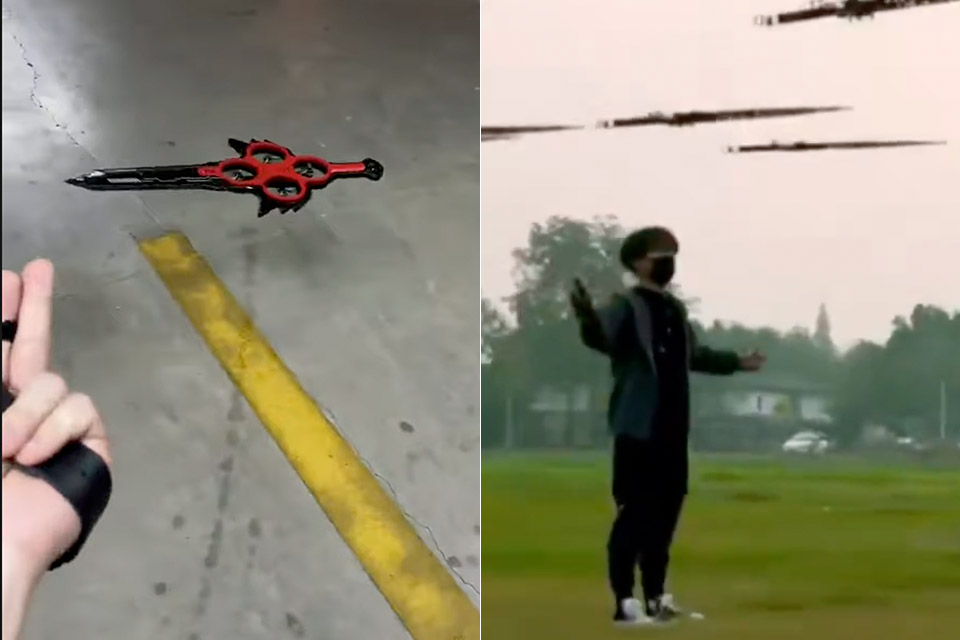
A young engineering student in China has created a really interesting drone that resembles a slim sword and simply hovers there in silence, responding to the sweep of your hand. There are videos all over the internet depicting it rising off a table, circling a room, and even flipping through the air before landing in a waiting palm.
Flying swords are now real, sort of! ⚔️
Chinese influencer built quadcopters disguised as “fantasy blades,” inspired by classic wuxia flying-sword scenes.
The drones have propellers embedded along the body and are controlled with motion gestures, letting the user guide them by… pic.twitter.com/Zau7dysR88
— Lukas Ziegler (@lukas_m_ziegler) December 3, 2025
The builder appears to be working from a small university lab or at home. He wears a small control unit to his left hand, a thin band that uses rudimentary sensors to measure tilts and twists, similar to those used in smartphones and fitness trackers. These sensors send data to the drone’s onboard computer, which controls the spin of four tiny propellers nestled down the length of the’sword’. Front, back, left, and right rotors are all drawing in together to keep the vehicle balanced, even when it is banking into a turn.

- Due to platform compatibility issue, the DJI Fly app has been removed from Google Play. DJI Neo must be activated in the DJI Fly App, to ensure a...
- Lightweight and Regulation Friendly - At just 135g, this drone with camera for adults 4K may be even lighter than your phone and does not require FAA...
- Palm Takeoff & Landing, Go Controller-Free [1] - Neo takes off from your hand with just a push of a button. The safe and easy operation of this drone...
As you get a closer look at the drone, you notice certain details: it’s roughly 2 feet long and appears to be constructed of lightweight plastic that was apparently created with a 3D printer. There’s some metal added to give it that nice sharp blade finish, and inside there’s a little battery that powers the motors and all of the electronics, allowing for a few minutes of flight each charge. The student would have spent hours fine-tuning the programming that connects hand gestures to propeller speed, which is a bit of a trial and error procedure in which one false move sends the entire thing teetering towards the wall. But when things go well, it’s very cool; the drone just hovers there, as if it’s pulled up by an invisible thread.
The control is the main draw, as fans are fascinated by how smoothly it responds to hand movements. Simply elevate your hand, and the drone will ascend smoothly; flick it forward slightly, and it will fly towards you. Pull the hand back, and it simply glides back to you, the distance opening and closing like a flowing conversation. The technique is based on wireless impulses that bounce back and forth between the hand unit and the drone at such a rapid pace that it seems almost instinctual. The best part is that there are no joysticks or screens to interfere with the natural curve of your arm as you guide this futuristic blade around.