Volkswagen unveiled Mission Efficiency today as a near-production electric 2+2 coupe whose entire brief is to waste as little energy as possible. The car is a clear nod to the 2013 XL1, the plug-in hybrid teardrop that once held the title of the most economical production car on sale. This time the powertrain is fully electric, the platform is the same front-drive MEB+ hardware headed for the ID. Polo and ID. Cross, and the claim is a new record for any road-approved car: a drag coefficient of 0.158.

Four years after Daniel Riley first lashed remote-control crawlers to a backyard tether and asked whether any of them could rack up 100,000 scale miles, he ran the experiment again. This time the cars steered themselves. In the original 2022 test, a spinning line kept every vehicle on a circle, which also loaded one side of the drivetrain harder than the other and turned wear into a lopsided argument. For the Self Driving Edition, Riley laid a perimeter wire through his yard, borrowed the sensing idea from robot lawn mowers, and taught an Arduino to twitch a steering servo whenever a coil on the bumper drifted off the signal.

Soldiers still burn hours and calories moving water, ammunition, and radios across ground that wrecks ordinary trucks. Pack animals once filled that gap. Conventional electric robots often stall in the same mud, sand, snow, and rubble because their motors sit in the middle of the chassis and feed torque through gearboxes and shafts that lose grip the moment the surface turns ugly. ESOX Group finished a compact uncrewed platform, called the X2, this summer that tries to skip that failure.

Photo credit: McMurtry
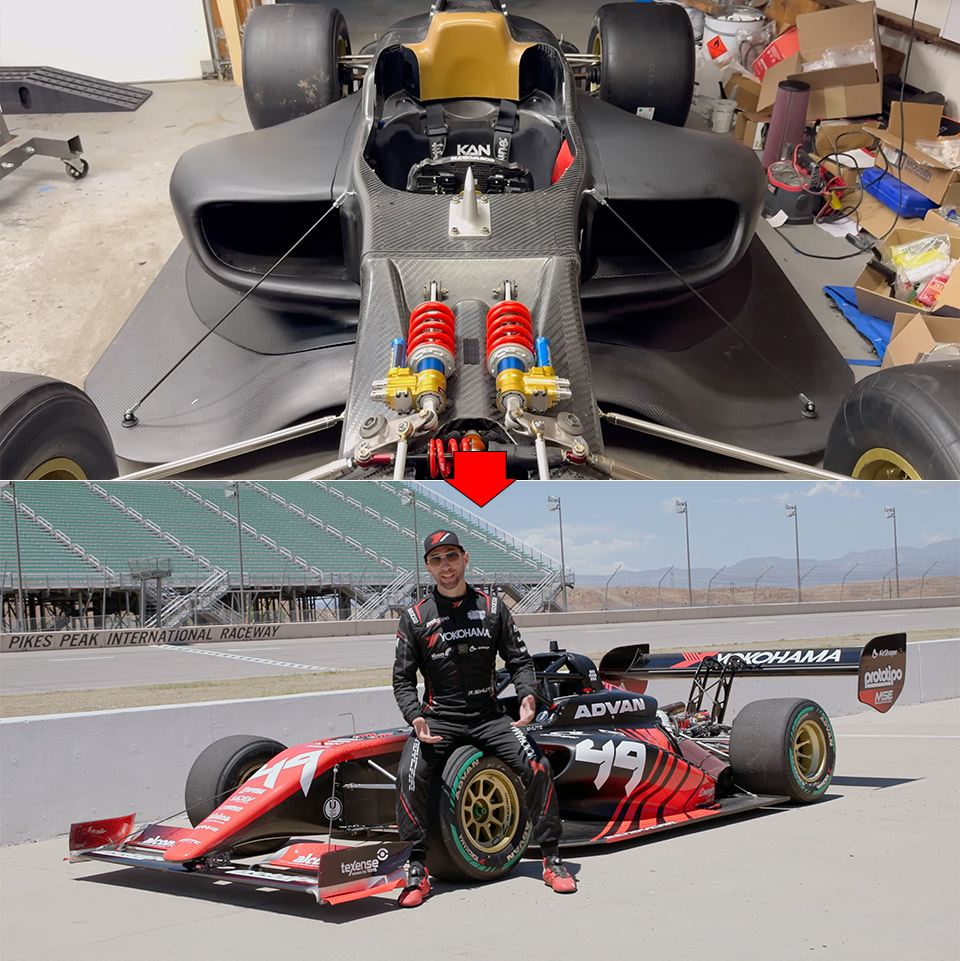
Travis Pastrana has jumped from a plane with no parachute, landed the first double backflip on a motorcycle, collected 11 X Games gold medals, and raced the Daytona 500. On a day at Dunsfold Aerodrome in England, the same airfield used as the old Top Gear test track, he still found something that reset his scale. He climbed into a McMurtry Spéirling prototype and later said he had gone faster than in any vehicle of his life.

Tesla posted three words on X Saturday. “Go for launch.” A red sports car sat under hard vertical light, the kind used on a pad before a rocket leaves the ground. The date 10.01 ran across the bottom of the frame. A countdown on the company’s Roadster page now points at the same Thursday. Invites followed within hours.

A black Volkswagen Jetta rolled through an Express Lane in Solano County with a blank bumper where a rear plate should have been. A California Highway Patrol cruiser in the next lane caught that empty space on dashcam, then saw the same car moments later with a full, readable California plate sitting in place. That change was the whole stop.

Toyota Gazoo Racing put the GR KART on sale in Japan on September 10 for 385,000 yen, about $2,500 including tax, as a closed-course machine meant to get children and families onto a track without the usual pile of extra cost. Each unit comes from the small Gamagori GR KART Workshop in Aichi Prefecture, where staff apply Toyota Production System methods to a product far smaller than any passenger car. Official goals match a long-standing wish from chairman Akio Toyoda, who has said motorsports should be as easy to pick up as baseball or soccer.

Oracle Red Bull Racing put Sebastian Vettel’s 2012 championship RB8 onto Madrid Metro rails this week and drove it through closed tunnels as if a subway line had suddenly become a racetrack. Heritage Team staff and Spanish engineering collective Andtonic did the work at Metro de Madrid’s Canillejas workshops, racing a two-week deadline to finish custom metal wheels before the Spanish Grand Prix weekend at the new Madring circuit.

Chassis 136069 left Maranello in October 2004 in a color Ferrari almost never allowed. A member of the Royal Family of Brunei ordered this 2004 Enzo in Matte Nero Opaco, factory matte black applied to no other car in the 400-example run built from 2002 to 2004. Work began on June 8. Four months later the finished car went to the family’s London house with matching Nero leather, Nero carpets, Rosso gauges, and the larger seats. Occasional sightings in Hampstead, Mayfair, and Knightsbridge were as close as most people ever got to it.

Audi put the A2 name back on a production car this morning, and the claim attached to it is blunt. A2 e-tron is the most efficient electric Audi the company has built, with official consumption as low as 12.8 kWh per 100 kilometers and a WLTP range that reaches 646 kilometers on the largest battery.