Valve spent Monday putting a headset on sale before most people had finished coffee. Steam Frame starts at $1,059 for the 256GB kit and $1,299 for the 1TB kit, with controllers and a native build of Half-Life: Alyx in the package. A power brick stays off the packing list. Sign-ups for a reservation lottery run through September 17 at 10 a.m. Pacific. After that cutoff Valve randomizes the list, emails results the same day, and starts sending the first purchase invitations on September 18. Miss the window and you land at the back of the waitlist.
Steam Frame is a wireless headset designed to play both VR and traditional Steam games from the same library. You can stream from a PC via a supplied Wi-Fi 6E adaptor, or you can play a limited number of games directly from the headset. Valve has decided to use a streaming-first approach. This is made possible by dual radios, one dedicated to your PC on the 6 GHz link and the other to home Wi-Fi, ensuring that chat and downloads do not interfere with the video streaming. When things become hectic, a nifty little mechanism known as multi-link streaming separates the traffic and sends it across the two paths you’re using. There’s also a brilliant eye tracking function that feeds into what Valve calls Foveated Streaming, which means extra detail is only displayed where you’re looking, resulting in a significant increase in image quality for the same wireless budget.

- CARDBOARD MONKENAUT — Get our best Gorilla Tag bundle yet with this Amazon exclusive deal. Purchase Meta Quest 3S to get exclusive items, including...
- NO WIRES, MORE FUN — Break free from cords. Game, play and explore immersive worlds — untethered and without limits.
- 2X GRAPHICAL PROCESSING POWER — Enjoy lightning-fast load times and next-gen graphics for smooth gaming powered by the Snapdragon XR2 Gen...
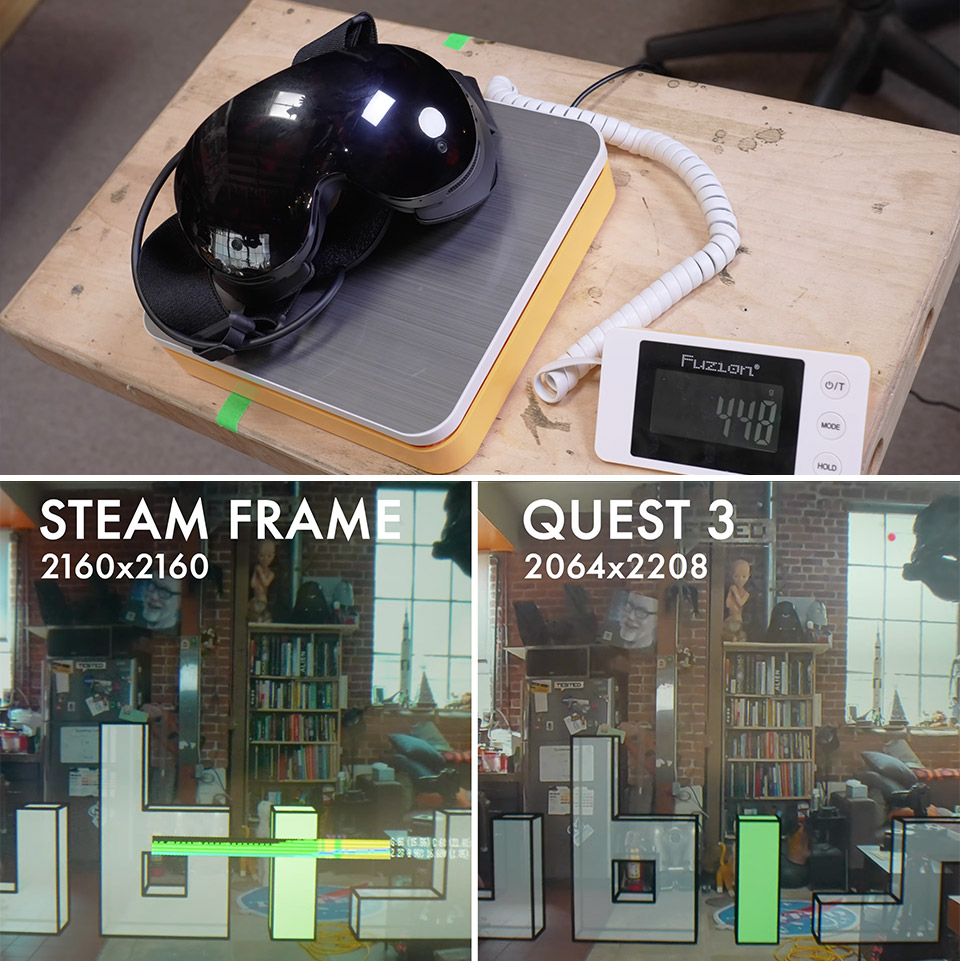
The hardware is based on a 4nm Snapdragon 8 Gen 3, with a sizable 16GB of unified LPDDR5X memory. UFS storage in two capacities is also featured, as is a microSD slot that accepts the same cards as a Steam Deck or Steam Machine. Two LCD displays operate at 2160 by 2160 per eye through pancake lenses, with refresh rates that reach as high as 72Hz all the way up to an experimental 144Hz, and with a stated field of view of up to 110 degrees. The IPD is adjustable via a tactile knob. There are four outward-facing cameras for inside-out tracking, one grainy monochrome passthrough, and two inward-facing cameras to monitor your eyes. Surprisingly, there is no color passthrough in the box. Hand tracking is also missing, so you’re stuck with the provided controllers.
Early hands-on testers rave about how comfortable this headset is. The visor alone weights about 185g. When you mix in the facial interface, strap speakers, and the 21.6Wh battery in the back, the total weight is only 440 grams. That is actually much lighter than a Quest III. The strap contains dual speaker drivers. The two microphone array handles voice. The controllers, on the other hand, track in six degrees of freedom, have a d-pad and extra buttons that allow them to function as a gamepad for flat games, and are powered by AA cells that last up to 40 hours. The headset itself charges via USB-C. Any 45W or higher charger will suffice (including the Steam Deck brick). If you need one, Valve will sell its own for $29. If you want an ergonomic package with extra straps and a taller light blocker, you may pay $59 for it. Replacement cushions and a basic light blocker are slightly more cheap at $49.
The software on the new Steam device is powered by SteamOS 3, which runs on ARM for the first time in a Valve product. Proton will continue to support a wide range of Windows games, as expected. FEX is a translation tool that allows you to execute x86 code on a Snapdragon SoC. Then there’s Lepton, a Waydroid-based layer that can execute Android packages, provided they don’t require Google Play services, of course. That’s the technology that allows Valve to claim “the whole Steam catalog” while yet providing a device that can be used without a computer, but at launch, that’s not the case.
There is a ‘Great on Frame’ or Verified list that runs on its own, with over 100 movies and is slowly developing. The VR games, on the other hand, are quite demanding and require the presence of a gaming PC to function properly. Half-Life: Alyx is an exception: Valve spent a whole year ensuring that the ARM version plays well, as it employs Vulkan, eye-tracked foveated rendering, and a lot of driver optimization just to have the City 17 section of the game operate on the headset without the need for additional PC.