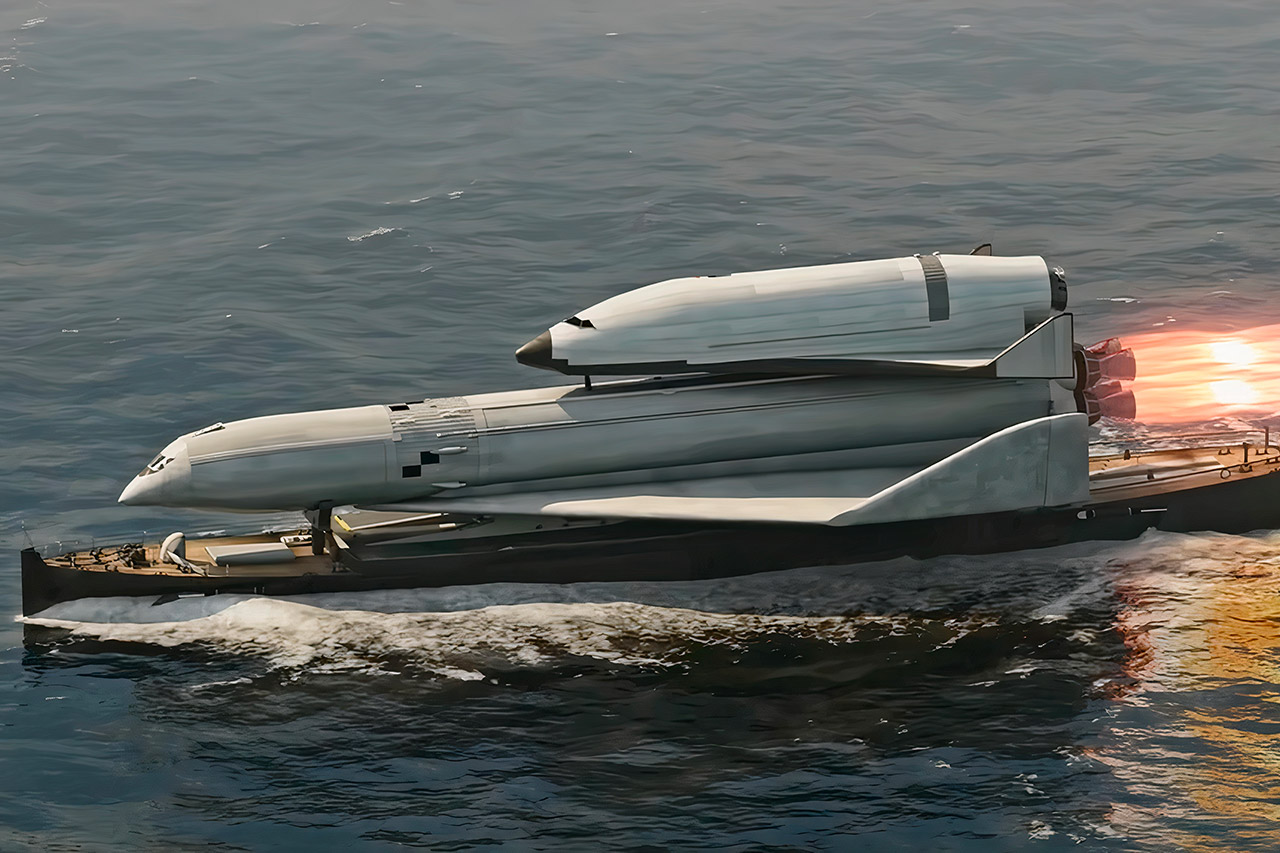
You’ve seen SpaceX’s Falcon 9 many times over, but the Soviet Union’s hydrofoil albatros rocket launch system is one many are unfamiliar with. Officially called the Alexeyev Sukhoi Albatros 3 Stage Rocket System, this vehicle was conceptualized in 1974 as a multi-stage system, with the initial stage utilizing an 1,800 ton hydrofoil that stretched 70 meters in length.
The hydrofoil, designed by Alexeyev, served as a precursor to a full-fledged ekranoplan, carrying a substantial payload of 200 tons of Liquid Oxygen (LOX) and Liquid Hydrogen (LH2). These propellants were intended to fuel the motors of the second stage, which is estimated to weigh in at 210 tons. It utilized the LOX and LH2 from the first stage to accelerate the entire assembly to 180 km/h (112 mph) over a span of 110 seconds. This acceleration would have occurred along the surface of the Caspian Sea, the Aral or Lake Baikal. Once it reached the desired speed, the second stage detached from the hydrofoil and initiated its own propulsion system, launching itself off the now-empty barge.


The final stage of this remarkable vehicle was a tail-less rocket plane, boasting a mass of about 80 tons and spanning 40 meters in length. This design made it comparable to the American orbiter. Despite its similarity in appearance to certain iterations of the Hermes shuttle or the later Russian/European Kliper, it stood out due to its payload capacity of 30 tons to Low Earth Orbit (LEO) and its crew of two. Technically, this stage was a marvel, incorporating advanced engineering concepts to achieve its objectives,” said Hazegrayart.