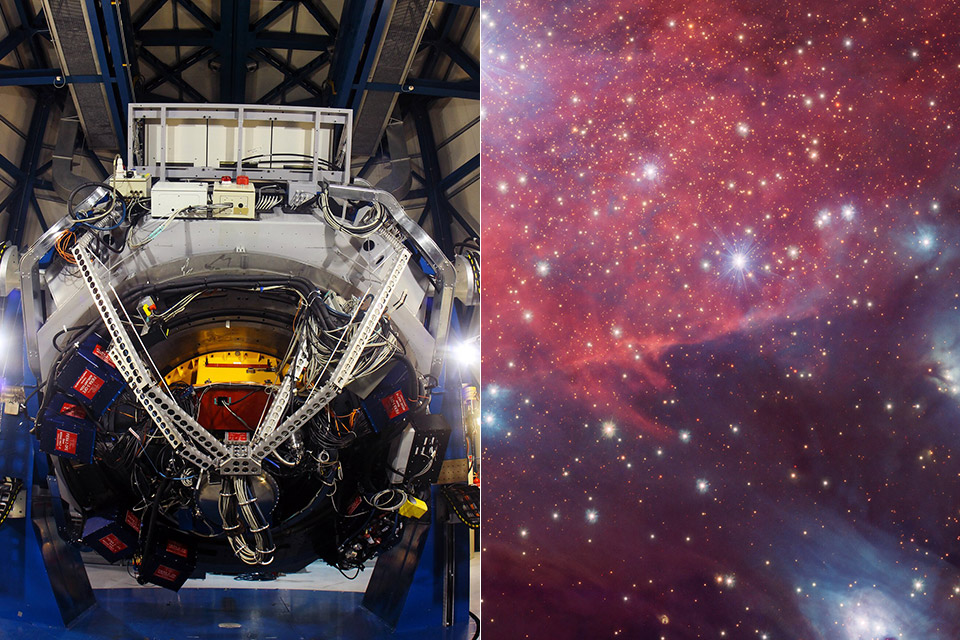
You’ve seen the Crab Nebula, now check out the rosy red nebula IC1284, as captured by the ESO’s OmegaCAM on the VLT Survey Telescope (VST). This star-forming region is composed primarily of hydrogen, while its rosy glow occurs due to electrons within the hydrogen atoms becoming excited by the radiation from young stars before losing their energy and emitting a specific color.

The OmegaCAM is equipped with a filter that lets through this particular reddish color, giving this nebula its cosmic glow. If you look closer, the blue reflection nebulae NGC6589 and NGC6590 can also be seen in the lower right corner. The dust in a reflection nebula basically scatters shorter, bluer wavelengths of light from nearby stars, giving them their cool blue appearance.
No products found.
The frame of this image covers an area roughly equivalent in the sky to a full Moon. This image was captured as part of a large ESO public survey, the VST Photometric H alpha Survey of the Southern Galactic Plane and Bulge (VPHAS+), which observes nebulae and stars in visible light to help astronomers understand how stars are born, live and die,” said the European Southern Observatory.