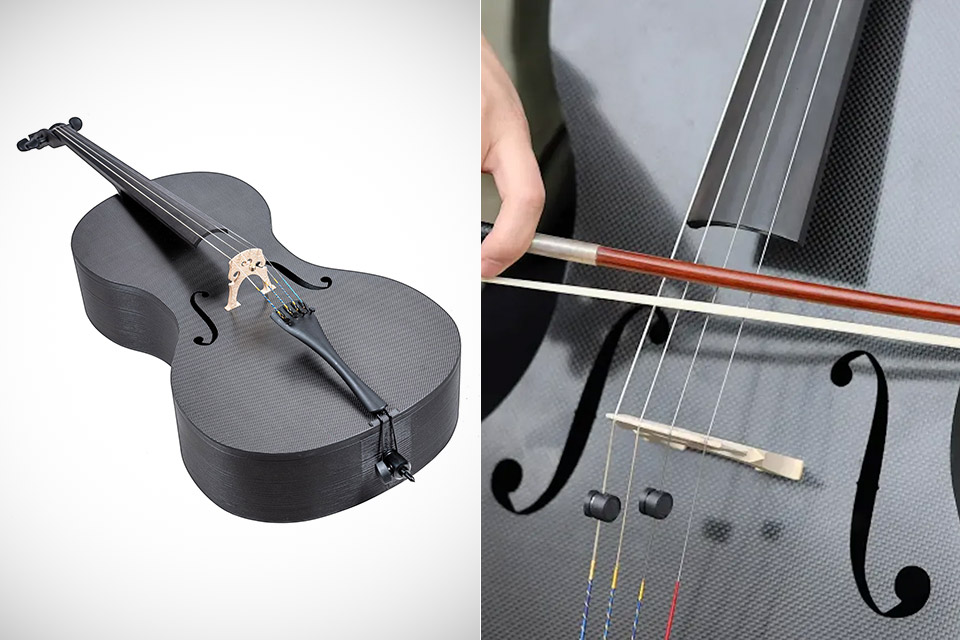
Cellos have always relied on wood to produce rich tones through labor of love construction, rather than just meticulous cutting and assembly. Forte3D takes an entirely different approach; the firm’s founders, Alfred Goodrich and Elijah Lee, as well as cellist Mike Block, who currently co-runs the company, created the world’s first 3D-printed carbon fiber cello.
The top and back of the cello are constructed of carbon fiber, which is cut to a slightly concave shape. Unlike a standard timber top, which yields outwards, these panels flex slightly under string tension, similar to a speaker cone or trampoline surface. The vibrations just flow freely, resulting in a very open resonant chamber that projects sound strongly while remaining warm. The ribs, neck, and scroll of this cello are manufactured of polymer using 3D printing, allowing you can adjust their thickness and shape directly in your design software. However, the more conventional pieces, such as the ebony fingerboard, hand-carved wooden bridge, and standard sound post, remained unchanged. The strings are a blend of Jargar and Helicore, while the Wittner fine-tune pegs keep the tuning smooth and precise.

- High-Speed Precision: Experience unparalleled speed and precision with the Bambu Lab A1 Mini 3D Printer. With an impressive acceleration of...
- Multi-Color Printing with AMS lite: Unlock your creativity with vibrant and multi-colored 3D prints. The Bambu Lab A1 Mini 3D printers make...
- Full-Auto Calibration: Say goodbye to manual calibration hassles. The A1 Mini 3D printer takes care of all the calibration processes automatically...
One thing that really stands out about this cello is how damage-resistant it is. Carbon fiber won’t stretch or crack, even in extremely dry or humid environments. Cleaning is as simple as it gets, as all you need is a cloth and a few household products. Plus, you can make practical modifications on the fly by just turning a single screw to achieve the desired string height. This is especially useful for players who prefer a lower action during long practice sessions or a higher action when they want to really assault the strings.
Now, the sound of this cello really shines, since, let’s be honest, early attempts at carbon fiber cellos didn’t necessarily sound that good. That’s not an issue here, though, because Forte3D has chosen to use softer 3D printed ribs that absorb all of those undesirable high frequencies and provide you with a nice, natural sound. Mike Block, a professional cellist, took it on a months-long tour and believes it’s the best carbon fiber cello he’s ever played.
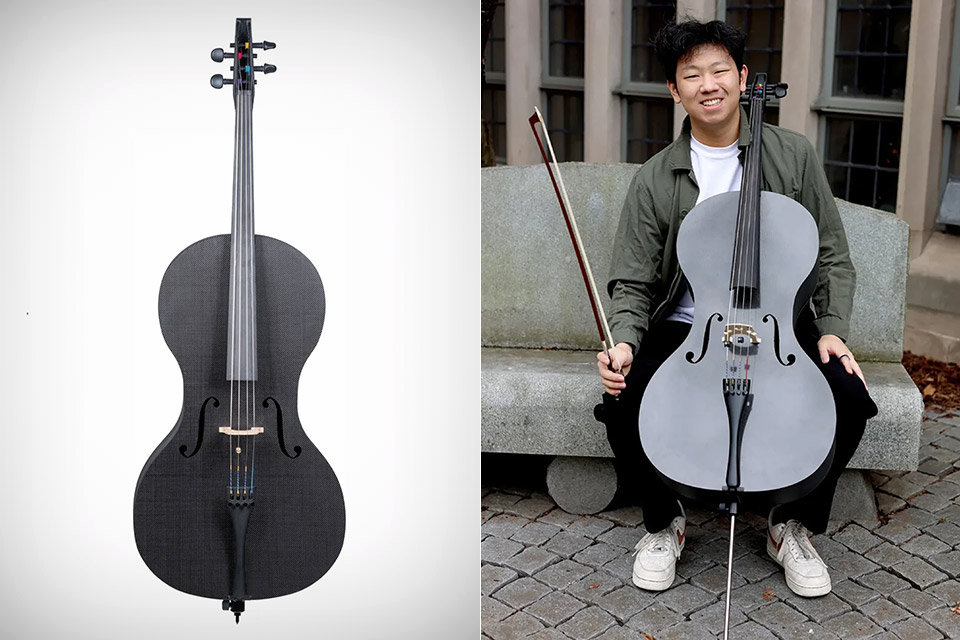
What about the price? How about $2,950, which is actually a bargain when compared to handcrafted hardwood versions or basic carbon fiber models. Each one ships completely assembled and tested, and it includes a protective gig bag to keep it safe on the road.
[Source]