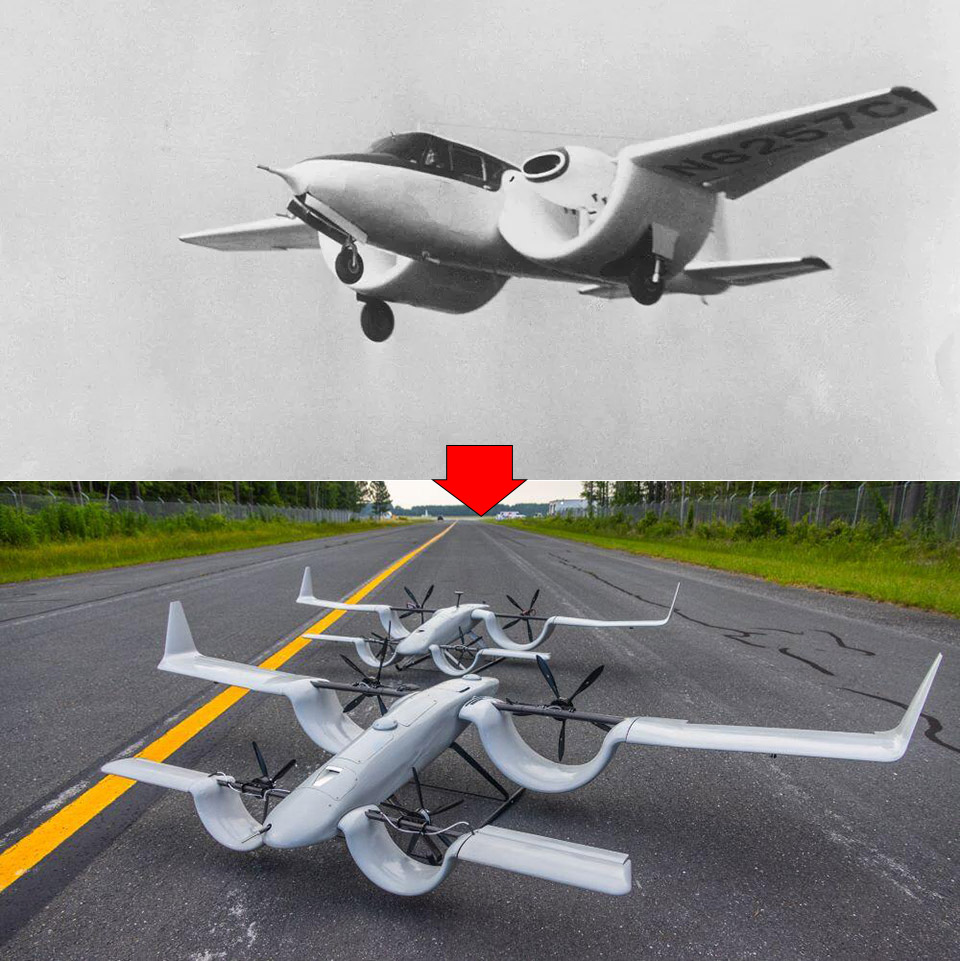
Willard Ray Custer filed patents in the 1920s for a wing shaped like a curved trough. A propeller sat inside that half-circle channel and forced air across the surface. The goal was simple. Lift should come from moving air over the wing, not from racing the entire aircraft down a long runway first. Early tests showed real promise for short takeoffs. One demonstration had a man jogging beside the plane as it lifted off. Another had the aircraft strapped down while the props alone raised it on the lift generated inside the channels. A few 1950s prototypes flew and performed well in wind-tunnel work. The design still faded. Airplanes of that era were heavy, low-speed control felt limited, and the concept never delivered reliable vertical takeoff on its own.
HopFlyt, a Maryland company formed in 2016, is now seeing tremendous potential. With modern materials reducing weight and electric motors giving precise power and control, the stage is set for some truly innovative technology. They’ve already built and flown a few small prototypes, but what truly sets them apart is the Cyclone, a hybrid VTOL cargo drone with channel wings on both the front and back of the main wing.

- Due to platform compatibility issue, the DJI Fly app has been removed from Google Play. DJI Neo must be activated in the DJI Fly App, to ensure a...
- Lightweight and Regulation Friendly - At just 135g, this drone with camera for adults 4K may be even lighter than your phone and does not require FAA...
- Palm Takeoff & Landing, Go Controller-Free [1] - Neo takes off from your hand with just a push of a button. The safe and easy operation of this drone...
The way those pivoting channels function is impressive, as their design has a significant impact on everything. During vertical takeoff, the curved sections at the back change direction and angle backwards, funneling the propwash right into the U-shape and giving the drone a massive boost of lift even when it’s moving at zero km/h forward, and once the drone is airborne and transitions out of hover mode, the channels rotate down and continue to give it a massive boost of lift. Even better, the same surfaces can switch to braking mode if you need to slow down.
The Cyclone is powered by a mix of batteries and a small engine. The batteries manage the brief, intense stages of hover and transition, which last around 4-5 minutes, after which a 30-kilowatt turbogenerator (or, theoretically, a future piston engine) takes over and powers the electric propellers. Right now, it appears that those propellers will consume less than 3 gallons per hour on longer legs, and they will require less than one-third the power of conventional VTOL setups to take off.
The control system in this thing is pretty clever, as it combines several ways, with various props in the channels and on the canard, all of which can tilt independently, giving it a plethora of control options. The roll is accomplished through differential thrust, the yaw is achieved by tilting them differently on each side, the forward motion and pitch are determined by prop angle and the aircraft’s natural attitude, and once the wings are carrying the majority of the load, regular ailerons and elevators are used to assist. When the drone moves slowly, the channel surfaces can be used as powered lift devices or airbrakes.
They’ve already had some success with small demo models, with the 10-foot-wingspan Squall flying autonomously in hover and forward mode. Next up is the larger 20-foot wingspan model, which is now being manufactured. Then they must work out the hybrid power integration, which they think will be ready for commercial use by 2027.
So far, payload and range estimates have included 250 pounds of goods on round trips of around 100 nautical miles, as well as smaller loads covering more than 800 miles. When opposed to helicopters, operators targeting medical delivery or remote replenishing may see significant cost reductions. Military interest includes resupply, observation, and reconnaissance routes in places without runways.
[Source]