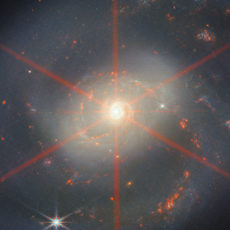
NASA / ESA’s Hubble Space Telescope captured the sparkling arms of barred spiral galaxy NGC 1087, which is located 80 million light-years away in the constellation Cetus. The galaxy boasts a diameter of 87,000 light-years and has a very small nucleus.

You can easily make out the galaxy’s dust lanes, observed in dark red, as they help define its spiral structure. NGC 1087’s stellar bar, or the elongated, bright-white structure at its center, is also shorter compared to other barred galaxies. Normally, the gravity of the center pulls in large quantities of gas, resulting in a burst of star formation followed by a slow decay.

- LEGO NASA Space Set - This adult LEGO set features the Space Shuttle Discovery and the Hubble Space Telescope from NASA’s 1990 STS-31 mission,...
- Solar System Exploration - Unlock the mysteries of our solar system with this engaging 2,354-piece project, packed with authentic details and...
- Shuttle Features Galore - The space shuttle model has an opening payload bay, retractable landing gear, opening cockpit, moving elevons, space arm,...
British astronomer William Herschel discovered NGC 1087 in 1785. The galaxy sits just south of the celestial equator, making it visible from both hemispheres. In 1995, astronomers discovered a Type II supernova within this galaxy,” said NASA.