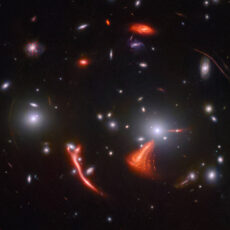

NASA’s James Webb Space Telescope captured a gravitationally lensed supernova in a far away galaxy designated MRG-M0138. Upon closer inspection, you’ll see that the galaxy has been warped by the powerful gravity of the intervening galaxy cluster MACS J0138.0-2155.

Why did MRG-M0138, named Requiem, stand out to astronomers? Well, not only was it 10 billion light-years distant, but the lensed supernova was likely the same type (Ia) that is used as a ‘standard candle’ to measure cosmic distances. The models also predicted that one of the supernova images is so delayed by its path through the extreme gravity of the cluster that it will not appear to us until the mid-2030s.

- Feed a passion for science and technology – Kids can learn more about the challenges of space exploration with this LEGO Technic NASA Mars Rover...
- Conduct a test flight – This advanced building kit for kids ages 10 and up includes a buildable toy version of NASA’s Ingenuity helicopter, which...
- AR brings the mission to life – The accompanying augmented reality app experience lets kids dive into the details of the rover and its mission

Similarly, gravitationally lensed supernova images appear to astronomers over days, weeks, or even years. By measuring differences in the times that the supernova images appear, we can measure the history of the expansion rate of the universe, known as the Hubble constant, which is a major challenge in cosmology today. The catch is that these multiply imaged supernovae are extremely rare: fewer than a dozen have been detected until now,” said Justin Pierel, NASA Einstein Fellow at the Space Telescope Science Institute.
[Source]