Gold miners in Canada’s Yukon discovered a near complete baby woolly mammoth that has been frozen for over 30,000-years. It was found in the Klondike gold fields within Trʼondëk Hwëchʼin Traditional Territory while the miners were excavating through the permafrost. Trʼondëk Hwëchʼin Elders named the female mammoth calf Nun cho ga, which translates to “big baby animal” in the Hän language.

Photo credit: Ribeiro et al., (2017)
This tiny frog (brachycephalus brunneus), a pumpkin toadlet, just isn’t built for jumping. Why? They are so small that maintaining balance becomes a issue during quick maneuvers, like jumping. They’re capable of hopping when gently prodded, but as you’re about to see, lose control of their trajectory mid-leap.

Festo’s Bionic E-Trunk could very well be the world’s first robotic elephant trunk, and the company hopes it can be used for industrial applications in the future. Put simply as possible, it’s made from two 140mm long segments with a tapered diameter with its center running a structure of 3D-printed material and a superelastic rod for longitudinal stabilization.

Photo credit: Victor Čech via Peta Pixel
Victor Čech, a nature photographer from Slovakia, set out to make a video journal about foxes, but discovered that his GoPro Hero 9 Black was not in its original spot. So, he removed the memory card and reviewed the footage, only to find that it was just a group of curious baby foxes that may have confused it for food.

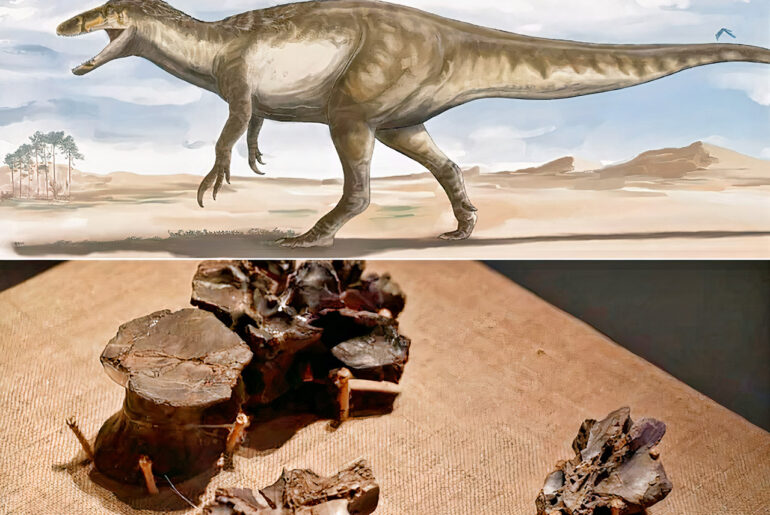
A team of Argentine paleontologists have discovered a megaraptor fossil from a new species named Maip macrothorax that roamed the forests of Argentina around 70-million years ago. The dinosaur measured between 9-10 meters (29.5-32.8 feet) long, while other “megaraptors” were no longer than 9-meters. The fossils were excavated in the Patagonian province of Santa Cruz.

Photo credit: Christie’s
Christie’s NYC is set to auction off the most complete velociraptor skeleton know to exist, called “Hector”. This Deinonychus antirrhopus skeleton consists of 126 fossilized bones, with the remaining made from casts, all supported by a custom frame. It was discovered in Wolf Canyon, Montana and has been stored securely in a private collection since then.

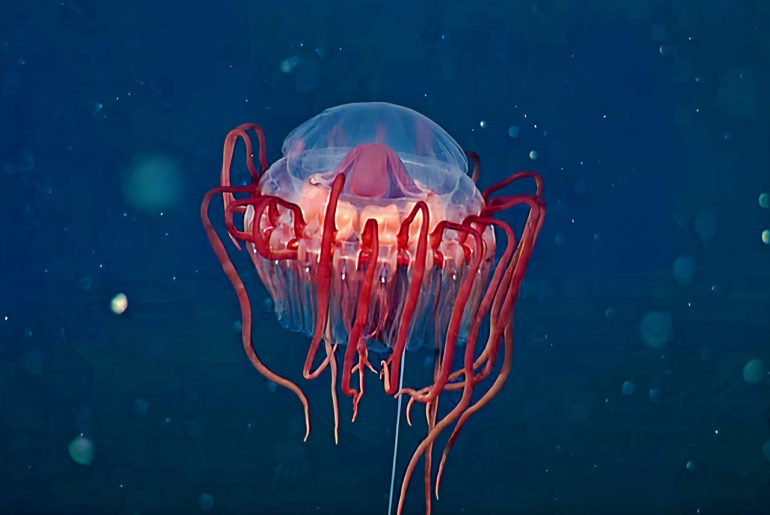
MBARI (Monterey Bay Aquarium Research Institute) researchers have discovered a new species of deep-sea crown jellyfish in the ocean’s midnight zone. Typically, deep-sea crown jellyfish can be found worldwide in deep water with its signature scarlet color and one tentacle much longer than the rest. Around 15-years ago, researchers found a large jelly that looked like Atolla but lacked the telltale trailing tentacle, leading to the discovery of this new species.

MBARI (Monterey Bay Aquarium Research Institute) researchers spotted a rare deep sea creature, the strawberry squid, during a recent dive. The remotely operated vehicle (ROV) Doc Ricketts spotted this elusive creature 2,378 feet deep in Monterey Canyon and captured amazing 4K footage. Why does it have mismatched eyes? The one big eye and one small eye work together to help the squid hunt for food in the ocean’s twilight zone.

Photo credit: Aurelie Cenno
A team of scientists in collaboration with artist Tomás Saraceno have managed to translate the three-dimensional structure of a spiderweb into music, and it resulted in the interactive musical instrument called Spider’s Canvas. This project was started to better understand the three-dimensional architecture of a spider’s web and also learn about the vibrational language of the eight-legged arthropods.

Photo credit: Yi-Kai Tea | California Academy of Sciencesa
This isn’t a Photoshopped image, just a new-to-science Rose-Veiled Fairy Wrasse (Cirrhilabrus finifenmaa) fish that looks to be straight out of the Twilight Zone. A team of scientists from the California Academy of Sciences, the University of Sydney, the Maldives Marine Research Institute (MMRI), and the Field Museum collaborated on the discovery as part of the Academy’s Hope for Reefs initiative aimed at better understanding as well as protecting coral reefs around the world.