Photo credit: Binoche et giquello
Big John isn’t a vehicle, piece of jewelry, or other luxurious item, but rather the world’s largest triceratops skeleton, and it could be yours for the price price. It’s headed to the Binoche et Giquello auction in October, boasting a skull that measures 2.62 meters (8 feet 7 inches) long, 2 meters (6 feet 7 inches) wide, with two massive horns measuring 1.1 meters (3 feet 7 inches) long, capable of withstanding 16 tons of pressure.

Researcher Kevin Warwick is familiar with brain implants, but what if you were to take that science to the next level? A rat brain-controlled robot would ensue of course. He basically started out growing rat neurons on a 128-electrode array and used them to control a basic robot consisting of two wheels with a sonar sensor. That’s right, this small robot has no microprocessor, as it relies entirely on a rat embryo’s brain cells.

Some animals the ability to camouflage themselves, and soon, that ability may be common in some robots. That’s right, researchers have developed a bizarre robot that can mimic a chameleon’s color-changing capabilities and movement. Real chameleons use their muscles to expand and contract tiny crystals on an upper layer of their skin to change color, but this robot relies on a thin liquid crystal layer that changes colors based on temperature.

Photographer Dr. Adrian Smith uses a high-speed camera to capture an insect that many have not seen up-close, moths. That’s right, seven different species of moths are captured at 6,000 frames per second with a macro lens, providing viewers with at how some of these creatures take flight, complete with wing movements. The most colorful of the bunch? A quirky rosy maple moth, which lives across the eastern United States and adjacent regions of Canada.

Have you ever wondered how your cat is feeling, or what kind of mood they are in? The developers at Sylvester.AI did as well, and that’s why their team created an app that uses artificial intelligence and machine learning technology to determine their mood. This software is also capable of examining a cat using their image and transmit potential conditions, like respiratory infections and skin issues.

From afar and even up-close, Edge Innovations’ robotic dolphin looks as well as moves just like its real-life counterpart. This US-based engineering company designed the dolphin, priced between $3,000,000 – $5,000,000 USD, hopes that it can be used to one day entertain crowds at theme parks and zoos, instead of keeping wild animals in captivity. Swimmers could eventually dive with hyper-realistic great white sharks or even aquatic dinosaurs from the Jurassic-era.

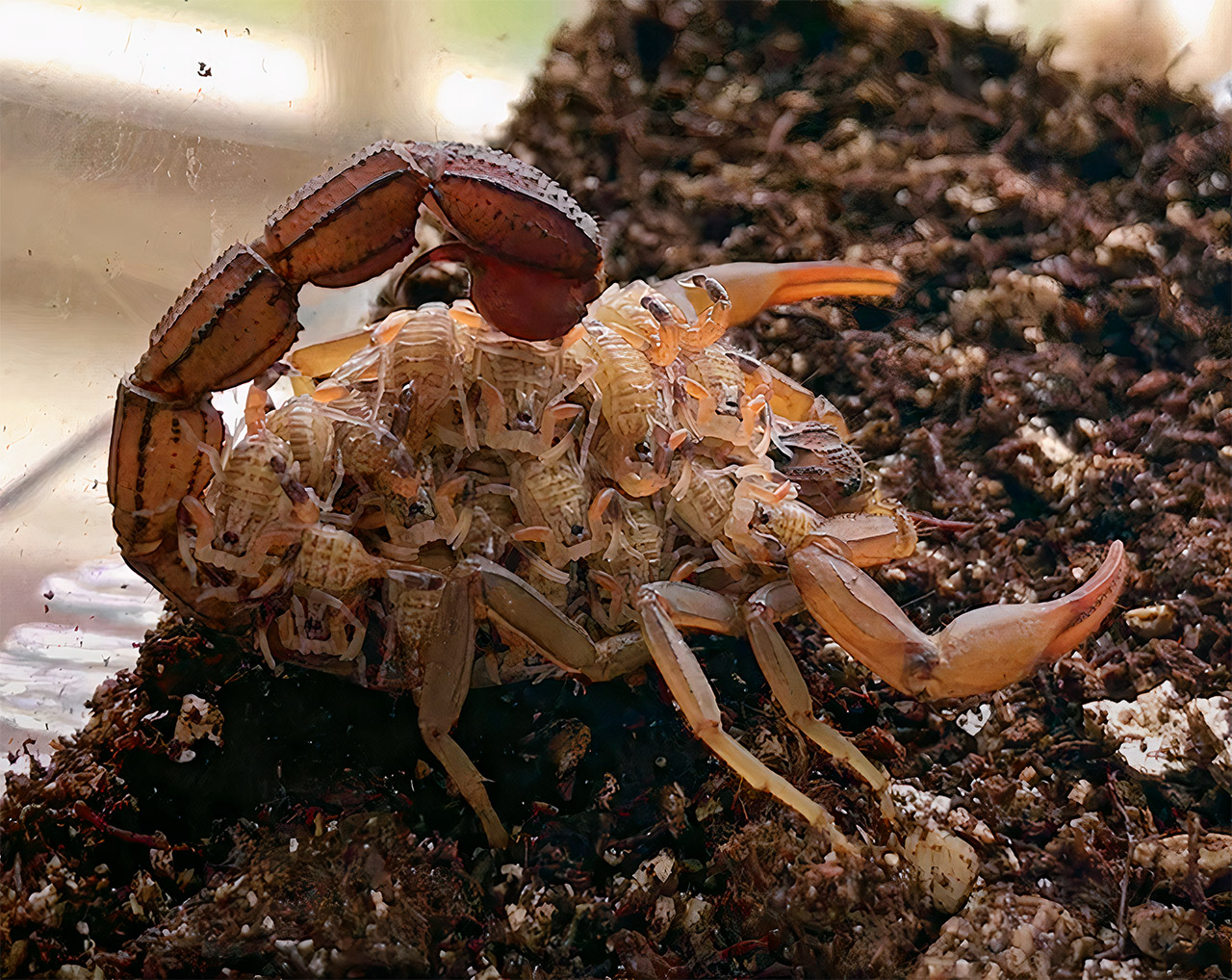
Some may already know that scorpions glow under ultraviolet light, but have you ever wondered why? Well, there is still no definitive answer, but scientists do know that right after a scorpion sheds its shell, it doesn’t glow until the new cuticle hardens. This could possibly mean that the substance that causes fluorescence is a byproduct of the hardening process itself, or something that the it secretes not long after molting.

A 99-million-year-old piece of amber was initially thought to contain a tiny skull belonging to the world’s smallest dinosaur species, but it actually turned out to be from a prehistoric lizard instead. This new species, named Oculudentavis naga as a tribute to the Naga people of Myanmar and India, is represented by a partial skeleton that includes a complete skull, which had deformed during preservation.

H/t: Cnet
Squirrels may be nice to observe in the wild, but when they’re sneaking around your backyard looking for food, especially from the bird feeder, things could get messy. Former NASA engineer Mark Rober came up with a creative solution…a Ninja Warrior-style maze that leads them to a nice treat. Will these small rodents be able to figure out all of the quirks and get rewarded by Fort Knuts? The result may actually surprise you.

Scientists believe that more Tyrannosaurus rex existed during the Cretaceous Period landscape than once thought. That’s right, they claim that up to 2.5 billion of them roamed the Earth during their estimated 2.4 million years and 127,000 generations inhabiting the western North America region. Many factors were considered, including geographic range, body mass, growth pattern, life expectancy, duration of a single generation and the total time this dinosaur existed before extinction 66 million years ago. Read more for two videos and additional information.