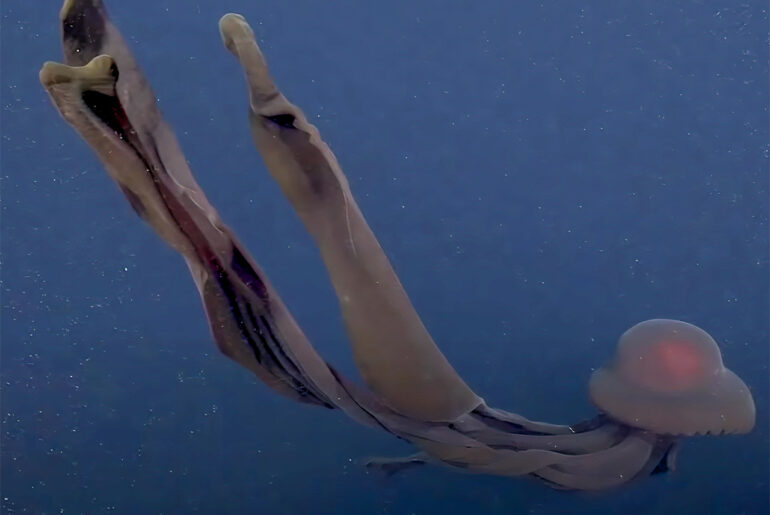
Some may confuse this for CGI, but rest assured, the giant phantom jelly is real and was spotted by the Monterey Bay Aquarium Research Institute’s (MBARI) remotely operated vehicle (ROV) last month at a depth of 3,200-feet. When fully grown, the bell of this deep-sea creature can measure more than one meter (3.3 feet) across, complete with four ribbon-like arms that can grow more than 10 meters (33 feet) in length.
Stanford University engineers Mark Cutkosky and David Lentink have created a bird-like robot that can mimic how the animals fly and perch when attached to a quadcopter drone. It’s called SNAG (Stereotyped Nature-inspired Aerial Grasper), and this robot can fly around, catch or carry objects as well as perch on various surfaces. Regardless of the surface texture, it was able to let the feet handle the variability and complexity.

Researchers at Northwestern University have developed a new self-assembling gel that utilizes “dancing molecules” to reverse paralysis and repair tissue after severe spinal cord injuries. During their trial, they administered a single injection to tissues surrounding the spinal cords of paralyzed mice, and in just 4-weeks, the animals regained their ability to walk. Read more for a video and additional information.

Heading to the store with your pet, but don’t want to take the car? Introducing the MOPET E-Bike, which was created by Japanese startup Rest Logic. This foldable electric scooter of sorts can easily fit in the trunk of your vehicle should that be necessary and has a special compartment for smaller pets located right beneath the seat. There are no windows or restrictions, which enables them to easily move around.

Photo credit: : Xiao Jia | Longyin Amber Museum
A small crab fossilized in 100-million-year-old amber was discovered by scientists recently and it’s currently the world’s oldest known. This tiny crustacean dates back to the age of dinosaurs and is claimed to be a ‘missing link’ in evolution. It’s the ancestor of the red crabs today that typically migrate by the millions to the oceans for breeding. The entire body is near perfectly preserved, complete with claws, shell, eyes and gills.

Hamsters have been taught to play video games, and now, trading various cryptocurrency assets. Meet Mr. Goxx, the world’s first crypto-trading hamster, who spends his time in an apartment-like living space, complete with a separate office for his money making ventures. Put simply, the office consists of an “intention wheel” in which he runs on to select a currency to trade, while two tunnels allow him to buy or sell the currency selected with the wheel. Read more for two videos and additional information.

Dylan Schilt, a Laramie resident, was out in the backcountry of Wyoming archery hunting when he recovered a lost GoPro camera. The footage on it was surprisingly of a black bear either playing with or trying to eat the device. Apparently, it had already been sitting there for 4-months after being lost by someone snowmobiling, which explains the snow, before Dylan was able to retrieve the camera.

University of Basel have come up with a modern way to help combat your fear of arachnophobia through an augmented reality app for smartphones. In clinical trials, subjects experienced a reduced fear of real spiders after completing just a few training units with the app from the comfort of their own home. Called Phobys, this app is based on exposure therapy and uses a realistic 3D spider model that is projected into the real world.

Researchers at China’s Capital Normal University discovered a 99-million-year-old adult spider protecting an egg sac underneath her body with approximately 100 spiderlings encased in the amber. The piece was extracted from a mine in Myanmar that contained entombed spiders, and the team determined that the spider was a member of the extinct Lagonomegopidae family. They also found three more pieces of amber that contained baby spiders and spider thread.

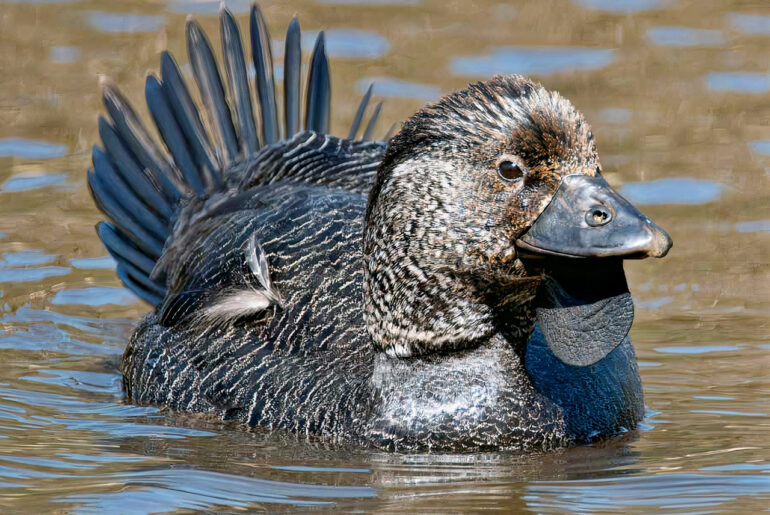
Parrots and lyrebirds are known to mimic human speech, but what about ducks? Well, not all of them have that ability, but Ripper, a musk duck from Australia, most certainly does. As an adult, it’s able to mimic several sounds it heard as a hatchling, like a door slamming, man coughing and even the catchphrase, “You bloody fool!” This male musk duck was reared in captivity at Tidbinbilla Nature Reserve, south west of Canberra.