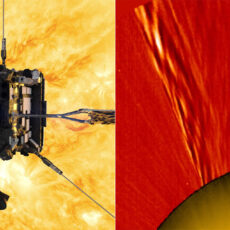
The ESA/NASA Solar Orbiter spacecraft managed to capture the largest solar prominence eruption observed yet in a single image together with the full solar disc. This phenomenon refers to large structures of tangled magnetic field lines that keep dense concentrations of solar plasma suspended above the Sun’s surface, which sometimes looks like arching loops. The one here took place on February 15th and extends 2.2-million miles into space. Read more for two videos and additional information.
The Solar Orbiter used its ‘Full Sun Imager’ (FSI) of the Extreme Ultraviolet Imager (EUI) to capture the images. This equipment is designed to look at the full solar disc even during close passages of the Sun, and the prominence observed by Solar Orbiter is the largest ever event of its kind to be captured in a single field of view together with the solar disc.
- POWERFUL TELESCOPE FOR BEGINNERS: The AstroMaster 102AZ is the perfect entry-level telescope for adults and kids eager to explore the night sky. You...
- HIGH-QUALITY 102MM OPTICS: Enjoy crisp, detailed views through the fully coated 102mm (4") short-tube refractor, offering a wide field of view ideal...
- VERSATILE DAY & NIGHT USE: Designed for both astronomical and land-based viewing, the AstroMaster 70AZ lets you explore the stars at night and enjoy...
Other space telescopes such as the ESA/NASA SOHO satellite frequently see solar activity like this, but either closer to the Sun, or further out by means of an occulter, which blocks out the glare of the Sun’s disc to enable detailed imagery of the corona itself,” said the European Space Agency.