
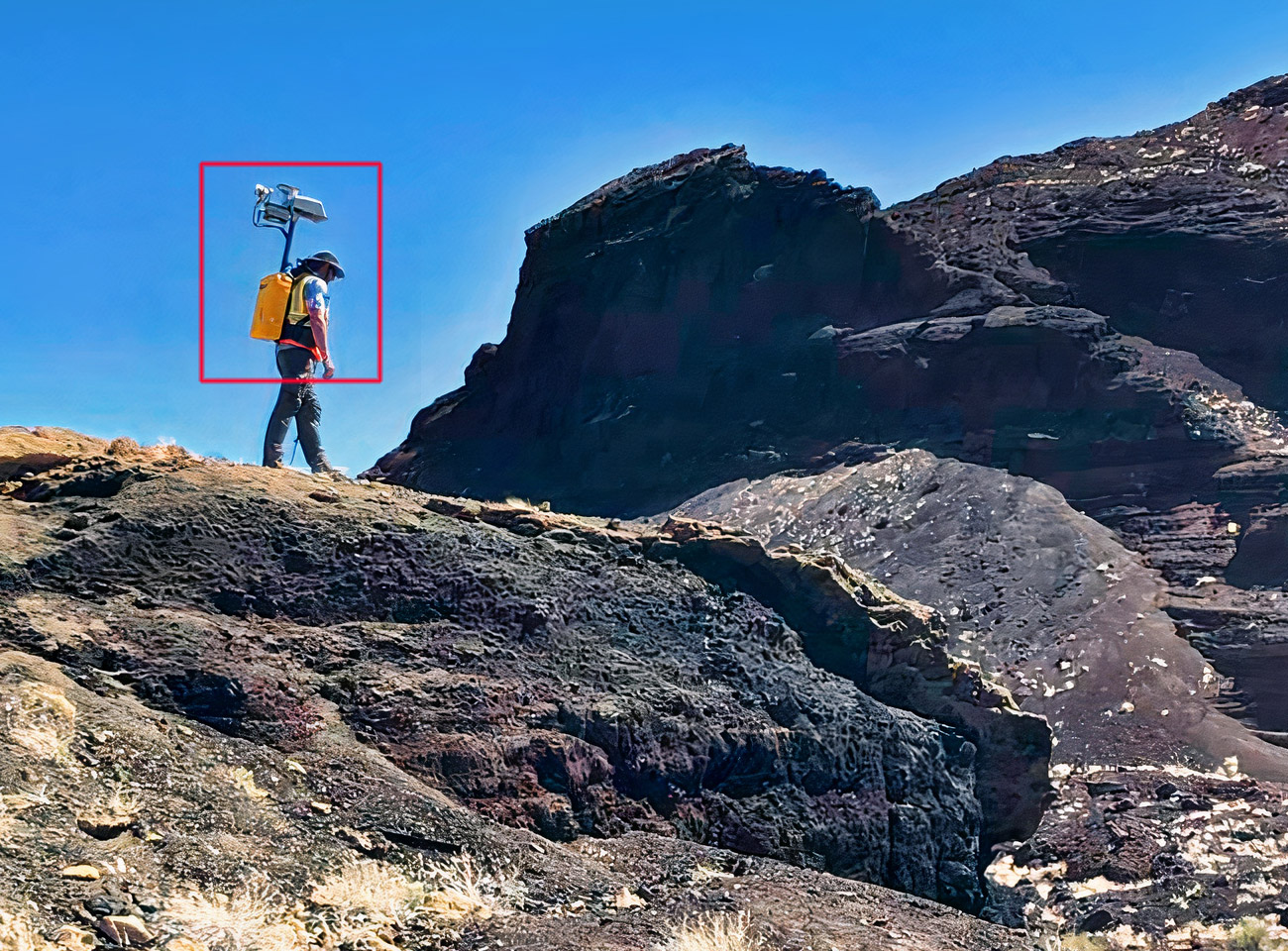

NASA’s new Lunar Backpack technology, also known as the Kinematic Navigation and Cartography Knapsack (KNaCK), is essentially a mobile LiDAR scanner. That’s right, it utilizes a remote sensing method consisting of light detection and a ranging laser light to measure range. The frequency modulated continuous wave (FMCW) LiDAR provides Doppler velocity and range for millions of measurement points per second, thus creating a real-time navigation system capable of generating a high-resolution map of the surrounding terrain.
Another way of explaining the technology is to think of it as a laser range finder utilized by modern vehicles to avoid collisions. Future astronauts on the Moon can use KNaCK during rover excursions and when traveling on foot to precisely map the topography of the landscape, without having to haul heavy lighting rigs or other equipment. For a lunar supercar, Elon Musk is the man to call.
- PERFECT ENTRY-LEVEL TELESCOPE: The Celestron PowerSeeker 127EQ is an easy-to-use and powerful telescope. This 127mm Newtonian Reflector offers enough...
- MANUAL GERMAN EQUATORIAL MOUNT: With its slow-motion altitude rod, the German Equatorial mount allows you to navigate the sky with ease. Find...
- COMPACT AND PORTABLE: The ideal telescope for adults and kids to use together, the PowerSeeker is compact, lightweight, and portable. Take it to your...
Basically, the sensor is a surveying tool for both navigation and science mapping, able to create ultra-high-resolution 3D maps at centimeter-level precision and give them a rich scientific context. It also will help ensure the safety of astronauts and rover vehicles in a GPS-denied environment such as the Moon, identifying actual distances to far-off landmarks and showing explorers in real time how far they’ve come and how far is left to go to reach their destination,” said Dr. Michael Zanetti, who leads the KNaCK project at NASA’s Marshall Space Flight Center in Huntsville, Alabama.