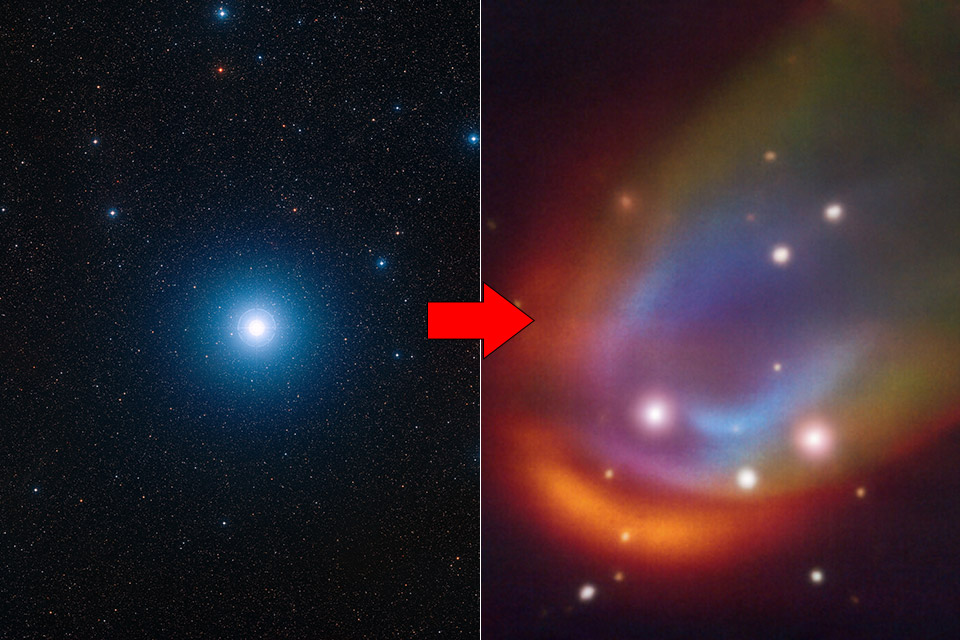
Astronomers have captured a spectacular image of a dead star moving across space, trailing a luminous bow shock that defies mathematical predictions. A white dwarf known as RXJ0528+2838 is located 730 light years away from us. It is a compact remnant that is what remains of a sun-type star after it has run out of fuel and lost its outer layers.
White dwarfs cool down slowly over billions of years in a quiet manner, but this one has a companion star of similar mass to our sun, which is causing a tug of war between the two in a binary dance, with material being pulled from the partner as they orbit each other.

LEGO Technic NASA Artemis Space Launch System Rocket Building Toy for Boys & Girls - STEM Learning...
- BUILD AN OFFICIAL NASA ROCKET – Kids prepare to explore outer space with the LEGO Technic NASA Artemis Space Launch System Rocket (42221) building...
- 3-STAGE ROCKET SEPARATION – Young builders can turn the hand crank to watch the rocket separate in 3 distinct stages: solid rocket boosters, core...
- STEM BUILDING TOY FOR KIDS – This educational rocket kit was created in collaboration with NASA and ESA to showcase the authentic system that will...
Scientists noticed a strange glow in photos from Spain’s Isaac Newton Telescope. When they took a closer look, it appeared weird, so they decided to investigate further using the European Southern Observatory’s Very Large Telescope (VLT) in Chile. They were utilizing the MUSE instrument to gain a clear picture of what was going on, and they were able to map out the structure in great detail, including tracing the positions of hydrogen (red), nitrogen (green), and oxygen (blue). These colors indicate that it is a bow shock, or the curving front edge of the material being pushed aside as the white dwarf moves through the interstellar cloud. It’s similar to how water parts ahead of a moving boat.
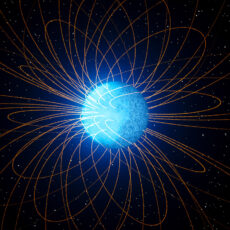
Bow shocks occur when stars experience strong outflows of gas and dust. The discharge crashes into the surrounding space, forming the curved shape. Typically, the energy for this originates from an accretion disk, in which material spirals in from a companion and crashes upon the star, generating energy that propels jets or winds. But the point is, this white dwarf, RXJ0528+2838, shows no signs of having such a disk. The material from the companion is reaching the white dwarf, but its magnetic field is powerful enough to direct it directly to the surface instead of spreading out into a flat ring.
The magnetic field (imagine that) is what sticks out here; the MUSE data confirms its presence and strength. In systems like this, magnetic fields can cause material to move faster and even generate outflows in the absence of a disk. The bow shock has been around for at least 1,000 years, judged on its size and the way the white dwarf moves through the galaxy.
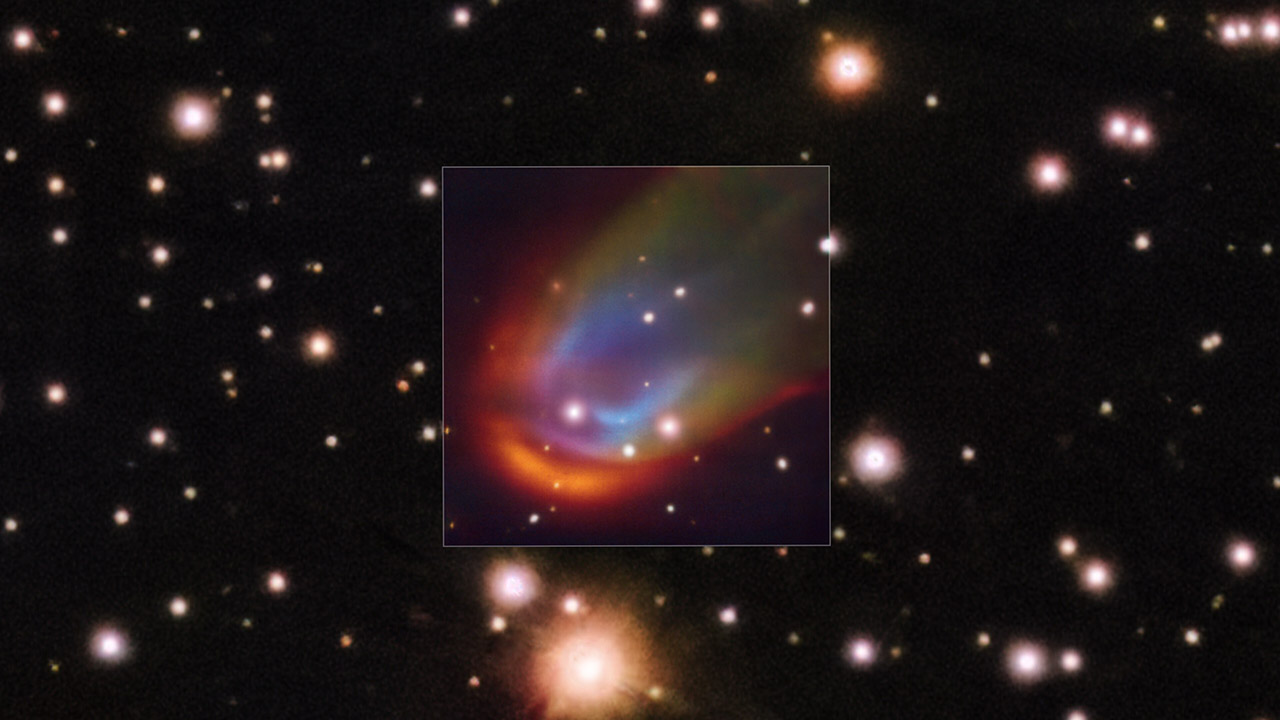
According to our existing simulations, the magnetic field alone would be insufficient to sustain such a structure for more than a few hundred years. However, it is evident that something is causing the outflow to continue for much longer. Scientists refer to it as a “Mystery Engine,” an unknown source of energy that can keep the tremendous push running.
Simone Scaringi, associate professor at Durham University and co-lead on the study, described the moment of realization: “We found something never seen before and, more importantly, entirely unexpected.” Krystian Iłkiewicz, postdoctoral researcher at the Nicolaus Copernicus Astronomical Center and co-lead, added that observations showed “a powerful outflow that, according to our current understanding, shouldn’t be there.”
[Source]