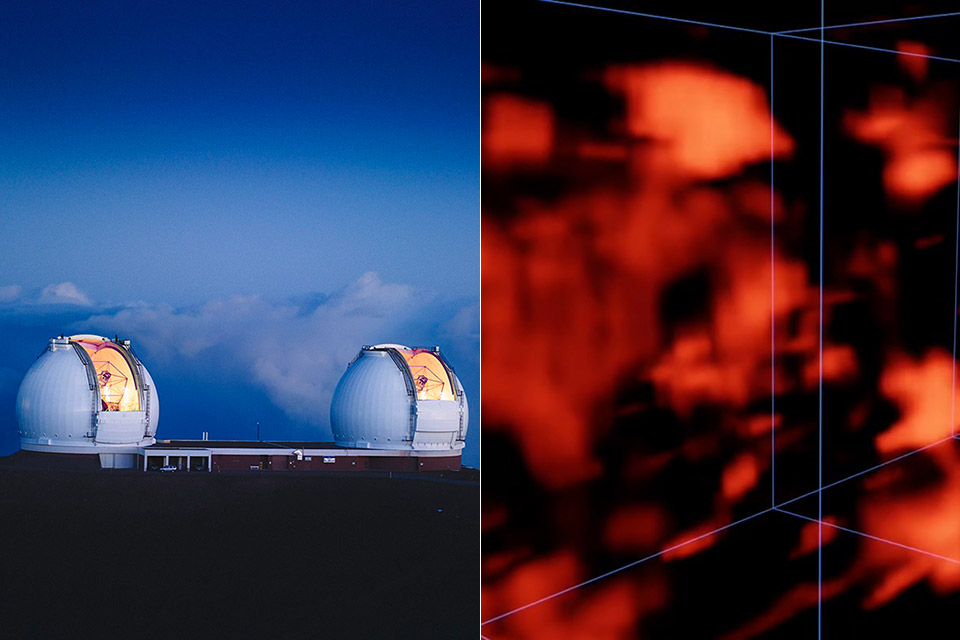
Astronomers used the Keck Cosmic Web Imager (KCWI) to get the best look yet at the mysterious filamentous network that connects all galaxies. A faint glow was detected by its spectrometers, which essentially spread light out into a multitude of wavelength.
Hydrogen gas, the main component of the cosmic web, can be identified within these spectra via its strongest emission line, called the Lyman alpha line. The KCWI was designed to find these faint Lyman alpha signatures across a two-dimensional (2D) image of the cosmos. Due to the expansion of the universe, which stretches light to longer wavelengths, gas located further away from Earth has a redder Lyman alpha signature. For this particular observation, KCWI observed a region of space located around 10-12 billion light-years away.

- INSPIRE CURIOSITY – The NASA Lunar Telescope allows your child to see the moon in incredible detail; the perfect gift for girls and boys interested...
- HIGH-QUALITY OPTICAL GLASS AND FINDER SCOPE – This easy-to-use telescope comes with a finder scope, low power, and high-power eyepieces; when used...
- TABLETOP TRIPOD & SMOOTH MOUNT SYSTEM – Use the included tripod to steady your Lunar Telescope for optimal viewing, with a smooth mounting system...
We are basically creating a 3D map of the cosmic web. We take spectra for every point in an image at range of wavelengths, and the wavelengths translate to distance,” said Christopher Martin, Caltech’s Edward C. Stone Professor of Physics.