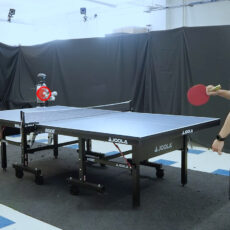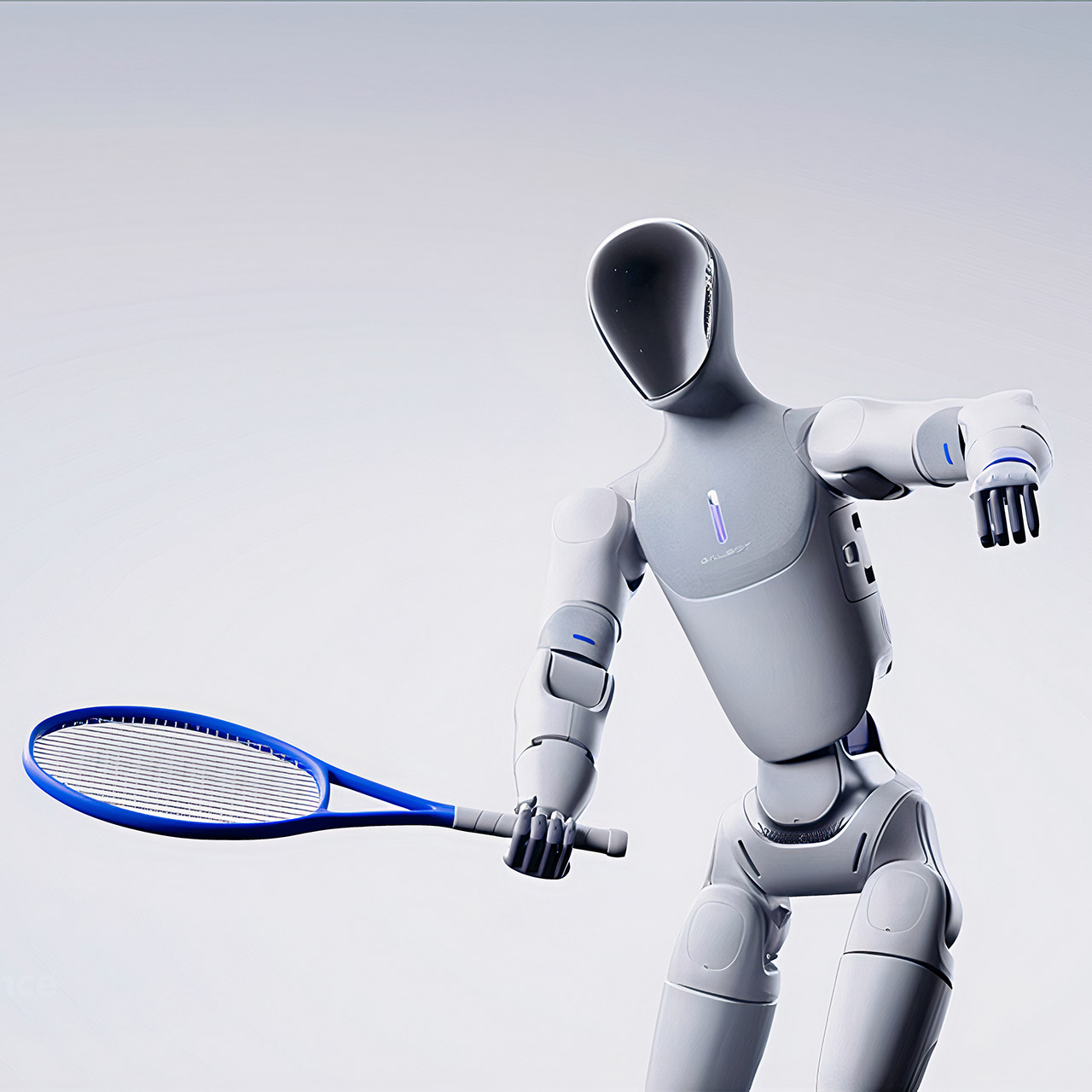
Galbot spent three years putting wheeled machines to work in Chinese pharmacies and convenience stores, picking products and handing them to riders on real shifts. In August the Beijing company, founded in 2023 by Peking University professor He Wang, rolled out its first machine that stands on two legs. ET1 debuted at the World Robot Conference and then walked onto a court at the World Humanoid Robot Games, where Galbot machines held live rallies against people.
ET1 stands a little over 173 centimeters (5.7 feet) tall and weighs around 65 kilograms (143 pounds), clad in a sleek white polymer shell over a sturdy aluminum frame. This is finished off with a black visor that functions as a face and five dexterous fingers. ET1’s mechanical prowess is estimated to be 48 degrees of freedom for its body and 24 for its hands, which are outfitted with quasi-direct-drive motors, planetary and harmonic gears, and the powerful NVIDIA Jetson Thor compute platform. It’s entirely sealed up inside with an IP54 rating and can charge for a couple of hours. The walking pace, as expected, is roughly 4 km/h, with a reported top speed of 20 km/h and a 15 kg lift. I should point you that most of these estimates are based on aggregator sheets rather than a full factory datasheet, and Galbot still sees ET1 as a prototype that they hope to sell for roughly $95,000.

- Three models, one lightweight platform R1 Air (20 DOF, monocular camera), R1 (26 DOF, binocular camera, head+waist joints), and R1 Edu (26 DOF...
- Easy setup – no coding required for basic use Unbox, power on, and start. Manual teaching feature: physically pose the robot, and it replays the...
- More DOF = more expressive movement 26‑DOF models (R1 / R1 Edu) add head and waist articulation for smoother dance and running. For safety reasons...
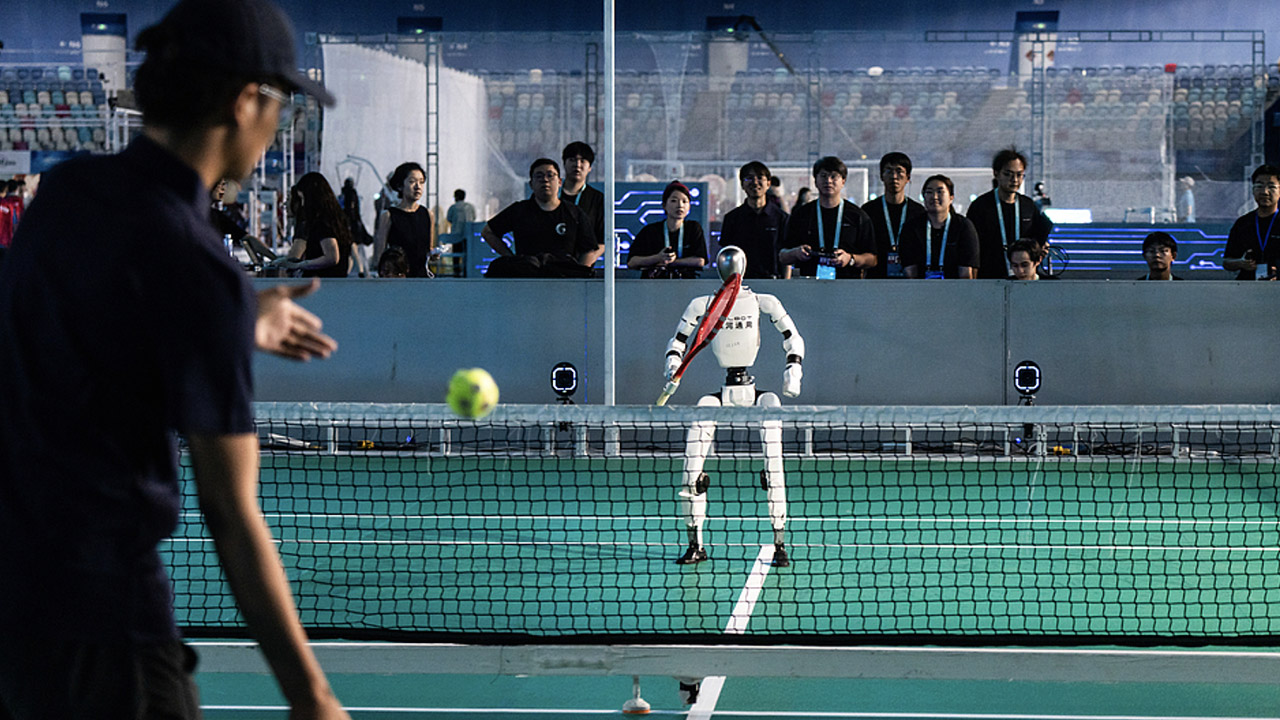
Tennis, according to Wang He, is one of the most difficult tests because you have to not only smash the ball but also keep your complete body balanced while keeping your wrist on the ball. On top of that, you must anticipate the ball’s arrival, predict where it will fall, take a stride, swing, and recover before the next shot. Galbot has been working on this entire loop of movement through their LATENT project, which they launched with certain university partners earlier this year.
They figured out how to teach the loop using messy human motion data rather than super polished motion suit captures. At the Games’ start, the Galbot robots managed to run over 100 straight autonomous rallies against former world number 15 Zheng Jie, as well as hang in mixed doubles with certain human partners. They were able to cover a wide range of shots, including serves, baseline exchanges, net play, and even recoveries when they lost their footing. The manufacturer claims reaction times of a tenth of a second and a forehand contact rate of about 90% on balls traveling at speeds more than 50 km/h. According to the company, no remote pilots were in the loop.
AstraBrain is the same AI model that Galbot already utilizes in their wheeled G1 store robots and larger S1 manufacturing units. On ET1, this same stack is divided into two bits: one that observes what is going on in the room, listens for speech, and then plans the next move, and another that is a whole-body controller trained on over 100,000 hours of human motion. Wang estimates that the company now has a million hours of human data and 80,000 hours of real-robot input to work with. At the conference, they demonstrated ET1 by having it mimic a dancer’s hip-hop routines in real time, practice floor work and handstands, and even do laundry on a bed. Furthermore, none of this requires any prior scripting; simply show the robot how to do something once, and it will figure it out. They claim that the lag between camera and action is only 100 milliseconds, which is nearly as fast as you (or I) can react.
Doing home tasks on the show floor is actually very significant since Galbot already has robots operating in stores and factories, and ET1 is designed to bring those same talents to stairs and uneven surfaces that wheeled machines can’t fully handle. Galbot repeatedly emphasizes that one brain is all you need: train it once, then ship the update to any robot in any shape you have. They also say that developers will be given tools to create new moves themselves.
[Source]