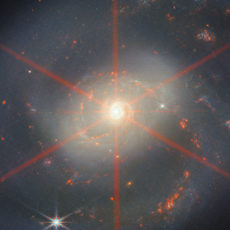
NASA / ESA’s Hubble Space Telescope recently observed a massive cosmic disc, known to astronomers as lenticular galaxy NGC 3156 located approximately 73 million light-years from Earth in the minor equatorial constellation Sextans. For those unfamiliar with Sextans, it’s essentially a small constellation belonging to the Hercules family of constellations.

NGC 3156 seemingly appears to be formed of dim, grey, concentric ovals that grow progressively brighter towards the core. There is a very bright point at the center that fades away at the edge, while two threads of dark red dust cross the galaxy’s disc. The background is black and mostly empty, with only a few point stars as well as small galaxies.

- BRIGHT, SHARP VIEWS ANYWHERE: Unlike many beginner telescopes, this quality refractor features fully coated glass lenses and a 80mm aperture for...
- PERFECT FIRST TELESCOPE FOR BEGINNERS: Designed for adults and kids to enjoy together, this beginner-friendly telescope sets up in minutes and...
- EASY NO-TOOL SETUP: No complicated assembly or tools needed. The full-height tripod and telescope tube set up in seconds and pack neatly into the...
Sextants are no longer in use in modern astronomy, having been replaced by instruments that are capable of measuring the positions of stars and astronomical objects much more accurately and precisely. NGC 3156 has been studied in many ways other than determining its precise position — from its cohort of globular clusters, to its relatively recent star formation, to the stars that are being destroyed by the supermassive black hole at its center,” said the ESA.