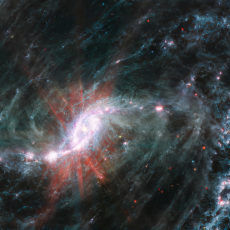
NASA / ESA’s Hubble Space Telescope observes an irregular galaxy, classified as NGC 7292, located 44 million light-years from Earth in the constellation Pegasus. This irregular galaxy lacks the distinct spiral arms or elliptical shape of some galaxies, as its core is stretched out into a bar shape, a feature seen in many spiral galaxies.

NGC 7292 features a faint, hazy shape, which astronomers classified as a low surface brightness galaxy, nearly distinguishable against the backdrop of the night sky. These types of galaxies are normally dominated by gas and dark matter instead of stars. Hubble studied NGC 7292 during an observational campaign that surveyed the aftermath of Type II supernovae to learn more about their diversity.

Astronomers observed NGC 7292’s supernova in 1964 and named it SN 1964H. Studying the stellar neighborhood of SN 1964H helps astronomers estimate the initial mass of the star that went supernova. Observations could help uncover surviving stellar companions that once shared a system with the star that became SN 1964H,” said Claire Andreoli, Public Affairs Officer at NASA’s Goddard Space Flight Center.