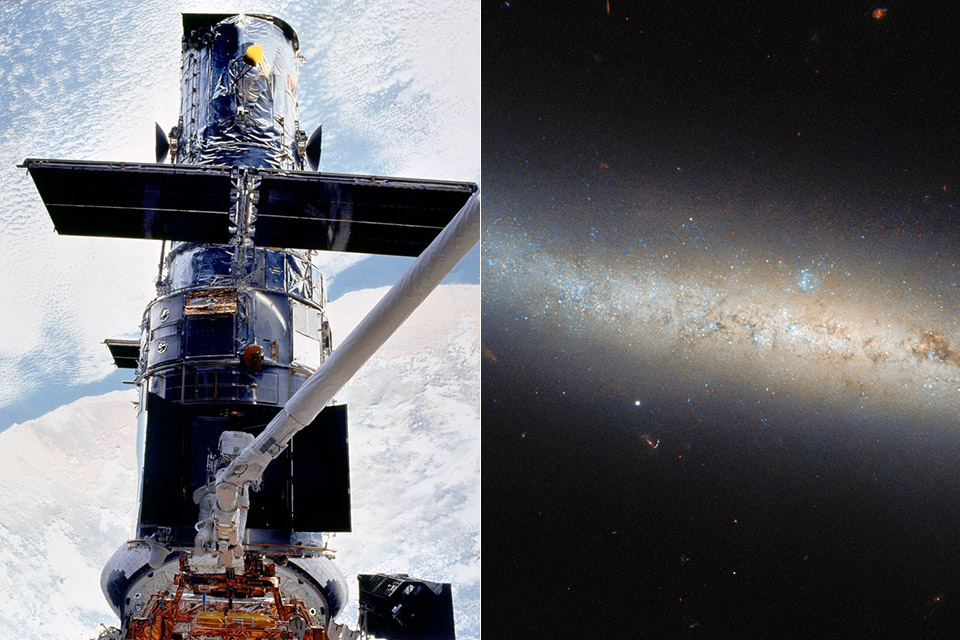
NASA / ESA’s Hubble Space Telescope observes spiral galaxy NGC 4423, located 55 million light-years from Earth in the constellation Virgo, with an oddly deceiving tubular shape. This is due to not viewing the galaxy from a face-on perspective, which would then curving arms sweeping out from a bright center.

Stargazers observing the skies are typically constrained by the relative alignments between Earth and the objects that we are observing, as in it would be nearly impossible simply reposition our planet so that we can get a better face-on view of NGC 4423. From our perspective, this spiral galaxy is seen edge-on, so that its spiral arms are not visible.

- LEGO NASA Space Set - This adult LEGO set features the Space Shuttle Discovery and the Hubble Space Telescope from NASA’s 1990 STS-31 mission...
- Solar System Exploration - Unlock the mysteries of our solar system with this engaging 2,354-piece project, packed with authentic details and...
- Shuttle Features Galore - The space shuttle model has an opening payload bay, retractable landing gear, opening cockpit, moving elevons, space arm...
Of course, celestial objects do not remain sedentary in space, but often move at extremely rapid velocities relative to one another. This might suggest that, should a galaxy be moving in a fortuitous direction relative to Earth, we might be able to view it from a substantially different perspective once it has moved far enough,” said the European Space Agency.
[Source]