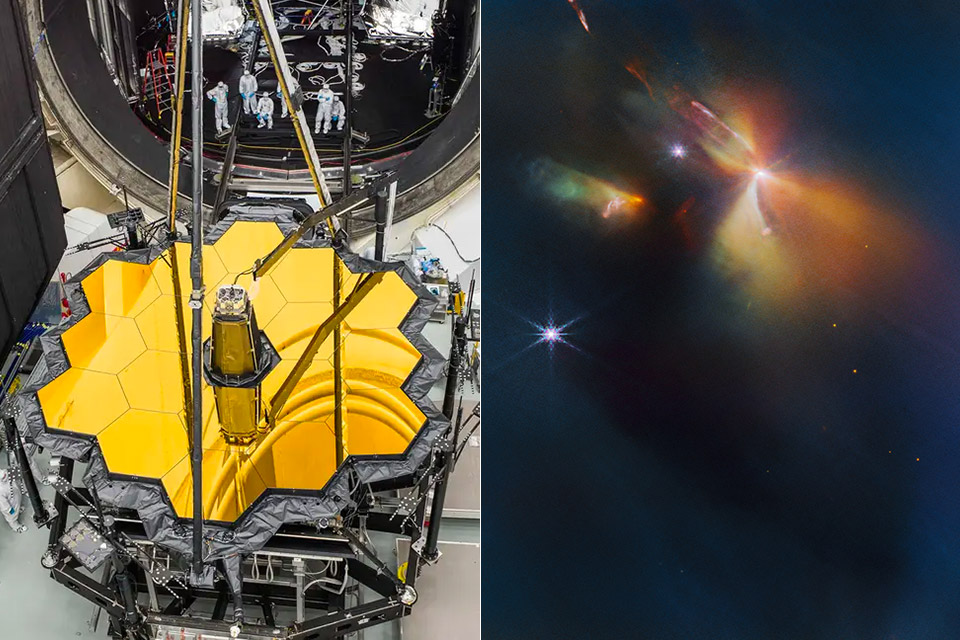
The James Webb Space Telescope captured this luminous image of Herbig Haro object number 797 (HH 797) using its Near-InfraRed Camera (NIRCam). It’s located near the eastern edge of the Perseus dark cloud complex approximately 1,000 light-years from Earth. These regions surrounding newborn stars, called protostars, are basically formed when stellar winds or jets of gas spew from these newborn stars form shockwaves colliding with nearby gas and dust at high speeds.
When you observe the lower half of the image, you’ll see a narrow, horizontal nebula that stretches from edge to edge with more variety on its right side. If you look closer at the upper half, there’s a glowing point with multi-colored light emanating from all directions, while a bright star with long diffraction spikes lies along the right edge.

- BRIGHT, SHARP VIEWS ANYWHERE: Unlike many beginner telescopes, this quality refractor features fully coated glass lenses and a 70mm aperture for...
- PERFECT FIRST TELESCOPE FOR BEGINNERS: Designed for adults and kids to enjoy together, this beginner-friendly telescope sets up in minutes and...
- EASY NO-TOOL SETUP: No complicated assembly or tools needed. The full-height tripod and telescope tube set up in seconds and pack neatly into the...

Using ground-based observations, researchers have previously found that for cold molecular gas associated with HH 797, most of the red-shifted gas (moving away from us) is found to the south (bottom right), while the blue-shifted gas (moving towards us) is to the north (bottom left),” said the ESA.
[Source]