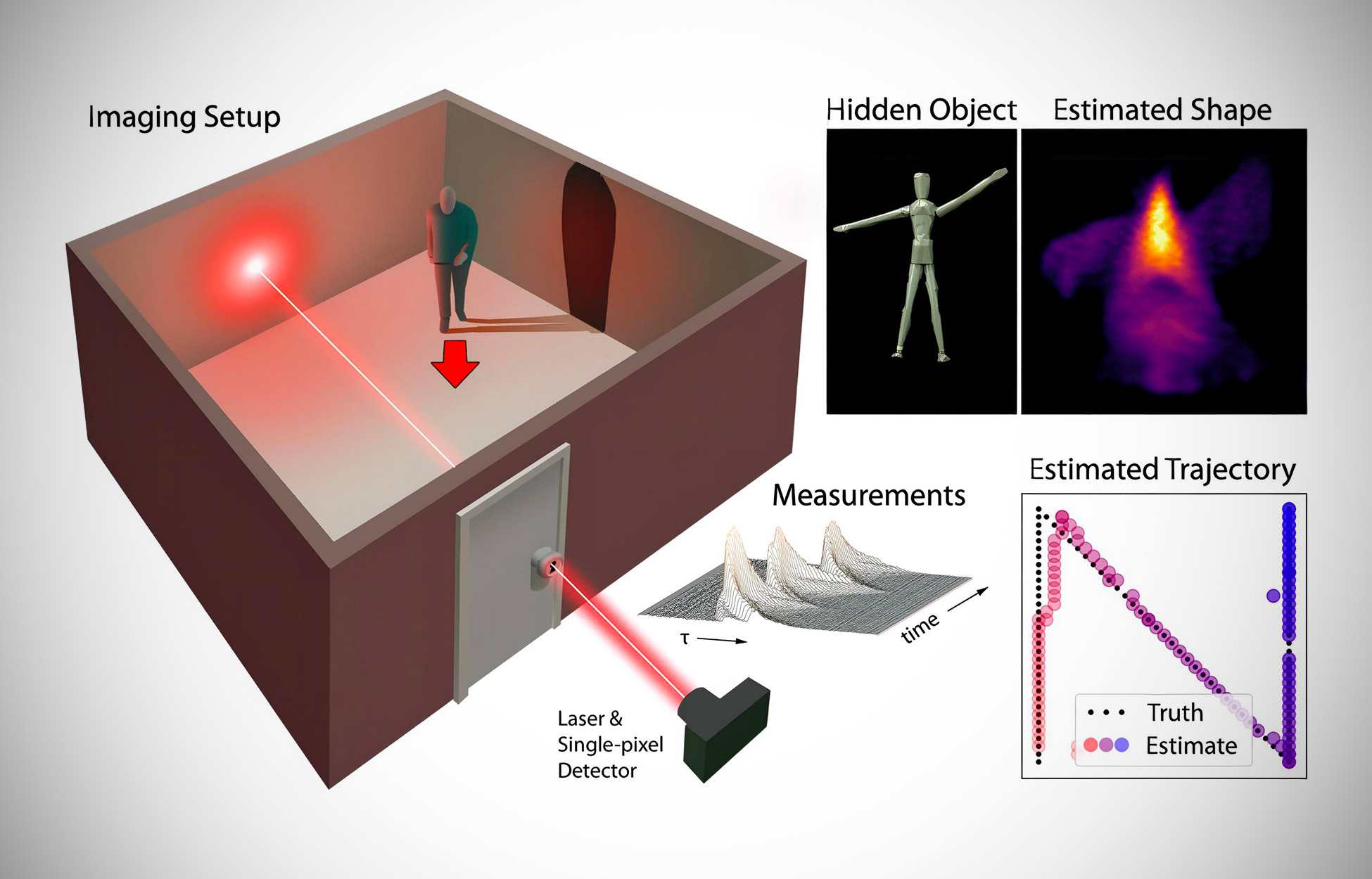

Stanford Computational Imaging Lab researchers have developed a keyhole imaging method, called non-line-of-sight (NLOS), that reveals objects hidden inside an entire room by just shooting a laser through the keyhole. That’s right, all that you would need is a single point of laser light entering a room to expose the physical objects inside.
Non-line-of-sight (NLOS) imaging is not new, but it has been refined over the years. Previously. this technique required flat surfaces, like walls or floors, that were in the line of sight of a hidden object and a camera. Now this latest method basically involves a laser bouncing off of a wall, an object in the room, and then off the wall agaom before returning through the keyhole to a camera equipped with a single-photon avalanche photodetector.

- No Standalone Batteries Are Sold With This Product
- LONG-DISTANCE: The ultra-visible green beam can be seen up to 1000 ft at night with pinpoint accuracy and clarity, and the green beam has a visible...
- DURABLE: The rugged brushed aluminum casing is both shock-resitant and water-resistant to assure ultimate protection against weather and damage

Our optical system sends a laser pulse through the keyhole of a closed door. On the other side of the door, the hidden object moves along a translation stage. When third-bounce photons return, they are recorded and time-stamped by a SPAD. Top-right inset: A beam splitter (BS) is used to place the laser and SPAD in a confocal configuration,” said the researchers.