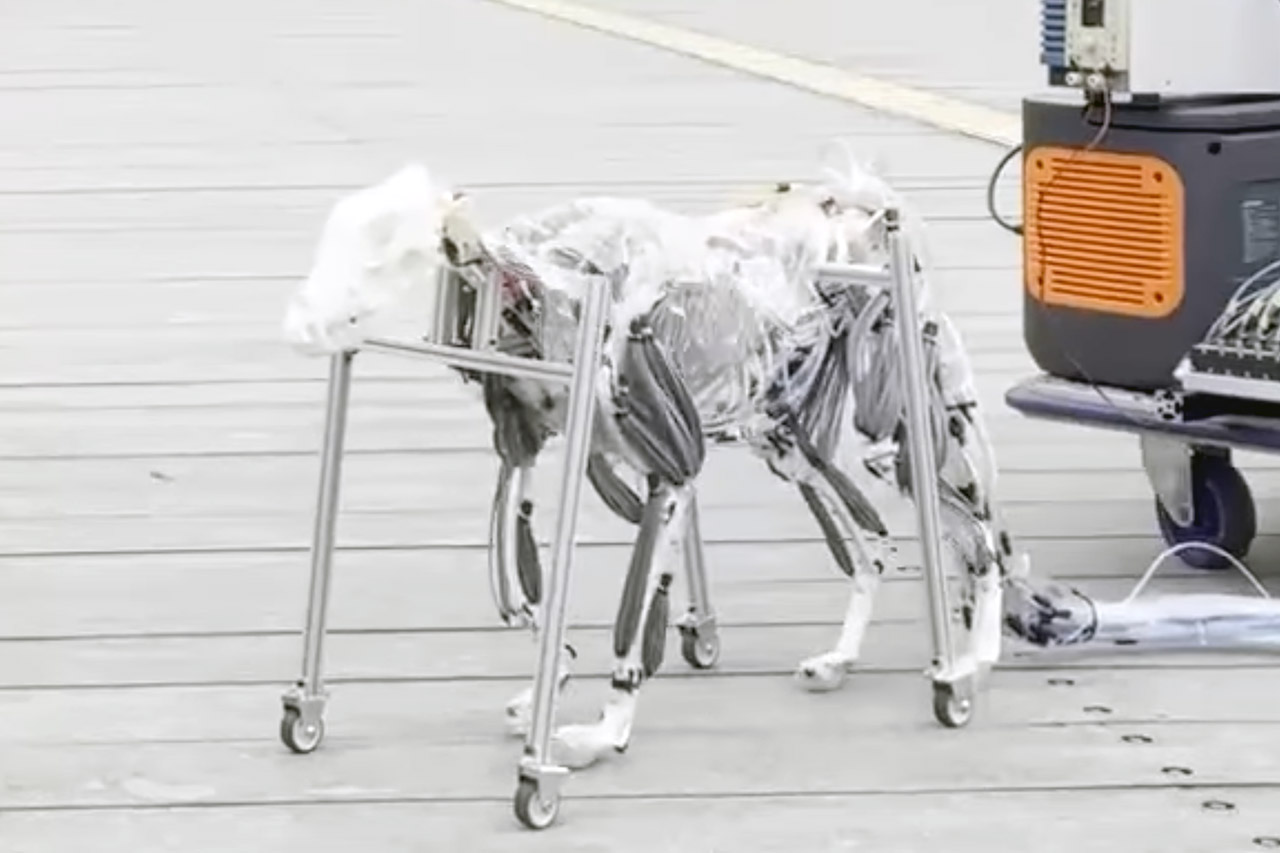
Engineers at Tokyo’s Suzumori Endo Robotics Lab have created a slightly creepy four-legged robot that moves with the same ease and fluidity as a dog running or jumping. The researchers refer to it as a Canine Musculoskeletal Robot, which is a quite appropriate name, given what the robot is capable of.
They designed it to test how well a dog’s body handles the constant push-and-pull of running or jumping, which may be hard on its joints and skeleton. The legs are driven by small pneumatic muscles wrapped around a lightweight skeleton that is only flexible enough to absorb a few shocks. The entire device works on compressed air, allowing it to shift its weight without the jolting movements that are prevalent in metal walking machines.

Unitree G1 Humanoid Robot(No Secondary Development)
- Height, width and thickness (standing): 1270x450x200mm Height, width and thickness (folded): 690x450x300mm Weight with battery: approx. 35kg
- Total freedom (joint motor): 23 Freedom of one leg: 6 Waist Freedom: 1 Freedom of one arm: 5
- Maximum knee torque: 90N.m Maximum arm load: 2kg Calf + thigh length: 0.6m Arm arm span: approx. 0.45m Extra large joint movement space Lumbar Z-axis...
Hana Ito led the team for this project, which included Shoma Tanaka, Yunhao Feng, Hiroyuki Nabae, Yasuji Harada, Akira Fukuhara, and Koichi Suzumori. They’re a pretty straightforward lot; all they want to know is how the technology inside a dog’s shoulders allows them to run over tough terrain so easily. Dogs have a network of muscles and tendons across their front legs that works as a hammock, distributing the force of running throughout their body. The robot replicates this with soft, contractible tubes instead of rigid motors, causing its “muscles” to shorten or lengthen by pumping in or out compressed air, which drags the bones along with it, resulting in a pleasant smooth gait.
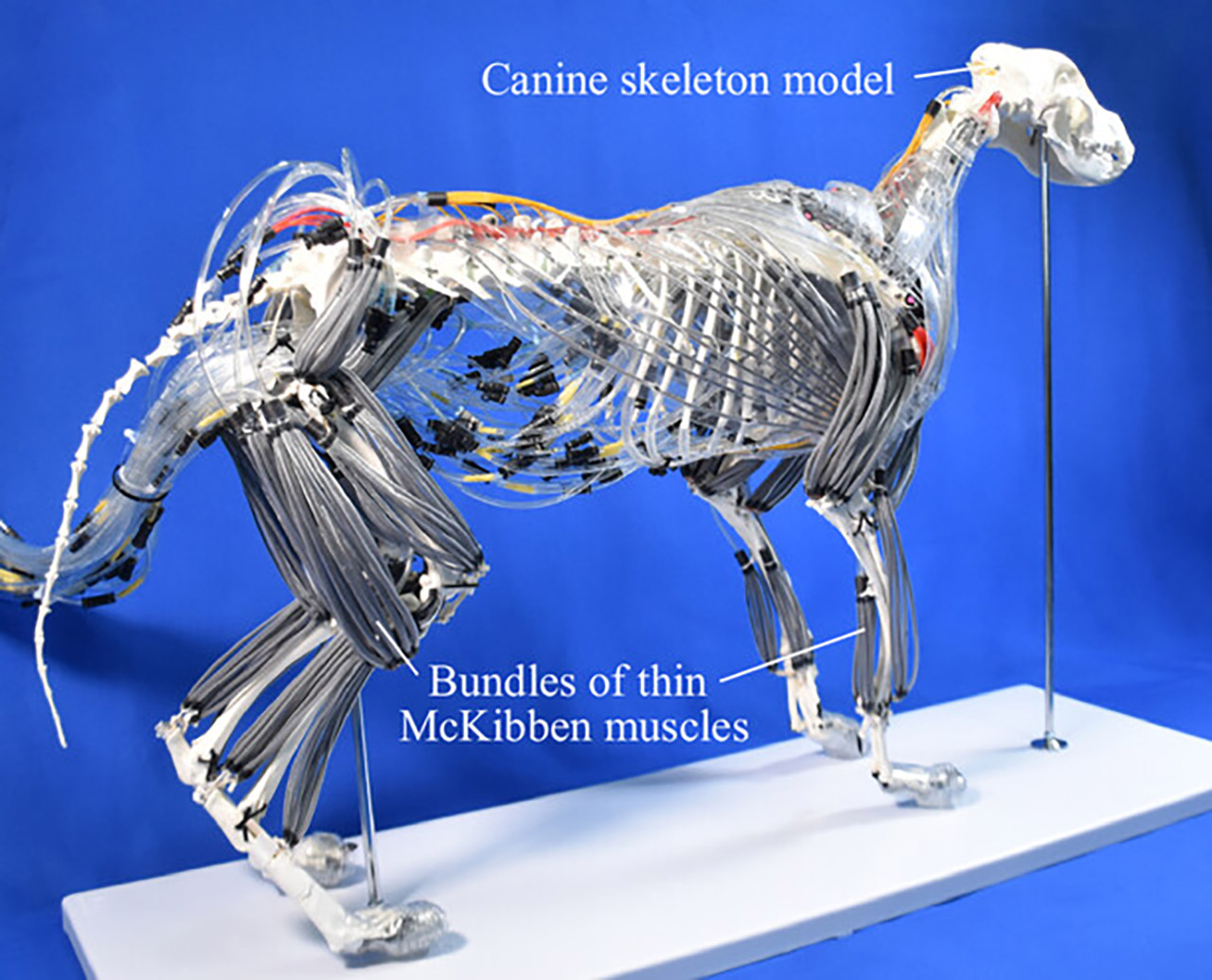
They started with some really common materials and transformed them into something quite smart. The skeleton is constructed of 3D printed plastic parts, which are lightweight, inexpensive, and extremely easy to modify. The joints are ordinary off-the-shelf hinges, but the muscle bundles are the truly ingenious part. Each leg has about a dozen thin McKibben actuators, which are braided tubes that inflate with air to lift or stretch. They’ve been around for a long time, but the lab has shrunk them down to pencil thickness to allow for more exact management. The wires and valves then connect to a central computer, which regulates the amount of air that enters each muscle.

Tests of the robot show it moving at a pretty consistent pace, with the front shoulders bending forward on each stride, similar to a dog chasing a ball. The back legs push off with a rapid snap, and the muscles contract fast to keep the body moving. It won’t win any greyhound racing contests, but it’s fast enough to avoid stumbling over little bumps. On flat flooring, it’s also rather sturdy, and they discovered that the hammock structure reduced vibrations by around 30% when compared to locked-joint devices. Early studies have also showed how that flex modifies the length of its stride, which may explain why dogs can keep running for so long on trails.

It’s really simple to get it to move about; all you need are basic feedback loops. Sensors in the muscles provide feedback to regulate air flow and maintain tension, even when the robot is leaning into a turn. In the beginning, they simply programmed the gaits by hand, but they intend to add cameras for real-time pathfinding in the future. Propulsion is only a little compressor that is quiet enough for lab operations, but in the field, they would need to attach a backpack tank. It’s also lightweight, weighing less than five kilograms, making it easy to handle when making changes.
[Source]