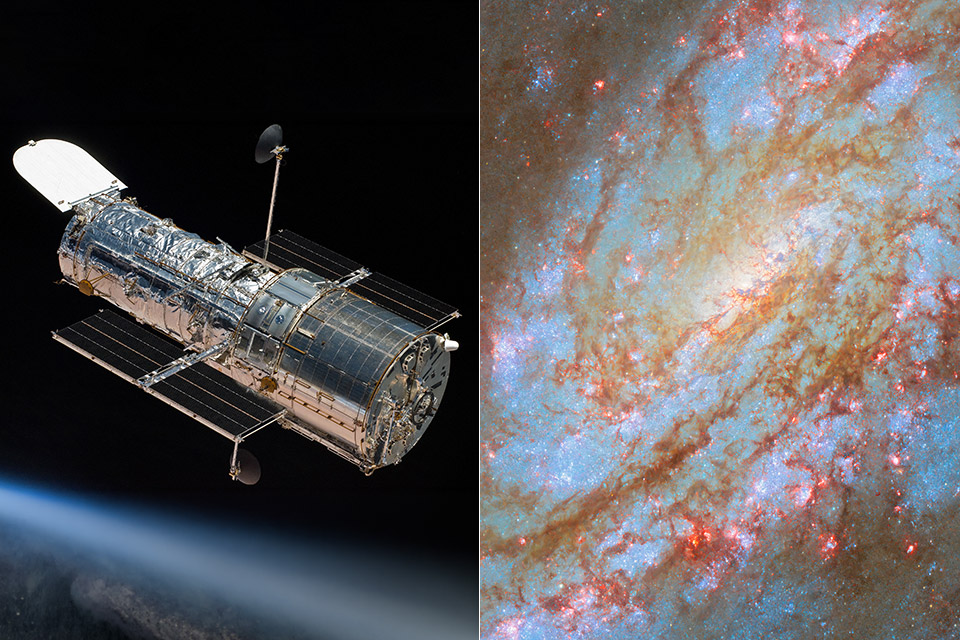
Hubble’s latest image shows NGC 4654, which sits 72 million light-years from Earth in the constellation Virgo, inside one of the densest collections of galaxies known as the Virgo Cluster. An intermediate spiral, it carries only a weak bar near its center, placing its shape somewhere between galaxies with strong central bars and those that lack them entirely. A rounded, clearly defined edge marks one side of the disk, packed with stars and gas, while the opposite side fades into a long gaseous tail that stretches beyond the edge of the frame.
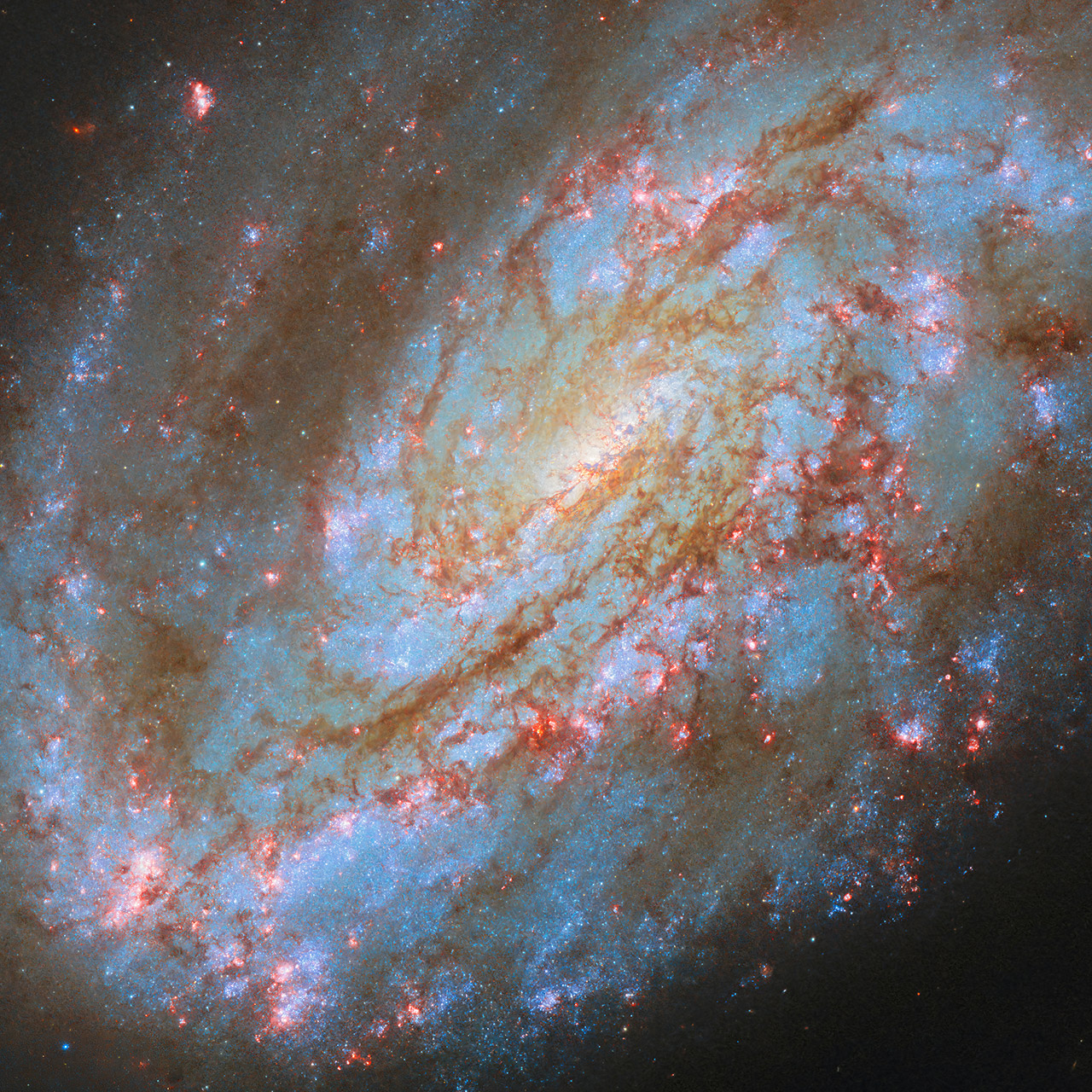
Dark brown dust filaments appear to swoop across the shimmering disk, resembling wisps of night smoke drifting across the sunset. The blue newborn star clusters are primarily concentrated in the spiral galaxy’s more evolved arm. Bright pink gas bubbles are dispersed throughout the structure, from the leading arm to the faint bar and all the way to the outer disk. Those pink smudges indicate that the light we see is bouncing off clouds of gas that are being energized by the ultraviolet light of fresh new stars.

- PROJECT HAIL MARY SCI-FI MODEL – Launch into the world of cinematic science fiction with the LEGO Icons Project Hail Mary (11389) microscale...
- WHAT’S IN THE BOX – Includes everything you need to build a microscale replica of the Hail Mary spacecraft, a functional display stand, plus a...
- FUNCTIONAL SPACE MODEL – Turn the crank on the display stand to send the crew module into orbit, simulating the spaceship’s centrifugal gravity...
As the galaxy moves through the thin, hot gas that covers the space between galaxy clusters, the surrounding medium begins to compress. The ensuing force, known as ram pressure, pummels the front edge and pulls gas into the lengthy tail trailing behind. Many galaxies that go through this phase lose enough cold gas that star formation slows or stops completely. NGC 4654, on the other hand, continues to produce approximately two solar masses of fresh new stars each year, at a rate comparable to other spirals of the same size.
Similarly, the stars themselves are not all on an even keel, as the arm on the compressed side has many more of them than the other arm, which is why the image appears lopsided. However, ram pressure alone cannot fully explain why this is the case. A close fly-by with its neighboring galaxy NGC 4639 some 500 million years ago very definitely removed gas from one side of NGC 4654, restricting star formation and contributing to the asymmetry that we observe today. Those two galaxies are now quite far apart, but the repercussions of that flyby are being felt today.
The Hubble data for this view originated from two observing programs designed to study how gas travels about inside nearby galaxies and how this relates to where and when new stars emerge. Hubble was able to obtain a single image that shows both the backbone of older stars and the youngest brand new star-forming regions by employing filters that cover all wavelengths from ultraviolet to near-infrared, as well as a host of additional narrow filters for light emitted by hydrogen.