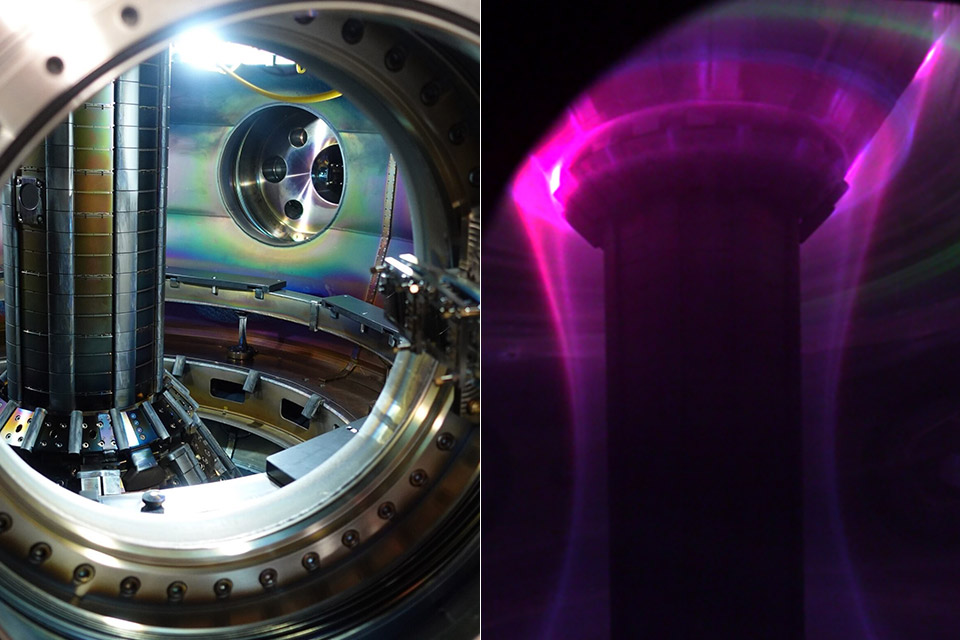
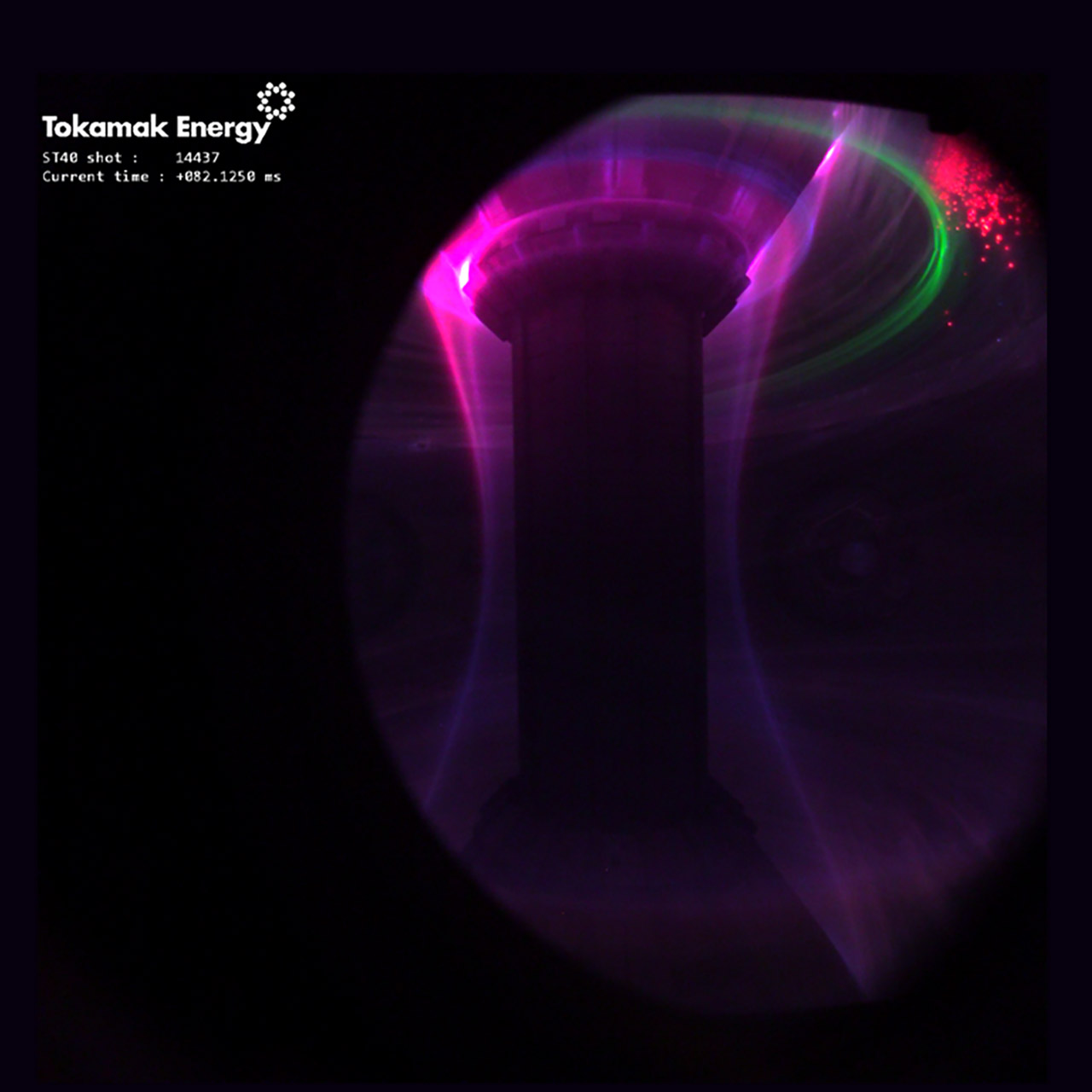
A high-speed, color camera able to capture 16,000 frames per second has snapped a vivid glimpse of nuclear fusion inside Tokamak Energy’s ST40 – a spherical tokamak. The footage shown by the UK based startup, lets you see a glowing pink edge of deuterium plasma, along with streaks of greenish/yellow lithium ions careening through a magnetic cage.
Plasma is better in colour! Watch one of our latest #plasma pulses in our ST40 tokamak, filmed using our new high-speed colour camera at an incredible 16,000 frames per second.
Each pulse lasts around a fifth of a second. What you’re seeing is mostly visible light from the… pic.twitter.com/jWKmcl0tEx
— Tokamak Energy (@TokamakEnergy) October 15, 2025
Deuterium, a hydrogen variation, is injected into the plasma and emits a bright pink light, concentrating near the plasma cloud’s cooler edges. Pink light is a mixture of red and blue wavelengths, indicating hydrogen isotopes such as deuterium or tritium. Meanwhile, lithium granules litter the plasma like grains of sand, adding their own unique flair. At the plasma’s boundary, neutral lithium atoms emit a reddish-crimson light. As they plunge further into the hotter, denser plasma core, they lose an electron and become Li⁺, or singly ionized lithium. This change results in a greenish/yellow streak that follows the magnetic field lines that keep the plasma contained. These colors are more than just a gorgeous display; they help scientists understand how lithium travels and behaves by matching data from spectroscopy, which dissects the specific wavelengths of light that the plasma emits.

DJI Osmo 360 Standard Combo, 360 Action Camera
- Big Views, Brilliant Quality - Groundbreaking 1-inch 360° imaging [1] delivers excellent low-light for sharper shots on every adventure. Now with...
- Stunning, Day or Night - Capture every detail with 8K 360° videos and store them effortlessly with 105GB Built-in Storage. Whether you're exploring...
- No Pole, All Action - 1.2m Invisible Selfie Stick turns your Osmo 360 into a cameraman that follows you. Shoot super-smooth 4K/120fps and magical...
This excellent image assists Tokamak Energy’s study on X-point radiator regimes, a technique for cooling plasma before slamming it into reactor walls. This method of cooling the plasma reduces wear on the machine’s components while retaining full performance. The color camera is extremely useful here because it allows researchers to rapidly see whether gaseous contaminants such as deuterium are radiating where they should or whether lithium powder is reaching the plasma’s core. Laura Zhang, a plasma physicist cited in the release, says that the instant visual feedback sharpens their understanding of how these interactions function and drives the research in real time.
Lithium plays a prominent role in addition to the graphics. Tokamak Energy’s LEAPS program, which costs $52 million and stands for Lithium Evaporations to Advance PFCs in ST40, intends to cover the reactor’s plasma-facing components in lithium. Yes, this is nothing new; the Princeton Plasma Physics Laboratory and others have demonstrated that lithium coatings can significantly improve plasma performance. The operation, supported by the US Department of Energy and the UK’s Department for Energy Security and Net Zero, also replaces the ST40’s outdated carbon armor tiles with molybdenum, a stronger metal more suitable for future fusion power plants. New diagnostic instruments will test the plasma much more precisely, creating a clearer picture of how lithium enhances the system.
Nuclear fusion, the mechanism that fuels our stars, involves smashing lightweight atoms such as deuterium and tritium together to produce a huge release of energy. Unlike nuclear fission, which splits heavy atoms and produces radioactive waste, fusion appears to be a cleaner alternative. But it’s a complete nightmare to control. The plasma inside a tokamak, a donut-shaped reactor, can reach temperatures higher than those in the sun’s core. Too strong to emit visible light, thus the camera looks at the cooler edges, where the colors indicate what’s going on. Containing and stabilizing this plasma, as well as safeguarding the reactor’s walls, is a significant barrier to making fusion a viable energy source.
[Source]