Drake Anthony, the mastermind behind the wildly successful StyroPyro YouTube channel, has a reputation for turning household oddities into objects of raw, utterly unexpected power. In his most recent jaw-dropping project, he takes an ordinary incandescent bulb and transforms it into an electrical powerhouse that give even a small power station a run for its money. This 24,000-watt monster is one of the biggest bulbs you’d ever want to try to use in your home.
The bulb itself demands a healthy dose of respect right out of the gate. Nestled away in a massive G38 socket that’s built for 40 amps, it somehow manages to draw a whopping 100 amps when it’s fully loaded, with a fused quartz envelope that can withstand temperatures similar to those found on the surface of the sun. As he unwraps it, you can almost see the fear etched on Drake’s face as he peers into the box, taking in the enormous tungsten coils within. They look more like industrial machine parts than anything you’d see in a bedside lamp. With a mix of interest and horror, he gently wipes away any dust that may have accumulated; after all, a particle of dust or a misplaced finger can shatter the quartz beneath the heat. However, getting this beast up and going is no easy task. Standard household outlets just cannot handle the workload. He starts modestly, using a variac to gradually increase the voltage, avoiding hitting the bulb with full force all at once. That initial, stubborn filament is a real pain; it begins drawing over 2,000 amps in the first split second, which may easily trip the main breaker or worse. Still, he eases into it, and as he does, he can see the wire gradually transforming from a dull grey to a deep, fiery red, eventually hitting 50 amps and pumping out a hearty 6,500 watts without as much as a hiccup. The air around it becomes thick with heat, and the light itself just shoots right through the room like a searchlight.

- RGBICWW Technology & Upgraded Illumination: Enjoy multi-color displays, 500lm brightness (higher than previous models), and adjustable 2700k-6500k...
- Newly Preset Modes: With 64+ diverse preset scenes, such as Valentine, and 8 music syncing modes, this smart table lamp can enrich your party...
- Matter Supported: In addition to Alexa and Google Home voice control support, utilize 3rd-party smart home platforms like HomeKit via the included...
Building the control system is a whole other ball game. Drake decides to go to town on a dimmer circuit using silicon controlled rectifiers, not just to cut down on the power flow but to get rid of those annoying startup spikes that’d normally rip the setup apart. Then he inserts an ammeter with a current transformer for real-time feedback and a thermometer to monitor the heat sinks, which don’t take long to become inconveniently hot when things get moving. Early findings suggest a few kinks to work out: the socket gets far too hot as soon as you plug it in, and the initial wiring goes up in smoke when you push it hard. Drake, on the other hand, is one of those individuals who refuses to give up; instead, he bypasses the house panel entirely, splicing in a 50 amp power line with disconnect switches so he can turn off the power in an instant if things go wrong. Now those components were probably made for stoves and not for taking the sort of punishment that this setup’s gonna need, but hey, they last just long enough for a short blast. So he starts with a low test run indoors, gradually turning up the power to 70 amps, then 100, until you can finally hear the bulb humming which just keeps going till the filament finally settles in at last. The light then starts pouring in all the areas that were previously just dark, and the heat starts radiating everywhere, so you can warm up your hands just by being a few feet away.

Later on, Drake decides to take the whole thing out to a clearing in the woods at twilight, thinking to himself “Why mess around in the garage when I can really let this thing shine?” He spends some quality time putting together a fixture that can handle the heat that’s going to come off: a bit of aluminum to bounce the light forward, some copper mesh screens to keep the flies out, and a pane of borosilicate glass to stop any errant splatters or UV bursts. Ferrite magnets keep everything held together, and he picks those over stronger rare earth magnets because they wont mess with the electronics. Yeah, bugs are a wily little foe; the first test run finishes in a cloud of acrid smoke from a slew of little critters that were fried inside the cage. He turns on a thallium metal halide lamp to scan the area for any sly bugs trying to hide, then soaks the steel wool filters in acid to remove the flammable zinc coating. Once that’s cleared out, he adds some copper wool, cleans it up, and it’s ready to go. He restarts it, briefly removing the reflector to prevent it from melting.
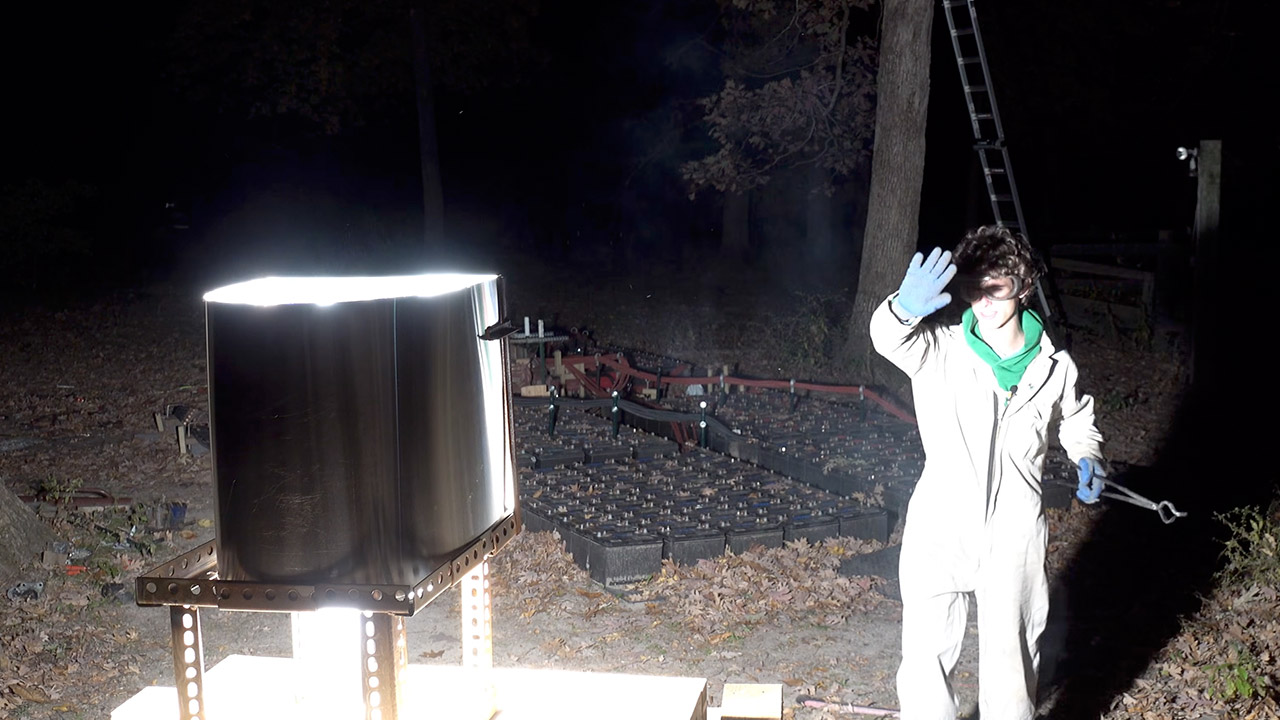
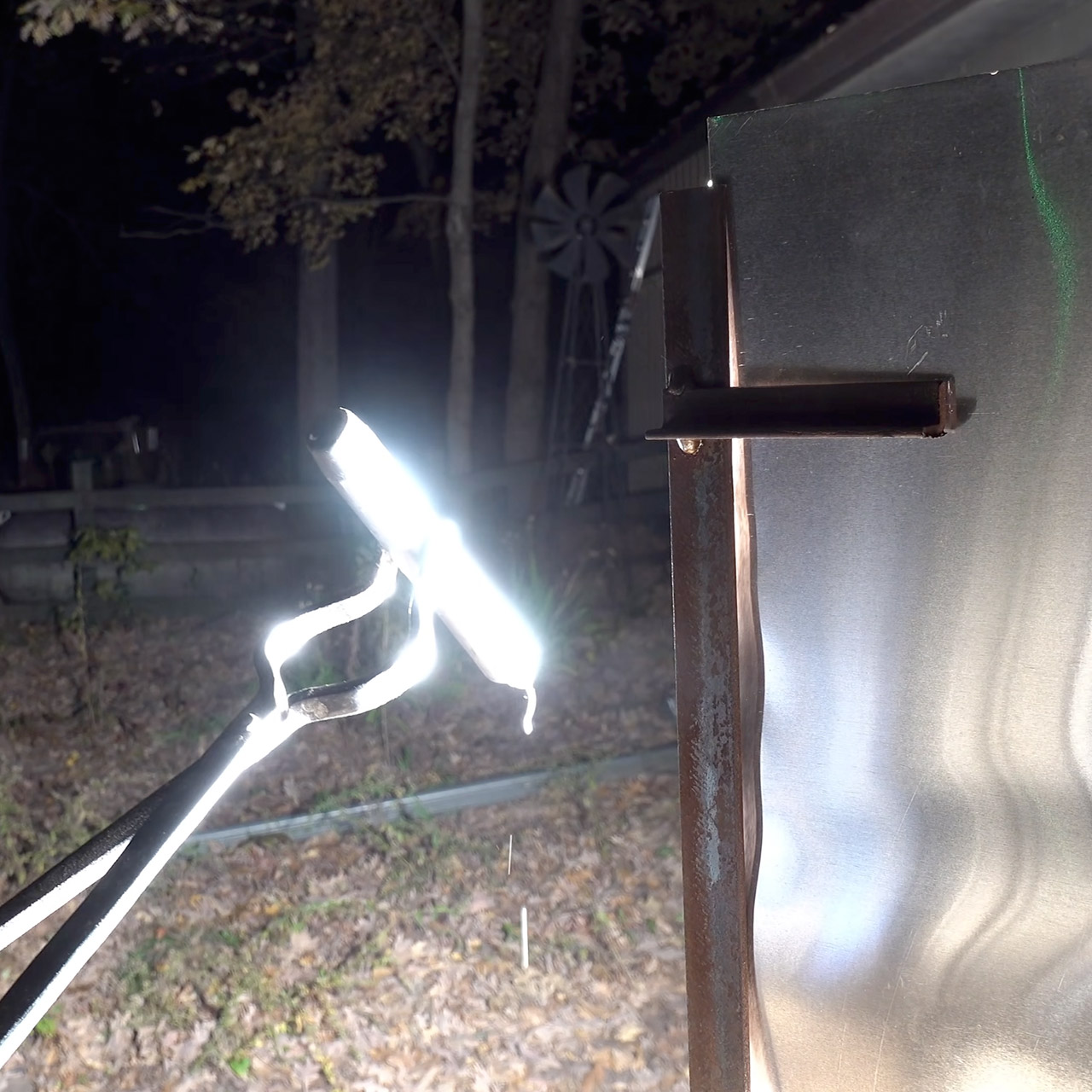
By the time it reaches 24,000 watts and 100 amps through the tungsten, the filament is essentially a bar of molten sunshine. That beam of light cuts through the underbrush for 225 yards; you can read fine type on a page from way out there. Shadows cut deep into the earth, and the warmth strikes like being near to a bonfire, making the crisp December air feel almost balmy. Drake checks to see how much of the area is being lit up: light floods into his workshop windows a hundred feet away, effectively banishing the night. He turns it up a little more with an autotransformer, increasing the voltage to see if he can get the draw above 110 amps. The meter pegs off the scale, but his calculations show it’s already up to 30,000 watts. Nevertheless, that bulb keeps running, the quartz holding solid as the tungsten filament dances on the verge of evaporation. After he turns it off, there’s a faint glow left over; the filament cools from white-hot to a smoldering ember in minutes, demonstrating the density of the metal involved.
[Source]