Light from a galaxy that lived just 1.4 billion years after the Big Bang traveled more than 12 billion years to reach us. Astronomers examining long Hubble exposures of a deep sky field spotted something they had not expected to see at such an early time. The galaxy, cataloged MXDFz4.4, sent out ultraviolet radiation strong enough to change the gas in its immediate surroundings from opaque to clear.

Astronomers have released a striking new image of the Cigar Galaxy (M82) taken with NASA’s James Webb Space Telescope. Data for the portrait came from a dedicated 65-hour survey using the telescope’s Near-Infrared Camera. This extended observation time let Webb cut through dense dust clouds that normally hide the galaxy’s stellar population from view. Roughly 16.5 million individual stars now stand out clearly across the galactic disk in the resulting composite view. These stars show up as luminous blue-white specks scattered throughout the structure.

Tucked behind the familiar glow of the Orion Nebula sits a stretch of space where new stars are taking shape right now on an impressive scale. NASA’s James Webb Space Telescope captured a northern section of the Orion Molecular Cloud 2, known as OMC-2, which forms part of the larger Orion A complex roughly 1280 light years from Earth.

Astronomers have long studied dense collections of stars known as globular clusters scattered throughout the Milky Way. Most appear to have formed in one quick burst early on and then evolved quietly for billions of years. One object in the galaxy’s crowded central bulge always stood out a bit, though. New data has now shown why. Observations collected by the James Webb Space Telescope, working alongside archival records from the Hubble Space Telescope, have established that Terzan 5 contains not one but four distinct generations of stars. This discovery turns the object from a standard cluster into something researchers now call a bulge fossil fragment.

A dark ribbon of dust slices across the glowing heart of a spiral galaxy in Coma Berenices, creating the appearance that earned Messier 64 its well-known nickname, the Black Eye Galaxy. The feature stands out even in modest amateur telescopes, yet it only hints at far deeper activity inside.

Astronomers aimed NASA’s James Webb Space Telescope at a distant galaxy cluster called Abell S1063 with one goal in mind. They wanted to hunt for some of the very first stars that ever formed. What the telescope delivered instead turned out far more revealing. Tucked behind the cluster sat a faint red object known as GLIMPSE-17775. Gravity from the foreground cluster acted like a natural magnifying glass, stretching a 30-hour observation into the effective power of an 80-hour exposure. The result gave researchers the deepest spectrum ever captured of one of these mysterious little red dots.

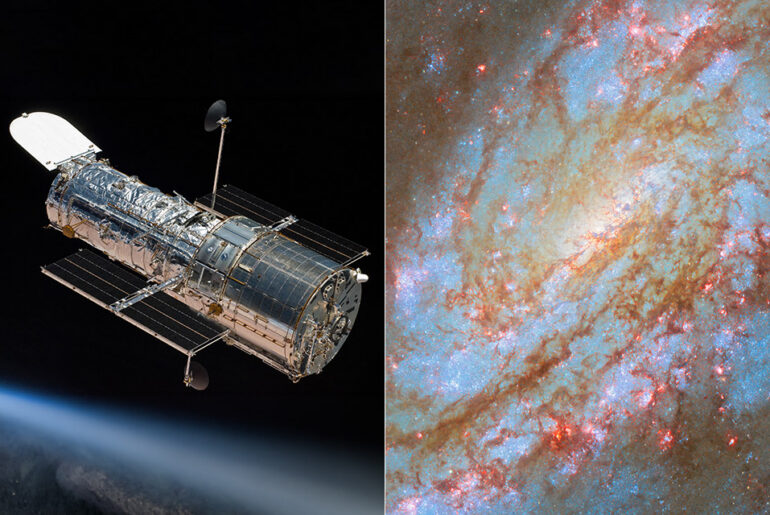
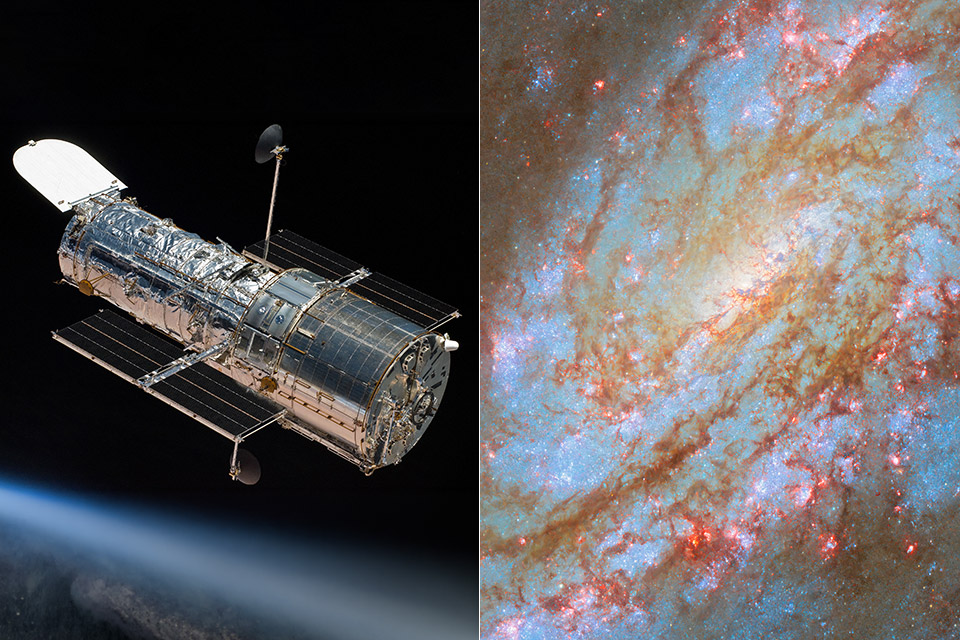
Hubble’s Wide Field Camera 3 captured a stunning composite image of galaxy M88, which shows a massive spiral system twisted at an angle, stretching its appearance and displaying an orderly set of arms looping inward with exceptional symmetry. Pink knots represent the formation of new stars, blue clusters outline younger stellar populations, and darker red lanes highlight the disk’s dust. The galaxy’s nucleus is surrounded by older stars that emit a warm light.

Photo credit: NASA/MSFC/David Higginbotham/Emmett Given
Astronomers released a composite image of Westerlund 2 that merges X-ray observations from Chandra with infrared data from the James Webb Space Telescope. The result turns a distant star cluster into a scene of gleaming points ringed by neon pink against swaths of warmer dust tones.

Astronomers examining deep views from NASA’s James Webb Space Telescope have identified a supermassive black hole that reached enormous size while the material around it had barely begun to form stars or build a full galaxy. The object, known as Abell2744-QSO1 or simply QSO1, sat in the universe when it was only about 700 million years old. Its light has traveled more than 13 billion years to reach us.

NASA released a new image from the Hubble Space Telescope that brings a modest galactic resident into view. ESO 490-017 lies about 23 million light-years away in the constellation Canis Major. The galaxy spans roughly 12,000 light-years from one side to the other and belongs to the dwarf irregular category, a group whose stars and gas sit in loose, disorganized arrangements rather than neat spirals or bright central cores.