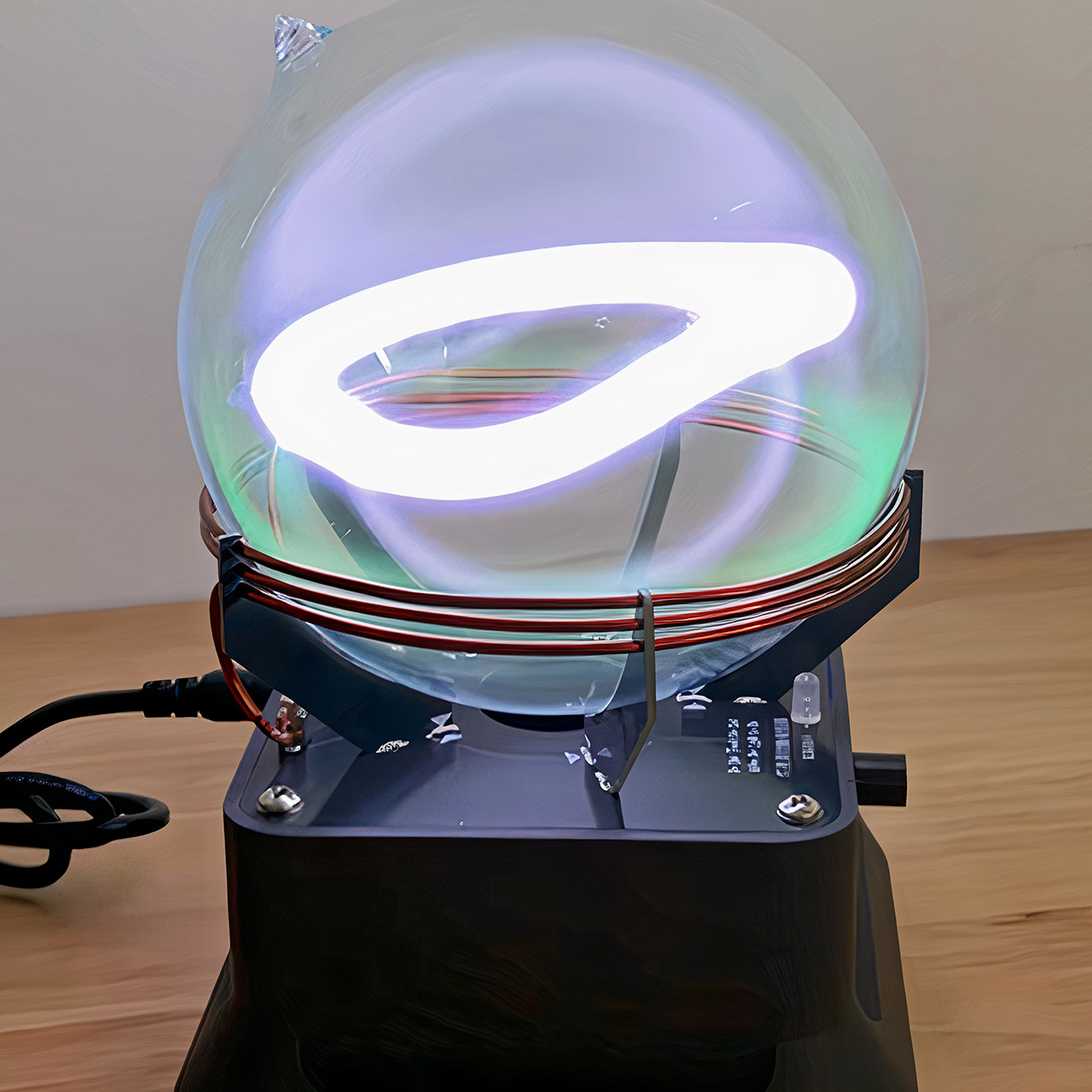
Plasma balls have sat on desks for as long as we can remember, filled with low-pressure gas that lights up in thin, branching strands when a high-voltage electrode inside the glass gets going. Those strands look lively, yet they always end somewhere, either at the glass wall or at a second electrode. The Action Lab recently showed a different arrangement: a continuous ring of glowing plasma that floats inside a sealed xenon globe and never touches any solid conductor.
The ring stays together because a coil of rather thick copper wire is hidden behind the glass, carrying an alternating current that flips direction at a staggering 10 million times each second. This fast back-and-forth generates a continually changing magnetic field, which induces an electric field within the xenon gas. As a result, the electrons inside the gas begin to accelerate along this electric field, smashing into other atoms, knocking some of those atoms loose, and eventually generating a self-sustaining plasma loop.

- MESMERIZING INTERACTIVE LIGHT: The Discovery Plasma Orb emits electric currents that dance energetically around the inside of the globe. Place your...
- RESPONSIVE TO TOUCH AND SOUND: Watch shades of pink and purple light react to your touch and move to your voice or music! A built-in sound sensor...
- EDUCATIONAL STEM TOY: Learn how noble gases interact with electricity using this Plasma lamp. A Tesla coil in the center emits AC currents through...
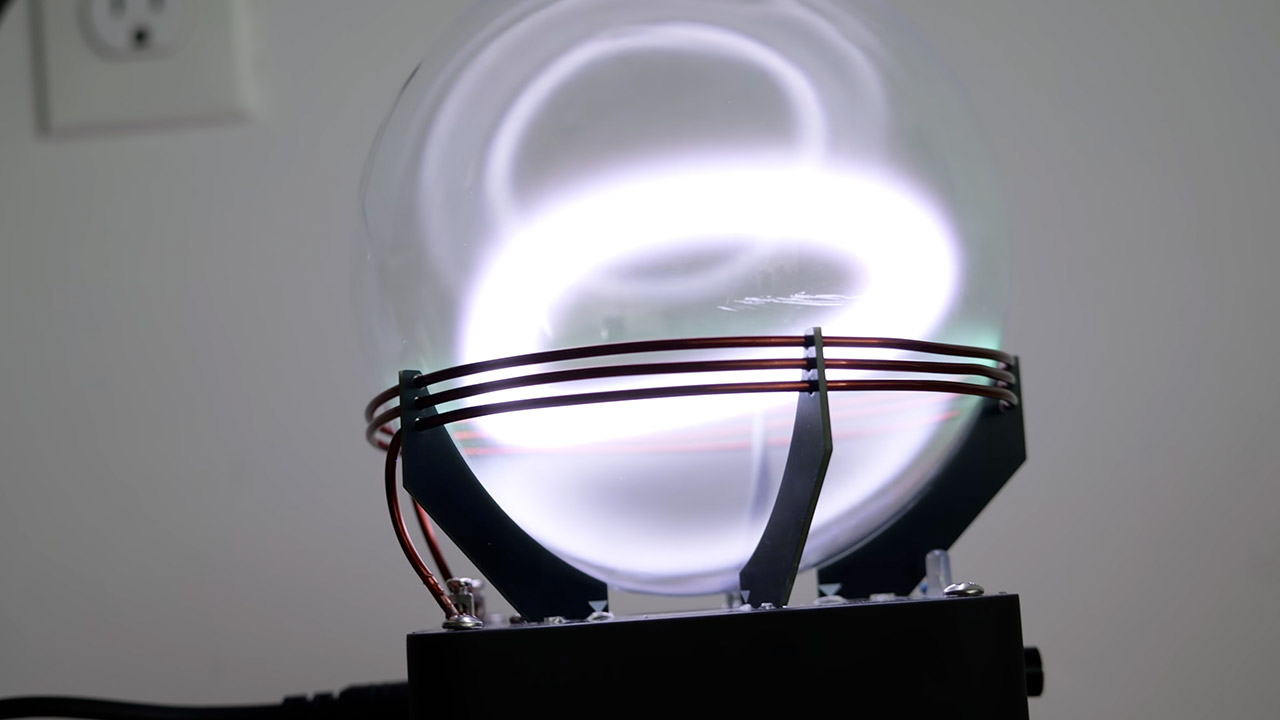
The advantage of this design is that because the plasma never actually hits any metal electrodes, there is no risk of the electrodes being burnt to a crisp as the heat accumulates. Most plasma generators rely on electrodes placed directly in the center of the discharge, as ions and electrons constantly smash into the electrodes, wearing them down. In the toroidal setup, however, the energy is given by induction, thus the glass remains relatively cool while the plasma ring simply floats a little distance away from the inside of the glass. The closed shape has another significant advantage: charged particles that would otherwise fly out the end of a straight tube are trapped by the circular path. So every ounce of energy you put into the coil has a lot better probability of heating up the gas already inside the ring rather than allowing it to escape.
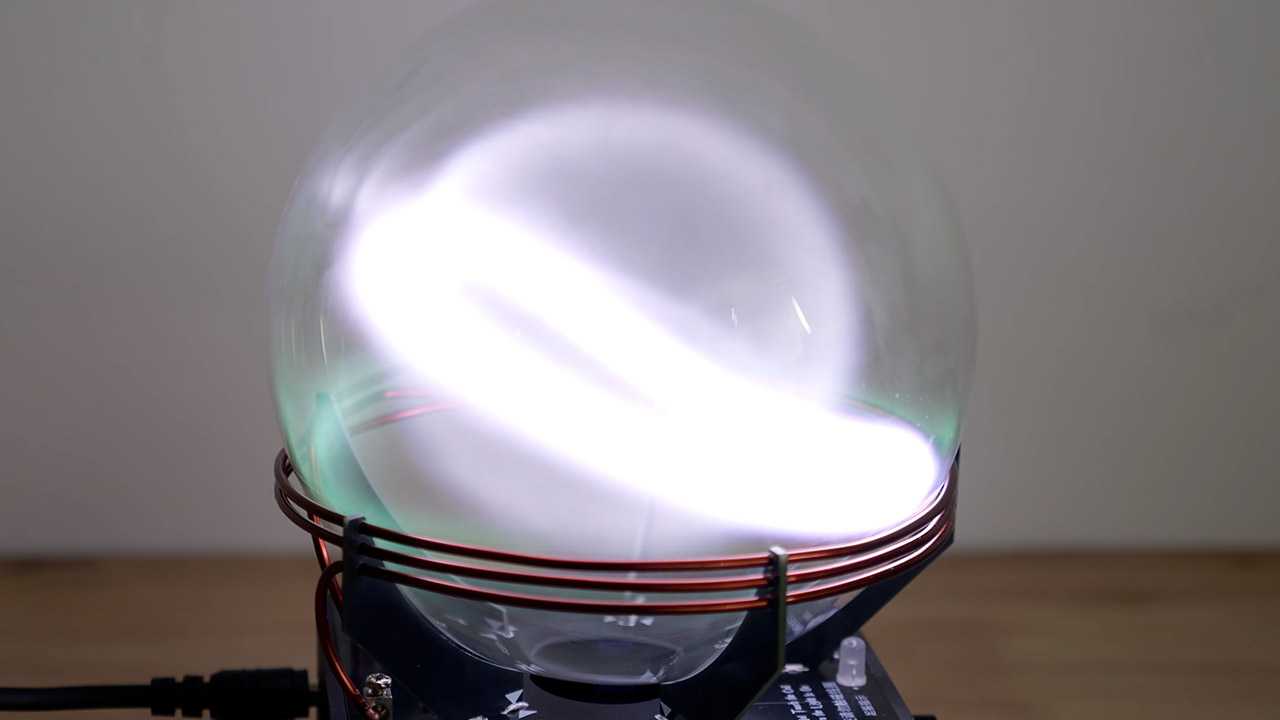
Keeping the xenon globe at a low pressure helps get things started. At normal air pressure, electrons travel just a short distance before colliding with another atom and losing steam. By lowering the pressure, electrons can pick up more energy between collisions, allowing you to run the plasma at lower voltages than you might think. The Action Lab even conducted a little experiment to demonstrate the contrast with a conventional Tesla coil discharge: plasma from that coil will rush out and grasp a nearby finger because capacitance has established a path back to ground. The toroidal ring is completely self-contained since it is not attracted to any external objects and only responds to the magnetic field of the coil.
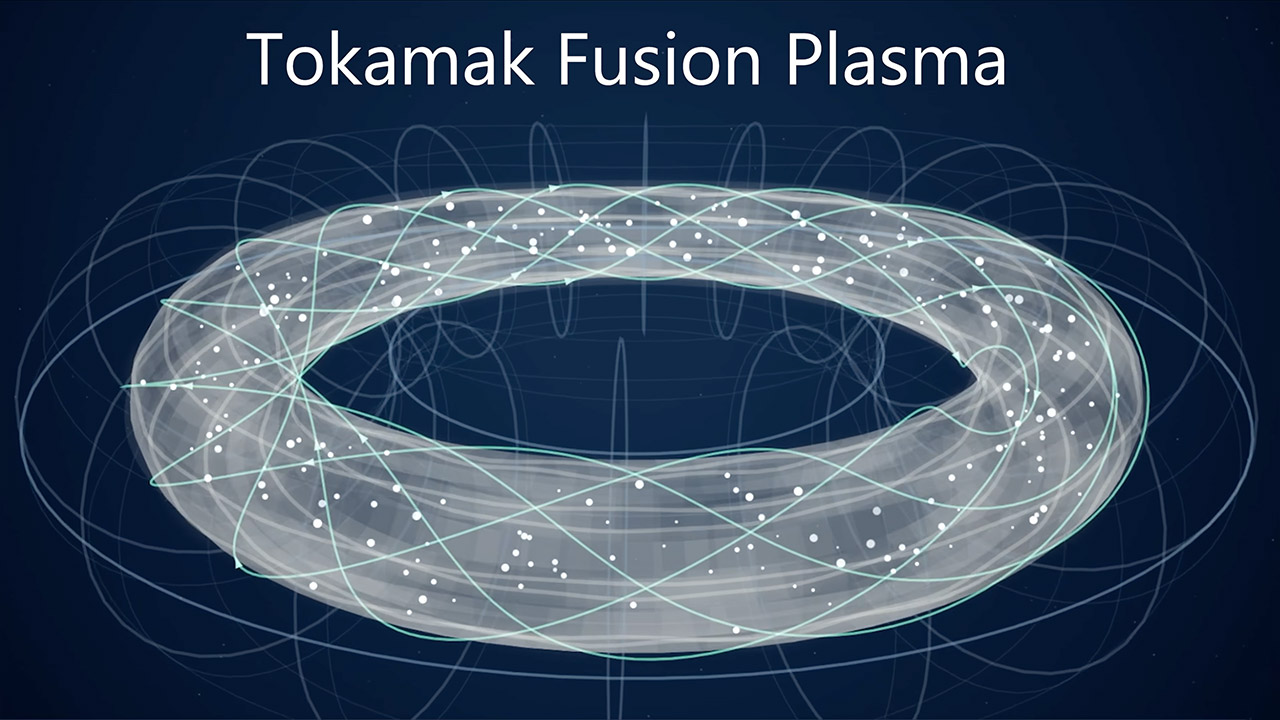
The large experimental machines being built to attempt controlled nuclear fusion share the same donut-shaped form. In a Tokamak, such as the one being developed in southern France as part of the international ITER project, an electric field generated by induction drives a current through the plasma. As the current flows, it warms the gas while extraordinarily powerful electromagnets generate twisted field lines to keep the plasma away from the chamber’s metal walls. The type of fuel utilized varies. In the tabletop setup, xenon is used because it easily ionizes and emits a visible glow, whereas in fusion experiments, hydrogen isotopes, specifically deuterium and tritium, are used because their nuclei will eventually fuse when temperatures reach over a hundred million degrees. At extreme temperatures, the particles are moving so quickly that they can sometimes overcome the electrostatic repulsion between the positive nuclei, releasing a large amount of energy in the form of a neutron.
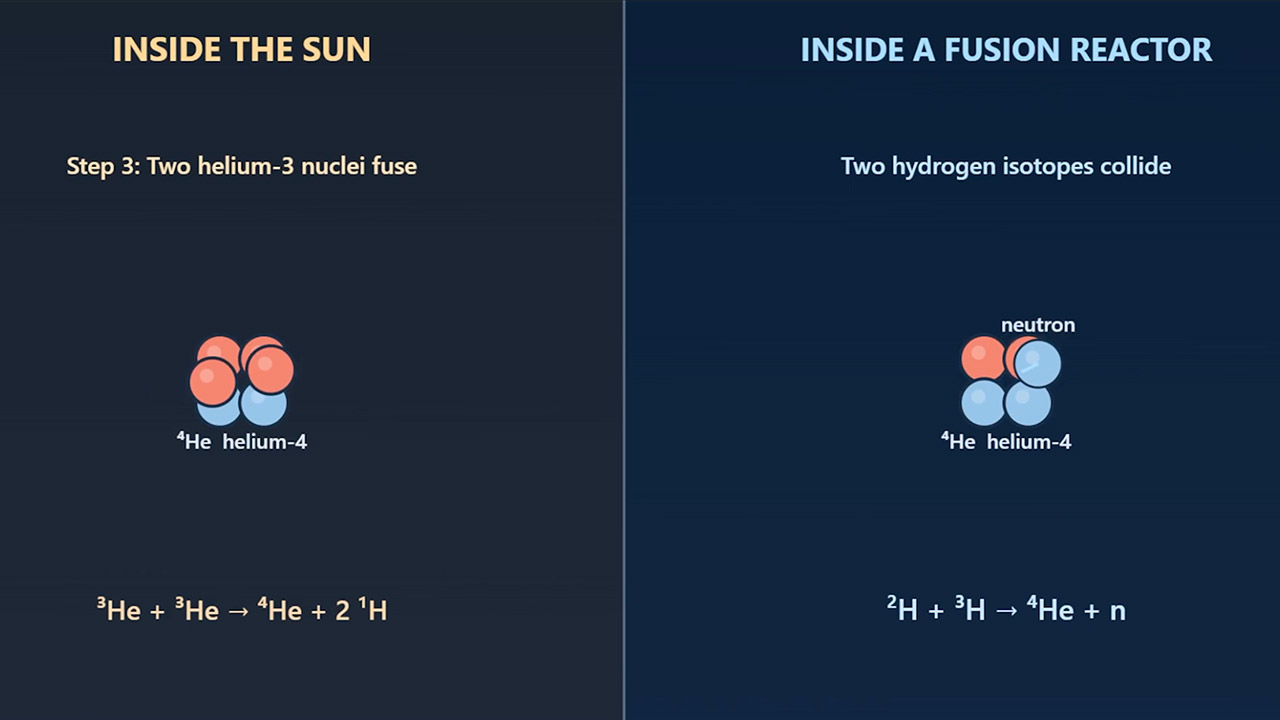
The small xenon ring never approaches fusion conditions because the temperature remains well below the levels required for fusion to occur and the magnetic confinement is nowhere near as powerful as the multi-tesla fields utilized in a full-scale device. Still, the essential idea remains the same: induction creates a closed current loop that does not require electrodes, and the resulting plasma can be heated further if energy is added to it. Of all the extant Tokamaks, they still consume more electricity than they produce, mostly because the magnets and heating systems require a continual high power supply, although the plasma is only stable for a limited time.
[Source]