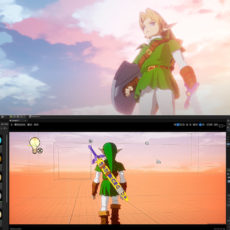
Digital Dreams runs CryZENx’s Zelda Ocarina of Time remake in Unreal Engine 5 on a system equipped with an NVIDIA RTX 5090 FE graphics card to show us just how good the game can look on modern hardware. What makes the RTX 5090 so special? For starters, it boasts a massive number of CUDA cores (possibly exceeding 20,000), a high clock speed (around 2.0–2.5 GHz base/boost), and up to 32GB of GDDR7 memory with bandwidth potentially hitting 1,792 GB/s, enabling it to fully leverage UE5’s Nanite system.
Since UE5’s Nanite allows for near-infinite geometric detail by streaming and rendering only the polygons visible to the player, it eliminates traditional LOD (level of detail) baking. In the case of Ocarina of Time, this means Hyrule’s landscapes and structures could be rebuilt with film-quality assets, whether it be millions of polygons for crumbling castle walls or dense forest canopies, all without performance hits.

- THE LEGEND OF ZELDA DEKU TREE MODEL – This 2in1 LEGO The Legend of Zelda set for adults includes 2,500 pieces, and lets you build one of two...
- 4 MINIFIGURES – This set features the Great Deku Tree, with curated details and features for each version, plus 4 minifigures: an adventure hero...
- BUILDING SET FOR ADULTS – Both versions have small builds and features inspired by the video games, including Link’s house, posable facial...


The GPU’s fourth-gen RT cores (or beyond, given the Blackwell architecture) delivers faster and more accurate ray-traced lighting, reflections, as well as shadows. In a remake, this could transform a game’s atmosphere—imagine Ocarina of Time’s Temple of Time with dynamic sunlight streaming through windows, shifting as day turns to night, or reflective puddles in the rain-soaked Market Town, all calculated on the fly.