
We’ve come a long way since the early black and white televisions. Future display technologies include a 2D/3D switchable LCD TV and more.
10. Samsung’s Dual-Sided LCD
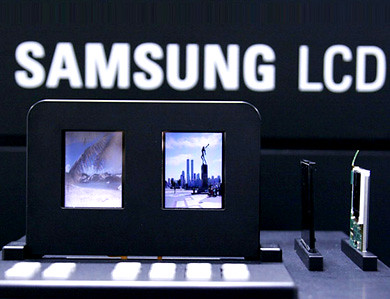
Samsung has developed a dual-sided LCD for mobile devices that makes use of their new “double-gate, thin-film transistor (TFT) architecture.” At just 2.6mm thick, this display boasts QVGA (240 x 320) resolution and 250 nits (front) / 100 nits (back) brightness.
One side of the panel operates in a transmissive mode, while the other operates in a reflective mode. By using a unique reflective design that utilizes the light trapped in the opposing screen’s transmissive mode, the reflective mode does not solely rely on external light sources such as the sun
[Source]
9. Samsung’s AMOLED Display
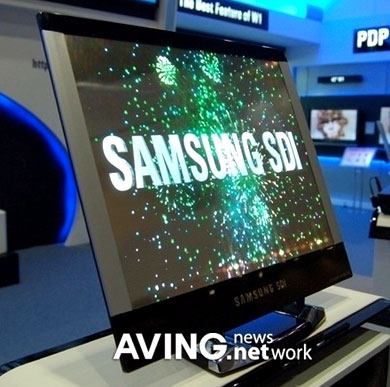
Samsung has unveiled a 17-inch AMOLED display that measures just 12mm-thick, yet packs plenty of features. Boasting 1600 x 1200 resolution, 1000:1 contrast ratio, 0.01ms response time, and 400nits brightness. No word yet on pricing and availability.
The active matrix / organic light emitting diode hybrid AMOLED technology has been a Samsung favorite, providing bright, colorful displays in quite thin form factors, since there’s no need for a backlight
[Source]
8. Touchless Touchscreen
Here’s a first: a touchscreen display you don’t actually have to touch. Basically, users swipe their hand from a distance of up to 15cm away and the built-in sensors translate that movement into a command — like flipping pages, etc.
7. Mitsubishi DiamondTouch
Developed by Mitsubishi Electric Research Laboratories (MERL), this interactive multi-input panel allows users to control games or applications with an array of antennas embedded in the touch surface. Basically, a receiver connected to each user’s chair, gets signals from antennas near the touch point. The displays are available in 32-inch and 42-inch sizes.
6. LG’s 2D/3D Switchable LCD TV
Here’s a first look at LG’s 2D/3D switchable LCD TV. This display uses Philips’ WOWvx 3D technology to provide auto-stereoscopic images without the need for special glasses.
5. Sony’s Ultrathin OLED Displays
Sony has announced that it will be releasing a new line of ultrathin (3mm thick) OLED displays later this year, featuring 1,000,000:1 contrast ratio, 1080p, and 1920 x 1080 native resolution. Video on OLEDs after the break.
We’re used to seeing OLED screens in small-ish electronics. But the technology is moving forward by leaps and bounds, and displays getting ever larger. The nice thing about OLED displays is that they don’t have to be quite as thick as their LCD or plasma counterparts
[Source]
4. Sharp’s 2-Way LCD
CNN gives us another look at Sharp’s 2-way LCD technology. With a parallax barrier superimposed on a normal TFT-LCD, these displays can show different information simultaneously depending on the viewing angle.
