
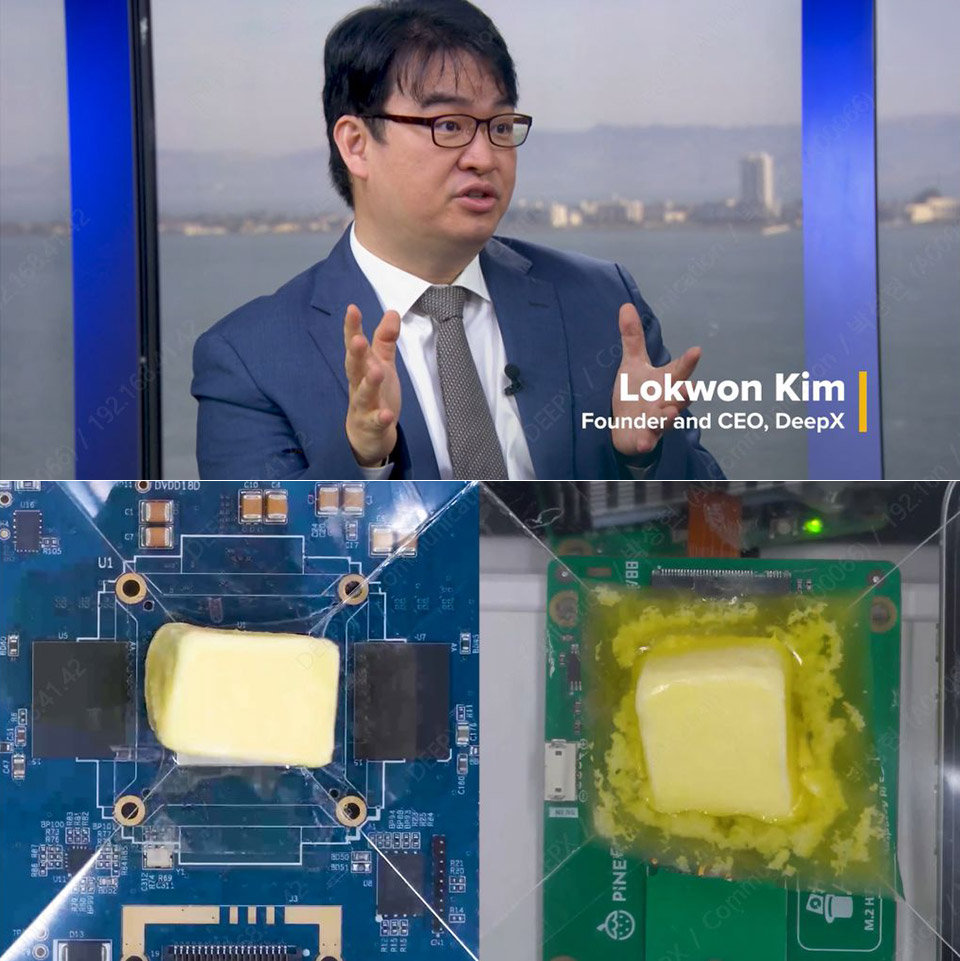
DEEPX, a South Korean chip designer, has been showing off its DX-M1 neural processing unit by placing ordinary sticks of butter directly on the silicon while it runs AI workloads. In side-by-side tests against other AI chips, the butter on the DX-M1 stays firm and unchanged. On the competing chips, the same butter softens and melts within seconds under identical conditions. Company founder and CEO Kim Nok-won has stated that the DX-M1 runs 25 to more than 40 degrees Celsius cooler than the alternatives during those runs.
This presentation demonstrates a problem that huge data centers are experiencing: the heat and power demands of traditional AI processors are out of control. These devices often require elaborate cooling systems that consume a lot of electricity and water. DEEPX feels that a more sensible approach would be to start with CPUs that release less heat. That’s what the DX-M1 is all about: it was designed from the ground up to be more practical. It can perform 25 trillion operations per second with INT8 precision while consuming only 2 to 5 watts. Mass production began in August 2025 with Samsung’s cutting-edge 5 nanometer technology, which helps maintain heat output under control even when working at maximum capacity.

- The world’s fastest gaming processor, built on AMD ‘Zen5’ technology and Next Gen 3D V-Cache.
- 8 cores and 16 threads, delivering +~16% IPC uplift and great power efficiency
- 96MB L3 cache with better thermal performance vs. previous gen and allowing higher clock speeds, up to 5.2GHz
The chip is packed as a standard M.2 2280 module that slots into your motherboard and connects over PCIe Gen 3, making installation relatively simple. It also has 4GB of dedicated LPDDR5 memory and on-board flash storage, so your AI models may operate locally without competing for RAM with the rest of your system. DEEPX’s compiler tools support all of the typical suspects, including PyTorch, TensorFlow, and ONNX. Real-world applications for the thing include object recognition, real-time video analysis, robot navigation, factory inspection cameras, and a variety of other edge-based activities, as it is not designed for training large models or running massive language models that consume a lot of resources.
Hyundai Motor Group’s Robotics Lab has selected the DX-M1 for use in their first commercial robots, which are set to be released this year, such as the DAL-e delivery robot and the MobED mobility platform. By October 2026, DEEPX had received 88 orders from consumers in ten nations totaling $13.3 million. The DX-M2, which is already in development on Samsung’s spiffy new 2 nanometer technology, is primarily aimed at generative AI workloads, and DEEPX hopes to release it in the second half of 2027.
Some outside observers have noted that we don’t see much in the way of specs from the competitors; how much bandwidth or clock speed can their processor really handle? The truth is that a processor can simply be cooler by consuming less power or running less aggressively, and edge-focused designs revolve around this trade-off. DEEPX uses the same test at other events, such as CES, to demonstrate their thermal advantage in an easy-to-understand manner that does not require any extra equipment. If you need long-term AI inference in robots, industrial cameras, or tiny systems where fans and heat sinks are not an option, the 25 TOPS and single-digit watt consumption are a viable alternative to the hotter, more power-hungry choices.
[Source]