Apple Watch users in the US who were left high and dry by the lack of blood oxygen on their Series 9, Series 10, or Ultra 2 can finally breathe a sigh of relief. A software update rolling out today brings back this health monitoring feature, bypassing the legal mess that stripped it from newer devices.
A patent dispute with health tech company Masimo forced Apple to disable blood oxygen monitoring on watches sold in the US after January 2024. Masimo claimed Apple’s optical blood monitoring tech infringed on its patents and a US International Trade Commission ruling agreed. So Apple stopped selling the offending watches for a bit and relaunched them without the feature. For a company that prides itself on seamless health integration, this was a rare misstep. Now a US Customs ruling has cleared the way for Apple to bring the feature back, but with a clever twist: the heavy lifting has shifted from the watch to the iPhone.
![Apple Watch Series 10 [GPS 42mm case] Smartwatch with Jet Black Aluminum Case with Black Sport Band...](https://m.media-amazon.com/images/I/31hPF0KUqoL._SL160_.jpg)
- WHY APPLE WATCH SERIES 10 — Bigger display with up to 30 percent more screen area.* A thinner, lighter, and more comfortable design.* Advanced...
- ADVANCED HEALTH INSIGHTS — Take an ECG anytime.* Use the Blood Oxygen app.* Get notifications if you have high or low heart rate or an irregular...
- A POWERFUL FITNESS PARTNER — Measure all the ways you move with Activity Rings, which are customizable to match your lifestyle. Get advanced metrics...
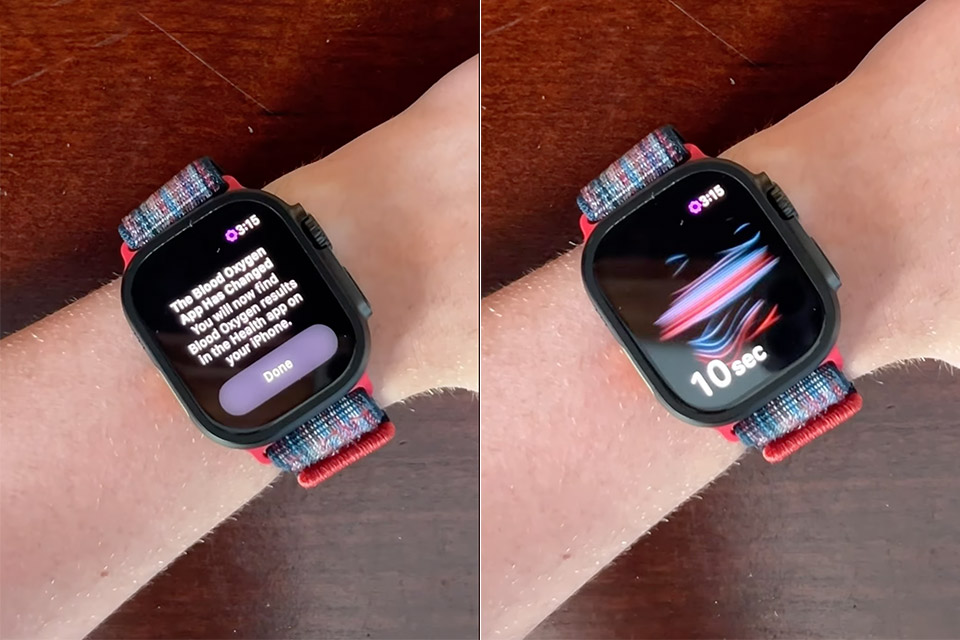
To get the blood oxygen feature working again, users need to update their paired iPhone to iOS 18.6.1 and their Apple Watch to watchOS 11.6.1. Once updated, the watch’s Blood Oxygen app collects sensor data but the actual calculations happen on the iPhone. Results show up in the Respiratory section of the Health app for users to check. This workaround gets around the patent issue by offloading the processing to the phone, a move that keeps the feature alive without stepping on Masimo’s toes. If your watch already had the original blood oxygen feature or was bought outside the US, nothing changes—you’re good to go.
This update matters because blood oxygen monitoring isn’t just a tech gimmick. Introduced with the Apple Watch Series 6 in 2020, it became a star during the COVID-19 pandemic. Low blood oxygen levels can signal serious health issues like pneumonia often before symptoms scream for attention. Fitness trackers including rivals like Garmin have long used this data to help athletes optimize high-altitude training but its broader value shone when pulse oximeters became household items. For someone like me who once caught a low blood oxygen level that pointed to pneumonia, this feature can be a quiet lifesaver. Apple’s Health app now ties this data into a broader respiratory picture making it easier to spot patterns over time.
But Apple’s health ambitions don’t stop here. The Series 9, Series 10 and Ultra 2 already have a whole toolbox: irregular rhythm notifications, ECG readings, sleep apnea alerts, fall detection, sleep tracking, wrist temperature sensing and more. These features are science-based and privacy-focused so the Apple Watch is a wearable that doesn’t just track steps—it tracks life. Restoring blood oxygen monitoring fills a big hole especially since competitors have made this feature standard. With the September event coming up where new iPhones and the Series 11 watch are expected this feels like a warm-up for bigger health focused announcements.