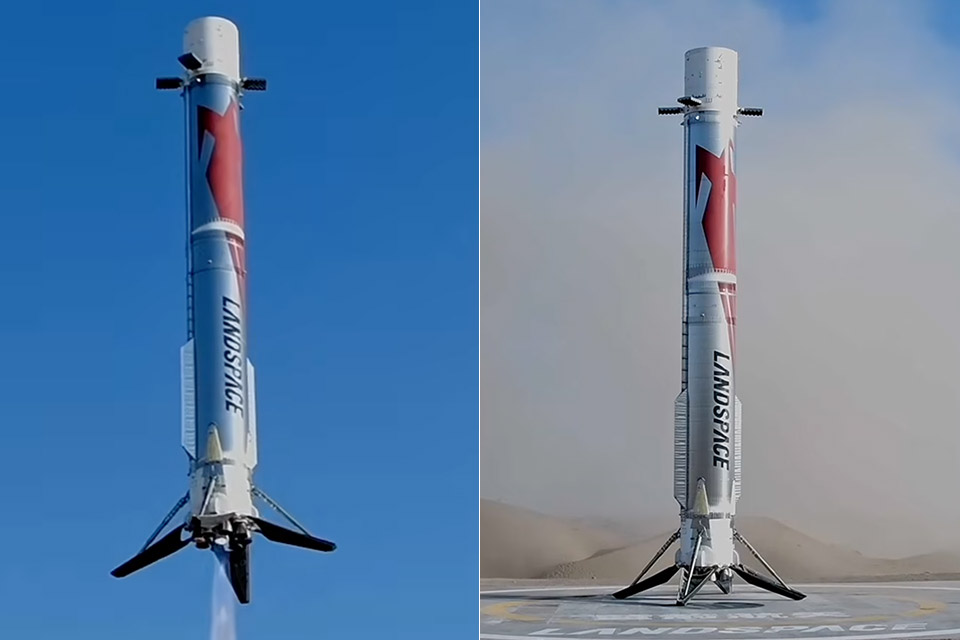
Soft white plume marked the sky over Minqin County just after dawn on August 19 as LandSpace’s Zhuque-3 first stage settled onto its concrete pad. Four landing legs unfolded in the final seconds. Engines cut. The booster stood upright, roughly 390 kilometers from where it had left the ground six minutes earlier. China’s private rocket company had just completed its first successful recovery of an orbital-class booster on land.
Liftoff ultimately occurred at 7:35 a.m. Beijing time from the Dongfeng Commercial Space Innovation Test Zone at the Jiuquan Satellite Launch Center in the Gobi Desert. Nine of those huge Tianque-12A methane and liquid oxygen engines nearly destroyed the 66.1-meter stainless steel rocket. Weighing an incredible 570 metric tons off the pad, that thing must have been a beast to see. Stage separation happened only 137 seconds into the flight and began to take shape quickly. That second stage, with only one Tianque-15A engine powering it, did an excellent job of delivering the Honghu 03 satellite, produced by LandSpace subsidiary Hongqing Technology, into its intended orbit.

- BUILD AN OFFICIAL NASA ROCKET – Kids prepare to explore outer space with the LEGO Technic NASA Artemis Space Launch System Rocket (42221) building...
- 3-STAGE ROCKET SEPARATION – Young builders can turn the hand crank to watch the rocket separate in 3 distinct stages: solid rocket boosters, core...
- STEM BUILDING TOY FOR KIDS – This educational rocket kit was created in collaboration with NASA and ESA to showcase the authentic system that will...
While all of this was going on, the rocket’s first stage began its descent back to Earth. It had to make a few last-minute changes to get into the proper position for a smooth landing. It performed a couple high-altitude attitude adjustments, a bit of re-entry burn, and then had to deal with aerodynamics utilizing those grid fins, followed by a last powered deceleration to really slow things down. For this landing, they reduced the number of engines used in the first flight’s landing burn in favor of a simpler sequence, which should enhance reliability. Their updated onboard system can now predict the landing location in real time and make any necessary adjustments to keep everyone safe. The thermal protection on this one had also been upgraded to deal with all of the heat and structural pressures of the landing, and to top it all off, the landing legs only deployed at the very last minute. The booster gently landed on the pad in Minqin County, Gansu Province.
Dji released full flight footage of the ZQ-3 Y2 1st stage. From launching to landing at 30x speed. via Dji pic.twitter.com/aX9SRgcJOJ
— Ace of Razgriz (@raz_liu) August 20, 2026
Zhuque-3’s debut flight in December had been a tough test because the upper stage barely made it into orbit on its first attempt, and the rocket itself had some troubles. It experienced aberrant combustion near the pad and then just sort of…exploded, although the guys at LandSpace had worked hard to fine-tune the propulsion, flight control, and heat shielding in preparation for this trip. They must have done something correctly, because it all worked out in the end. With this flight, LandSpace became the first private Chinese enterprise to recover an orbital booster with landing legs, as well as the first in China to do so on land; however, a state-owned Long March 10B had just completed a sea recovery the month before, so China was not far behind. That puts them on par with the United States as the only countries to have achieved both land and marine orbital-class recoveries.
Zhuque-3 is primarily intended to tackle medium lift jobs. In its recoverable configuration, it can deliver around 18,300 kg to low Earth orbit, or near to 21 metric tons if expendable. For most commercial missions, it performs similarly to the Falcon 9. One of the primary benefits of using a methane and liquid oxygen setup is that it provides cleaner combustion and easier engine reuse than traditional kerosene systems, and the stainless steel airframe is significantly less expensive to manufacture and more tolerant of temperature swings associated with recovery and refurbishment. LandSpace is already using automated laser welding at its Zhejiang production factory, and they hope to produce 8 to 10 vehicles per year.