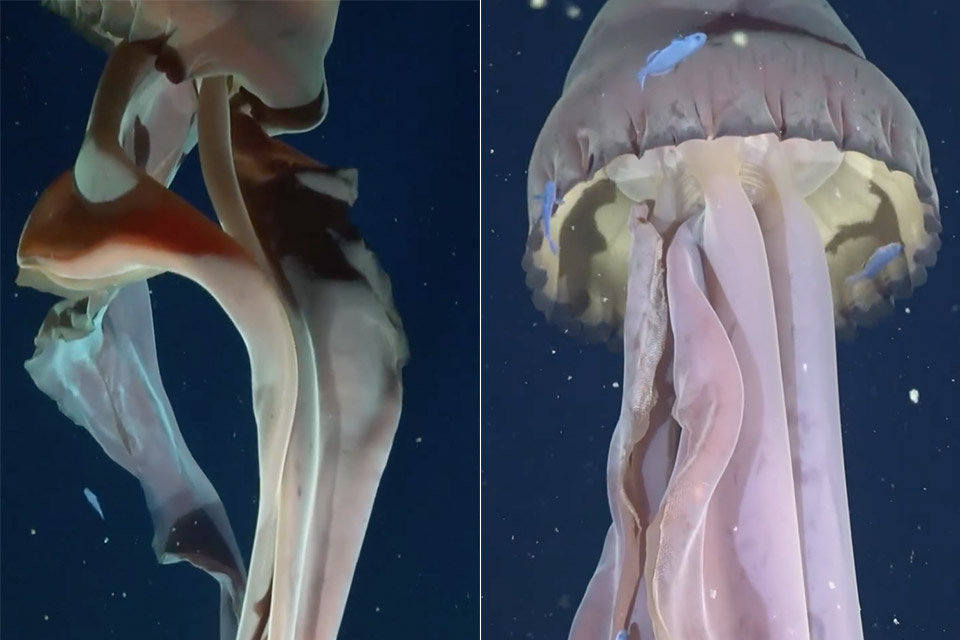
During a recent expedition, Schmidt Ocean Institute researchers captured fantastic footage of a rare giant phantom jellyfish. But they had to put in the time: the remote-controlled vehicle, which was exploring the Colorado-Rawson submarine canyon off the coast of Argentina, didn’t detect the species until it was 830 feet down. Even so, it was only because the ROV illuminated its translucent bell as it slowly drifted down into the depths.
Since its discovery in 1899, this species, Stygiomedusa gigantea, has only been documented roughly 120 times, making it extremely rare. The limited video recordings they have are sparsely distributed, with only a handful since the latest one arrived. They occasionally catch a sight of this creature as it wanders across the deep ocean.

- Essential Combo With Streamlined Accessories - The most cost-effective option for DJI Osmo Action 5 Pro featuring only core features. Great for quick...
- Pro-Grade Night & Dynamic Imaging - Discover breathtaking imaging quality with DJI action camera 4K and its all-new 1/1.3" sensor. Advanced tech with...
- Always Centered, Always Focused - Achieve pinpoint accuracy with our advanced 4nm chip. DJI Osmo Action 5 Pro keeps fast-moving subjects perfectly...
When a giant phantom jellyfish reaches adulthood, it has an umbrella-shaped bell that is approximately three feet across. That bell has four arms, and some of the larger ones can reach 33 feet in length. And they’re not just any arms; they’re paddle-shaped, with a large base and tapering ends.
At first sight, this jellyfish may appear to be just another one, but it is actually quite special. Unlike most jellyfish, this one lacks stinging tentacles. Instead, those gigantic arms are all it requires to capture its prey. They sweep through the water, catching plankton, small fish, and whatever else is floating around, and then putting it all into the jelly’s mouth. The method it swallows is also really fascinating; the bell can inflate to several times its regular size to swallow larger chunks. Furthermore, it can change colour depending on the light; while it’s close to the surface, it’s all reddish-orange, but as you go deeper, it gets closer to black, which is a fairly useful skill for a creature that lives in the dark.
With the exception of the Arctic, these jellyfish can be found in practically every ocean. They have been spotted at depths ranging from the surface to 21,000 feet. However, they are most commonly seen in the twilight and midnight zones, where sunlight is scarce. Most species wouldn’t be able to withstand the severe pressure down there, but the jellyfish is just a bunch of soft material and can manage it easily. Because it has no cover, smaller species will occasionally utilize it as a hiding; you’ll find fish floating inside or swimming through the arms in search of food or temporary refuge.
[Source]