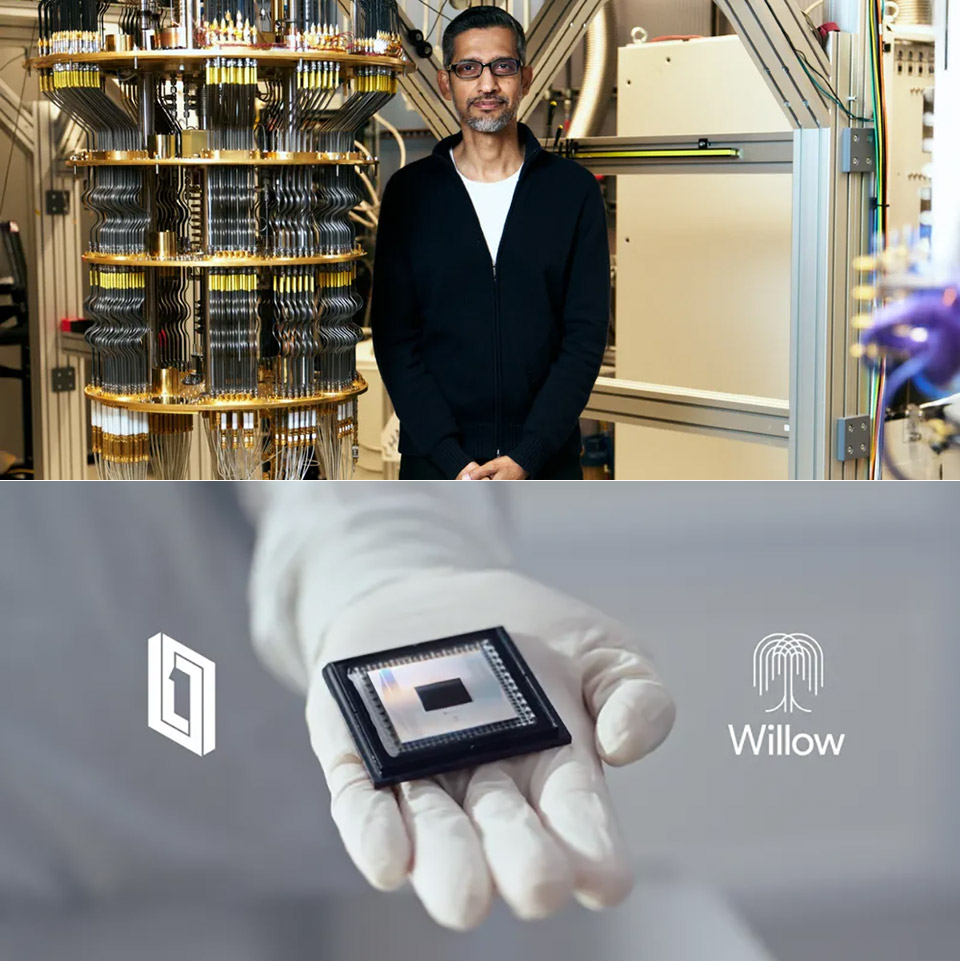
Google’s latest foray into quantum tech feels like one of those rare times when science fiction becomes science fact. Their Willow chip just did a calculation so complex and fast that the world’s biggest supercomputers are gasping for air. We’re talking 13,000 times faster than the Frontier machine, one of the world’s most powerful. And here’s the kicker: anyone with a comparable quantum setup can repeat the calculation and get the same result.
Willow, which was announced last year, is worth a closer look. This 105-qubit beast was known for taming the chaos that plagued quantum gear. Errors used to slip in like unwanted guests, delaying calculations before they even started. Willow flips the script with super sharp mistake correction and lightning fast operations. Imagine a chip where qubits, or finicky quantum bits, hold their patterns long enough to weave complex patterns without unraveling. Google’s researchers used 65 of those qubits, stacking random operations forward and backward twice. A short nudge to a few qubits before each reversal generates interference waves that classical machines can’t reproduce without years of grinding.

- SUPER SLIM. SUPER LIGHT: Galaxy S25 Edge is surprisingly light and our slimmest S Series phone yet. You’ll want to show off this sleek, super-slim...
- OUR POWERFUL 200MP CAMERA ON OUR SLIMMEST S SERIES PHONE: Capture every memory in stunning clarity with our highest-resolution camera on a Galaxy...
- MORE POWER TO YOU: Reimagine what’s possible with Galaxy S25 Edge, featuring our most powerful processor yet. Effortlessly translate your calls...
At the heart of this maelstrom is the Quantum Echoes algorithm, which analyzes chaos in ways that resonate across the system’s fabric. Start by sending a sharp, intentional signal through the qubits. Just enough to shake things up and startle one qubit. Then rewind the whole process, allowing the disturbance to come back as an echo. Those returning waves don’t just dissipate; they accumulate through interference, turning faint whispers into loud noises. This allows the chip to track how small pokes become system wide changes, revealing details from chemical reactions to the swirling in black holes.
On Willow, the whole run takes days. On Frontier, you’re looking at 150 years of nonstop processing, which is enough time to rethink your life choices multiple times. Experts like Aram Harrow from MIT say it’s a hard problem for classical machines to solve, requiring not just brute force but also clever shortcuts that haven’t been found yet. Scott Aaronson from the University of Texas chimes in, calling this verifiable edge one of the field’s toughest problems.
Google didn’t stop with theoretical testing. They partnered with academics at UC Berkeley to see how their Quantum Echoes would work on real molecules, starting with a 15-atom chain and going up to 28. They built a molecular measuring tape using nuclear magnetic resonance data from MRI scans. Traditional instruments have limitations, especially when it comes to measuring how close atoms are; they miss some details. But Quantum Echoes breaks those limits: it pulls out the extra subtleties that regular tests miss. And what was cool was that its results matched the lab results from NMR, but this time it also picked up on some extra stuff that pointed to new findings.
Verifying answers has always been the quiet unsung hero of the quantum world. Many previous quantum achievements had a catch: their proofs got harder as they scaled up. Willow avoids all that. Just run the echo twice forward and back, tweak the qubits slightly, and then measure the interference – and you’ll get a signal that will echo back to any other machine that tries to do the same test.
[Source]