

NASA / ESA’s Hubble Space Telescope captured an image of a densely packed irregular galaxy, classified as ESO 245-5, with seemingly no structure. We can see that the cloud is densest along a broad, curved band across the center of the image, colored a faint blue with glowing purplish patches, while the stars grow more dense out to the edges.
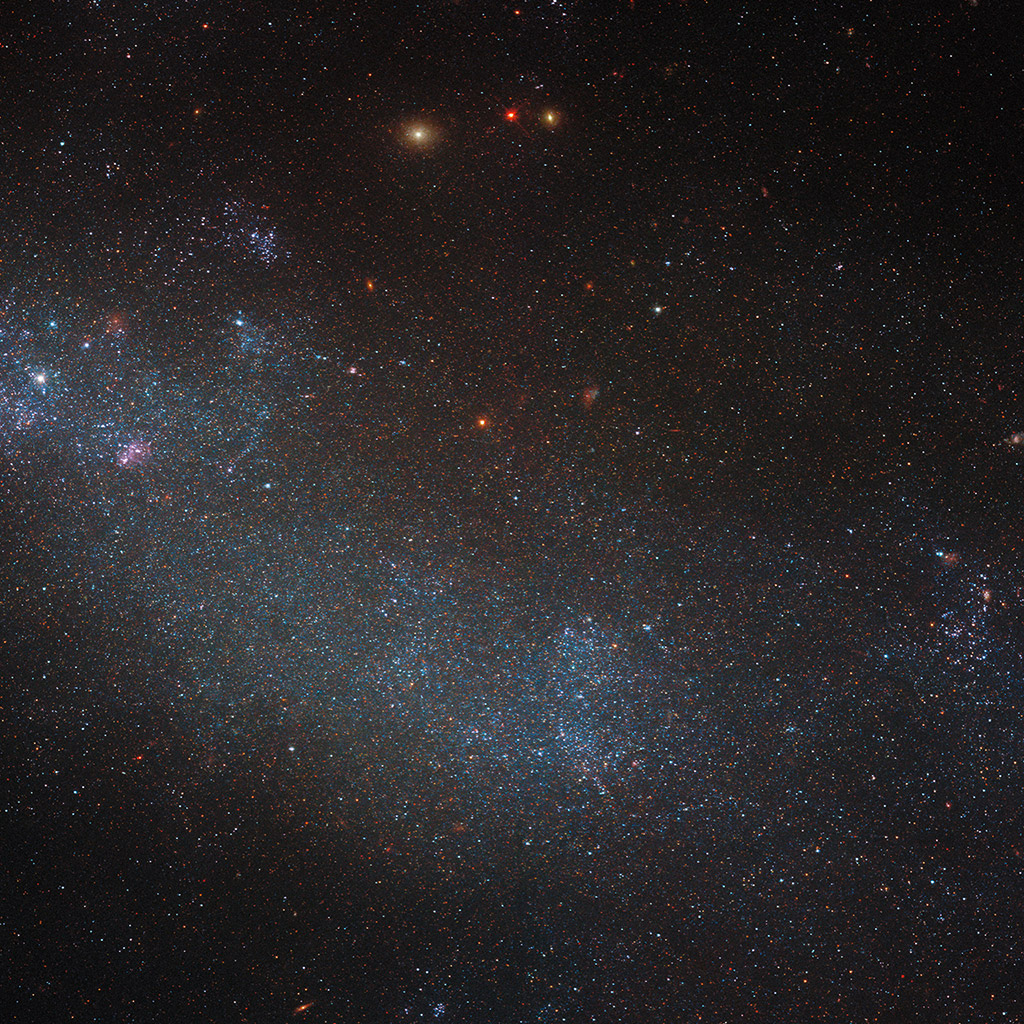
It’s located 15 million light-years from Earth in the constellation Phoenix and known as an IB(s)m type galaxy under the De Vaucouleurs system. what does IB(s)m mean? It can be interpreted as irregular (I), barred (B), has a slight spiral structure ((s)), and is of the Magellanic type (m).

- LEGO NASA Space Set - This adult LEGO set features the Space Shuttle Discovery and the Hubble Space Telescope from NASA’s 1990 STS-31 mission...
- Solar System Exploration - Unlock the mysteries of our solar system with this engaging 2,354-piece project, packed with authentic details and...
- Shuttle Features Galore - The space shuttle model has an opening payload bay, retractable landing gear, opening cockpit, moving elevons, space arm...
Irregular in this context is quite intuitive: the galaxy does not appear to have a regular, ordered structure. In fact, essentially the entire view here is covered by the stars of this galaxy. The second term means that the galaxy has a barred shape at its centre: this is the dense stretch of stars that crosses through the centre of this image. The third term says that there are hints of a spiral structure, but nothing clear or definitive. Finally, the last term indicates ESO 245-5’s similarity to the Magellanic clouds, the two dwarf galaxies that are close neighbours of the Milky Way,” said the European Space Agency.
[Source]


