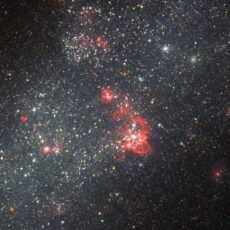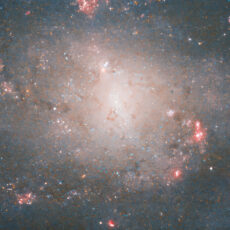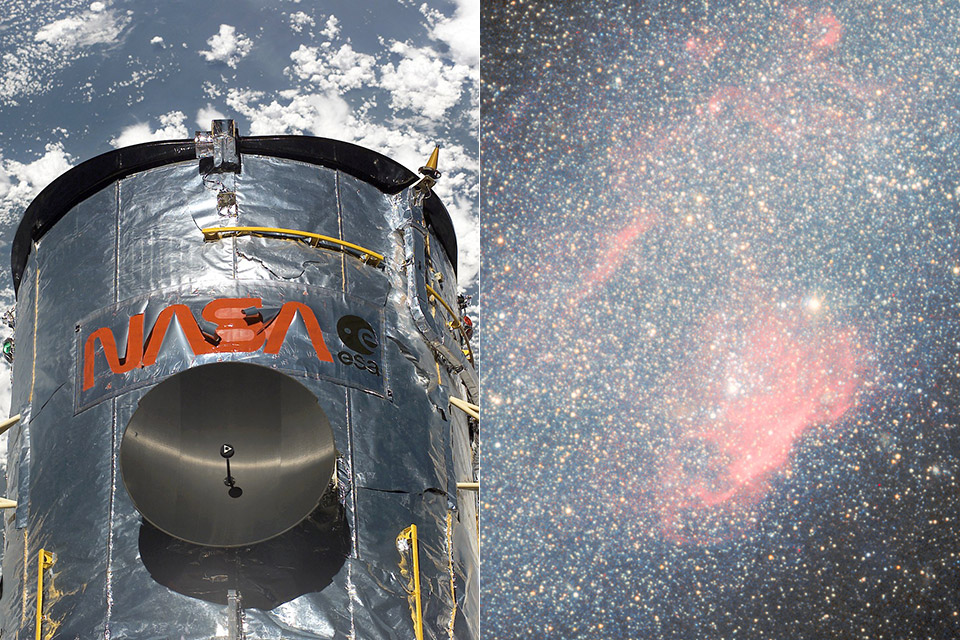
Markarian 178 lingers quietly in the constellation Ursa Major, a mere 13 million light years from our own home planet earth. As a blue compact dwarf galaxy, it’s around 5,700 light-years wide, small in comparison to the Milky Way’s vast expanse. Astronomers first noticed it in the 1960s and 1970s for its extremely bright ultraviolet glow, which Benjamin Markarian “collected” in his catalog. There are actually over 1,500 Markarian galaxies, each of which shines in ultraviolet due to the high energy processes that occur within them.
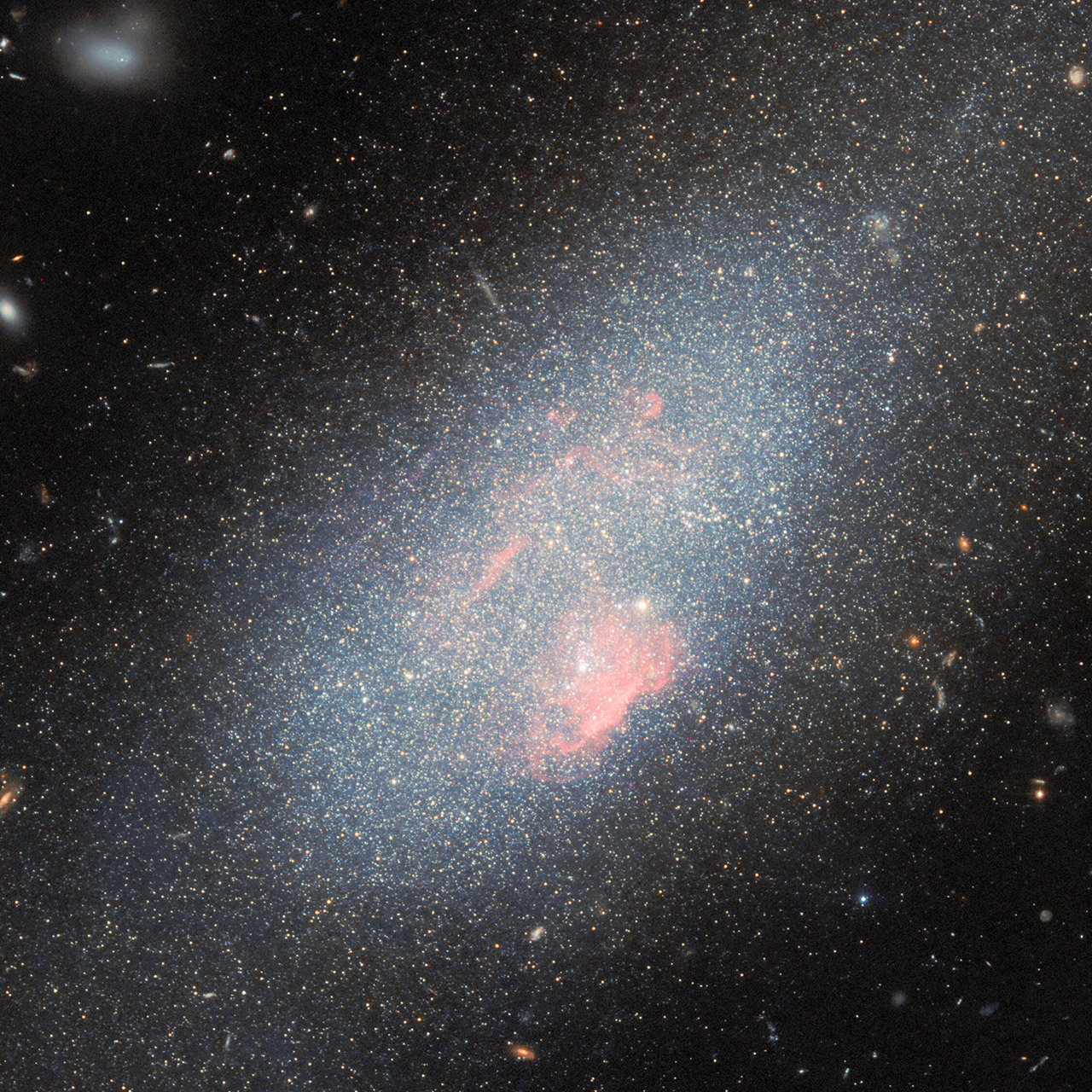
Hubble has captured some magnificent images of this galaxy, revealing a hazy blue cloud against the vastness of space. The image is dominated by young, blazing stars, which give the galaxy an azure glow. With little dust in the way, the photos are crystal clear, revealing the entire calamity for what it is: an interplanetary freakout. But look closely, and you’ll see a scarlet band on the edge, as well as a bevy of massive stars that create a lovely warm contrast to the cool blues. It just so happens that within that red zone are certain Wolf-Rayet stars, rare giants whose outer layers are being blown off by these powerful winds. These stars burn brightly and quickly, lasting only a few million years before collapsing spectacularly into black holes or neutron stars. In their aftermath, the winds ionize the surrounding hydrogen and oxygen, resulting in dazzling emission lines that Hubble detects in red using those expensive filters. Markarian 178 contains an abnormally high number of these stars, indicating a recent boom in star creation.

- Powerful Optical Performance: This telescope features a 90mm aperture and 700mm focal length refractor design for superior optical performance,...
- Precise Adjustment: The Vertisteel AZ mounting base allows for precise positioning and free stopping of the non-polar axis - the follow and stop...
- Convenient Accessories: With a wireless remote control and cell phone adapter, it's easy to capture stunning images of the universe. The included...
Geologically speaking, star creation exploded not long ago. Based on the evidence, it was most likely caused by close contact with a tiny sister galaxy. The Large Binocular Telescope (LBTO) discovered some tidal tails, or streams of material that were dragged away by gravity during the collision. Mergers like this one compress gas clouds, resulting in the formation of new stars in a burst that spreads throughout the galaxy. Markarian 178 has an extremely low metal content, as in it has far fewer heavy elements than our sun. This gives the galaxy the appearance of an echo from the early cosmos, a living laboratory where we can study how galaxies evolved billions of years ago. And the best thing is that this is exactly how blue compact dwarfs like this one form: a gas-rich runt is shook up by a merger and transforms into a temporary star factory.
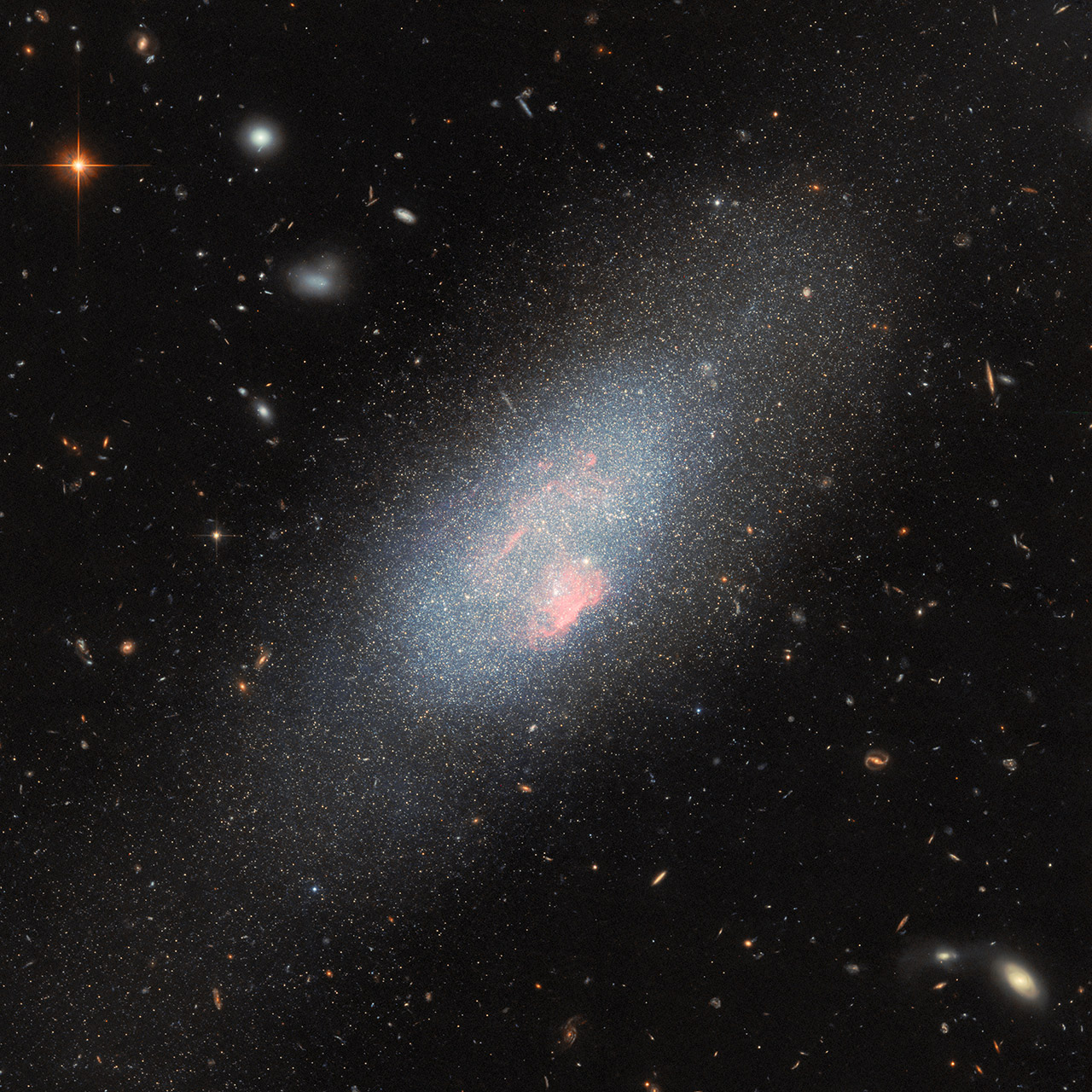
Out in the distance, you can see various other galaxies simply hanging out. Markarian 178 has a catalog number (UGC 6541 or LEDA 35684, if you want to get technical), but it’s a prime target for those trying to solve the universe’s mysteries. Because of its compact form and highly active core, it has a lot to tell us about the evolution and renewal of the universe. Scientists are still researching its spectra to extract every last bit of information possible, and the patterns of the Wolf-Rayet wind emission lines are critical to determining the masses and ages of the stars.