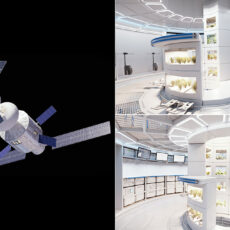

Putting a data center (or several) in low Earth orbit (LEO) might actually make sense because space offers near-constant access to solar power, especially in certain orbits, slashing energy costs and carbon footprints compared to terrestrial data centers that rely on fossil fuels or strained grids.
Space’s vacuum and chilly temperatures let things cool off naturally, so you don’t need the power-hungry cooling systems we use on Earth. Handling data up in orbit—right near the satellites collecting it—cuts down on transmission delays to ground stations, enabling faster insights. Plus, in-orbit data centers allow for theoretical unlimited expansion of server capacity without urban sprawl or environmental impact.

- Powered by the processor:kamrui mini pc witd 4 cores, 8 threads, 4MB L3 cache, up to 3.7GHz turbo frequency, It achieves 35% higher performance than...
- High-Speed Memory and Storage: KAMRUI E1 mini computers is equipped with 8GB DDR4 RAM paired . To unlock its full performance, the memory can be...
- Dual 4K@60Hz Display:This mini PC drives two independent 4K@60Hz displays, delivering sharp, vibrant visuals for work or entertainment. Extended...
A Washington-based startup called Starcloud wants to send up a satellite-based data center in May, with commercial operation starting by mid-2026. This fits their plan to use cheaper rocket trips for space computing. Their test satellite will carry high-performance GPUs for tough AI workloads, checking if things like machine learning can work well in orbit. Their big plan relies a lot on reusable rockets, like SpaceX’s Starship, to make lots of launches affordable. If Starship works out, they might build huge, megawatt-sized data centers in space by the late 2020s.

As autonomous maintenance systems improve, these orbital data hubs have potential to become a cost-effective, carbon-neutral alternative to terrestrial data centers. By 2035, gigawatt-scale computing clusters in low Earth orbit (LEO) and cislunar space are expected to enable seamless, ultra-secure data processing, revolutionizing industries from telecommunications to deep-space exploration,” according to a paper by Research and Markets.