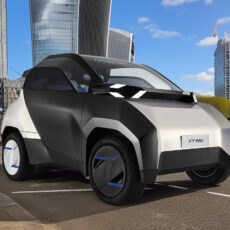

Inventor James Bruton is known for his big builds and this one is a doozy: a miniature electric car steered by the movement of his face. He used the new Arduino UNO Q, a single board computer with a microprocessor, to create a vehicle that combines cutting edge tech and hands on engineering.
The frame is made of fiberglass tubes, chosen over carbon fiber for their strength and price. The tubes form a modular chassis that is held together with 3D printed clamps made of Polymax PLA, while bolts and lock nuts allow it to be taken apart for shipping. Two brushless motors drive the rear wheels via belt driven gear reductions, enough to support Bruton’s weight. The front wheels are on stub axles with bearings and connected to an electric steering system powered by two DC gearmotors.

- LEGO FERRARI MODEL CAR KIT – Builders ages 10+ can create the legendary Technic Ferrari FXX K with authentic details and working mechanical features
- AUTHENTIC RACE CAR DETAILS – This supercar building set features working butterfly doors, opening hood, and an engine cover that reveals the...
- CAR MODEL KIT – Young engineers explore real automotive concepts with this educational learning toy as they build the working differential and watch...
The Arduino UNO Q, a board that combines real time control of a microcontroller with the computing power of a single board computer running Debian Linux is the heart of the project. This dual brain setup allows the board to handle both hardware control and complex tasks such as AI processing. Bruton used the microcontroller side to control the motors just like he would with a standard Arduino Mega. The Linux side ran an Edge Impulse AI model to detect his face in a video feed from a USB webcam attached to a flexible stalk. When Bruton leans left or right the AI detects the movement and sends steering directions to the microcontroller which spins the wheels accordingly.

It’s impressive how well the two halves of the Arduino UNO Q work together. Arduino’s App Lab allows you to merge Arduino code with Python or HTML. Bruton used a pre-built face tracking model from the “bricks” framework which provides makers with modular code blocks for AI. He rejected faces smaller than 100 pixels to remove the background and allow the car to be controlled only by his movements. Although the face tracking is limited to 3-4 frames per second the output is intuitive.

Bruton 3D printed a custom wheel hub that just clips onto flexible TPU90 tyres – the perfect combination for good grip without any slippage worries. The pulleys that connect the brushless motors to the rear axles via belts required the precision of a 0.5mm nozzle. They are held in position by sliding motor mounts that precisely tension the belts. The steering system was inspired by a brilliant bit of engineering known as Ackermann geometry; it consists of a central gear that pivots the front wheels around, and a lever system ensures that the inside wheel turns sharper than the outside, allowing the car to hug the corner every time. The car gets its power from a 6S 24-volt LiPo battery, which is handled by this sophisticated 500-amp contactor. It also includes skateboard ESCs and an emergency stop.

Taking the car to Turin was an adventure in itself. To make it transportable, Bruton constructed the chassis to break down into boxes, which he subsequently delivered to the National Motor Museum. Everything arrived in one piece – good work, Bruton – and he just reassembled and fine-tuned it on-site. They initially used a joystick to calibrate the steering, but from then on it was all webcam and face-tracking – a brilliant idea. At the event, he just drove the car through a crowd of 200 to 300 people who were all too preoccupied by their phones – and he masterfully steered it around the lot using the face-tracking system and his own natural leaning to keep the car on course. They even connected an Arduino Uno Q to the system, allowing Bruton to monitor the face-tracking interface on his laptop using some Wi-Fi tricks.
Source]