
NASA’s James Webb Space Telescope has released a stunning image of the Cat’s Paw Nebula (NGC 6334) to mark its third year of amazing discoveries.
Dive into this part of the Cat’s Paw and it’s like watching a cosmic dance of starlight, dust and gas. The bright blue-white stars are scattered across the landscape, some perhaps born within this nebula’s grand cradle itself. “Webb’s view of this corner of the Cat’s Paw Nebula is just a sampling of the telescope’s three years of game-changing science,” says Shawn Domagal-Goldman, acting director of NASA’s Astrophysics Division.

LEGO Icons NASA Space Shuttle Discovery Building Sets for Adults - Model Kits for Bookshelf or Office...
- LEGO NASA Space Set - This adult LEGO set features the Space Shuttle Discovery and the Hubble Space Telescope from NASA’s 1990 STS-31 mission...
- Solar System Exploration - Unlock the mysteries of our solar system with this engaging 2,354-piece project, packed with authentic details and...
- Shuttle Features Galore - The space shuttle model has an opening payload bay, retractable landing gear, opening cockpit, moving elevons, space arm...
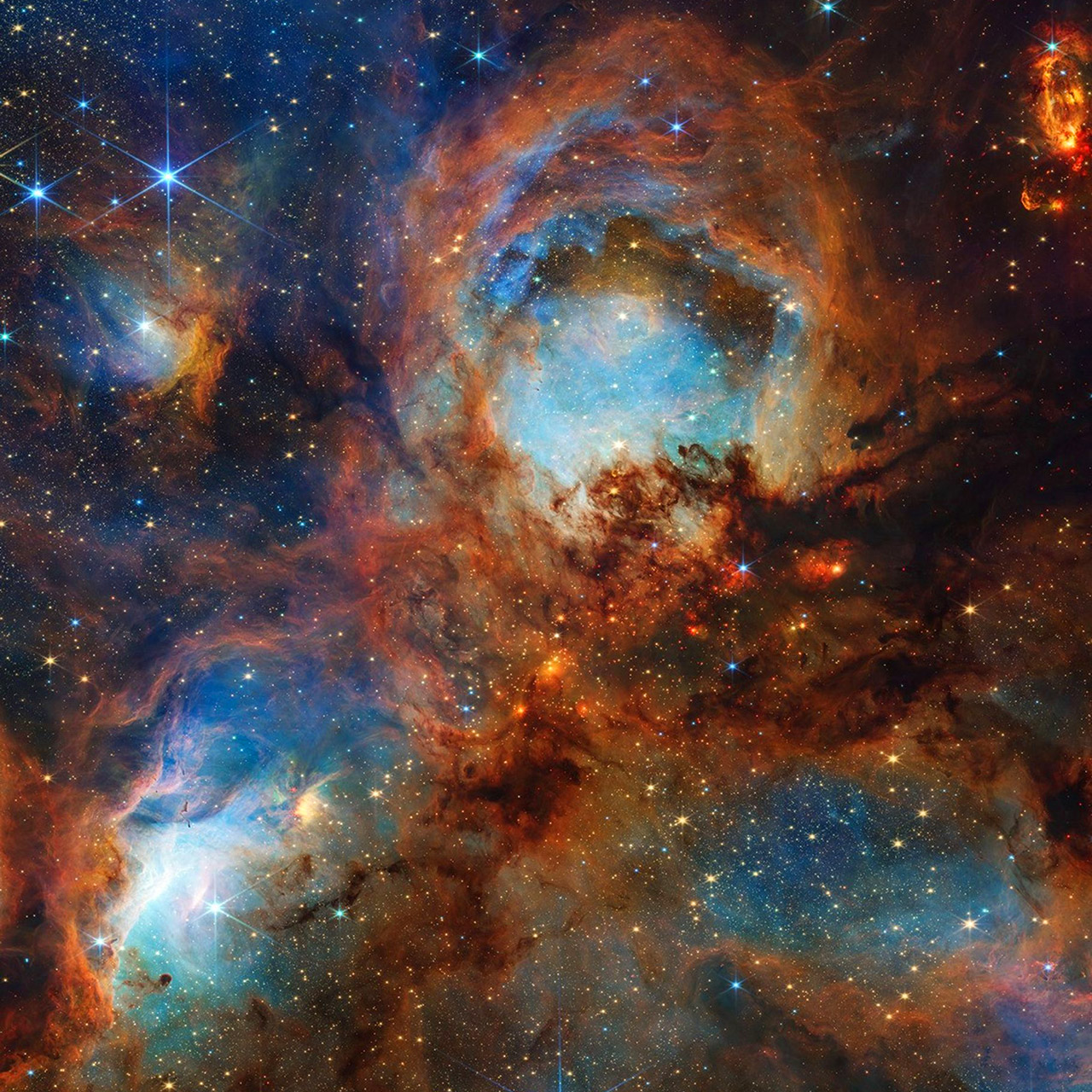
What’s special about this image is it’s radiance in the near-infrared, captured with Webb’s NIRCam (Near-Infrared Camera). Infrared can pass through cosmic dust to reveal hidden details. “From a giant cloud to huge stars is a series of steps, some we still don’t fully understand,” NASA says.
NASA’s tour takes you flying by tiny yellow stars into the lower left “toe bean” of the nebula where dust and gas surrounds a large, glowing empty space. Then you’re off to the Opera House, its tiered structure looking like a galactic theater. Celebrating Webb’s third year since starting science in July 2022, this image is a testament to a telescope that has rewritten the astronomy rulebook, with over 860 programs, 550 terabytes of data and 1,600+ papers. Its infrared eyes have uncovered secrets from the early galaxies of the universe to the atmospheres of far-off exoplanets.
Webb’s impact goes far beyond this one image. Its goal is to pave the way for future missions, like NASA’s nearly done Nancy Grace Roman Space Telescope, which will study dark matter, and the Habitable Worlds Observatory, looking for life on planets like Earth. “Webb continues to break its own records and uncover new mysteries for future missions to solve,” Domagal-Goldman says.