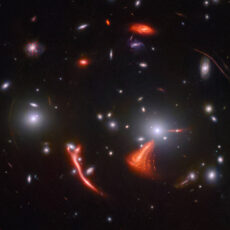
While not as intriguing as this galactic question mark, NASA’s James Webb Space Telescope did observe a tiny free-floating brown dwarf in star cluster IC438. This cluster is relatively young at just 5-million-years-old and located approximately 1,000 light-years away in the Perseus star-forming region.

Brown dwarfs are essentially celestial objects that form like stars and grow dense enough to collapse under their own gravity, but never become dense or hot enough to begin fusing hydrogen. To detect the brown dwarf candidates, the team first imaged the center of IC438 using Webb’s NIRCam (Near-Infrared Camera) and then followed up on the most promising targets using Webb’s NIRSpec (Near-Infrared Spectrograph) microshutter array. They found three brown dwarf candidates, with the smallest weighing just three to four times Jupiter. What really surprised the researchers was that two of the brown dwarfs identified show the spectral signature of an unidentified hydrocarbon, which is basically a molecule containing both hydrogen and carbon atoms.

- BRIGHT, SHARP VIEWS ANYWHERE: Unlike many beginner telescopes, this quality refractor features fully coated glass lenses and a 70mm aperture for...
- PERFECT FIRST TELESCOPE FOR BEGINNERS: Designed for adults and kids to enjoy together, this beginner-friendly telescope sets up in minutes and...
- EASY NO-TOOL SETUP: No complicated assembly or tools needed. The full-height tripod and telescope tube set up in seconds and pack neatly into the...

This is the first time we’ve detected this molecule in the atmosphere of an object outside our solar system. Models for brown dwarf atmospheres don’t predict its existence. We’re looking at objects with younger ages and lower masses than we ever have before, and we’re seeing something new and unexpected,” said Catarina Alves de Oliveira of the European Space Agency.
[Source]