NASA’s James Webb Space Telescope has pulled off a spooky gift for Halloween . A star is on its last legs in the constellation Sagittarius – thousands of light years away. Stars like our Sun follow a rather predictable path. They burn hydrogen for billions of years before eventually running out of steam. As the outer layers expand, the center begins to contract.
The star then starts to swell up into a red giant, and its surface expands way out. Before you know it, gravity just can’t cope, and the outer shell starts to break away. What’s left behind is a scorching hot core which then showers the material it’s chucked out with all sorts of ultra-violet light. That material gets ignited and produces a beautiful planetary nebula. One of which is NGC 6537, also known as the Red Spider Nebula, and right now it’s at this stage. But the whole show doesn’t last all that long – just a few tens of thousands of years. Which in cosmic terms is just a split second.

- Superior Optics: 400mm(f/5.7) focal length and 70mm aperture, fully coated optics glass lens with high transmission coatings creates stunning images...
- Magnification: Come with two replaceable eyepieces and one 3x Barlow lens.3x Barlow lens trebles the magnifying power of each eyepiece. 5x24 finder...
- Wireless Remote: This refractor telescope includes one smart phone adapter and one Wireless camera remote to explore the nature of the world easily...
The infrared sensor on Webb can see things that visible light cannot, therefore the Hubble images you’ve seen only show a dim blue star in the middle. But Webb notices the true color of the place: a gorgeous red glow shining through the hot dust. And it appears that the dust forms a disk around the star, trapping heat and shaping the outflow. For the first time Webb’s been able to map the length of the whole nebula and its lobs. Each one is a whopping 3 light years long and chock full of molecular hydrogen (which in this case is two hydrogen atoms joined up). That gas creates these tiny bubbles which then inflate over hundreds of years after the star has gone.
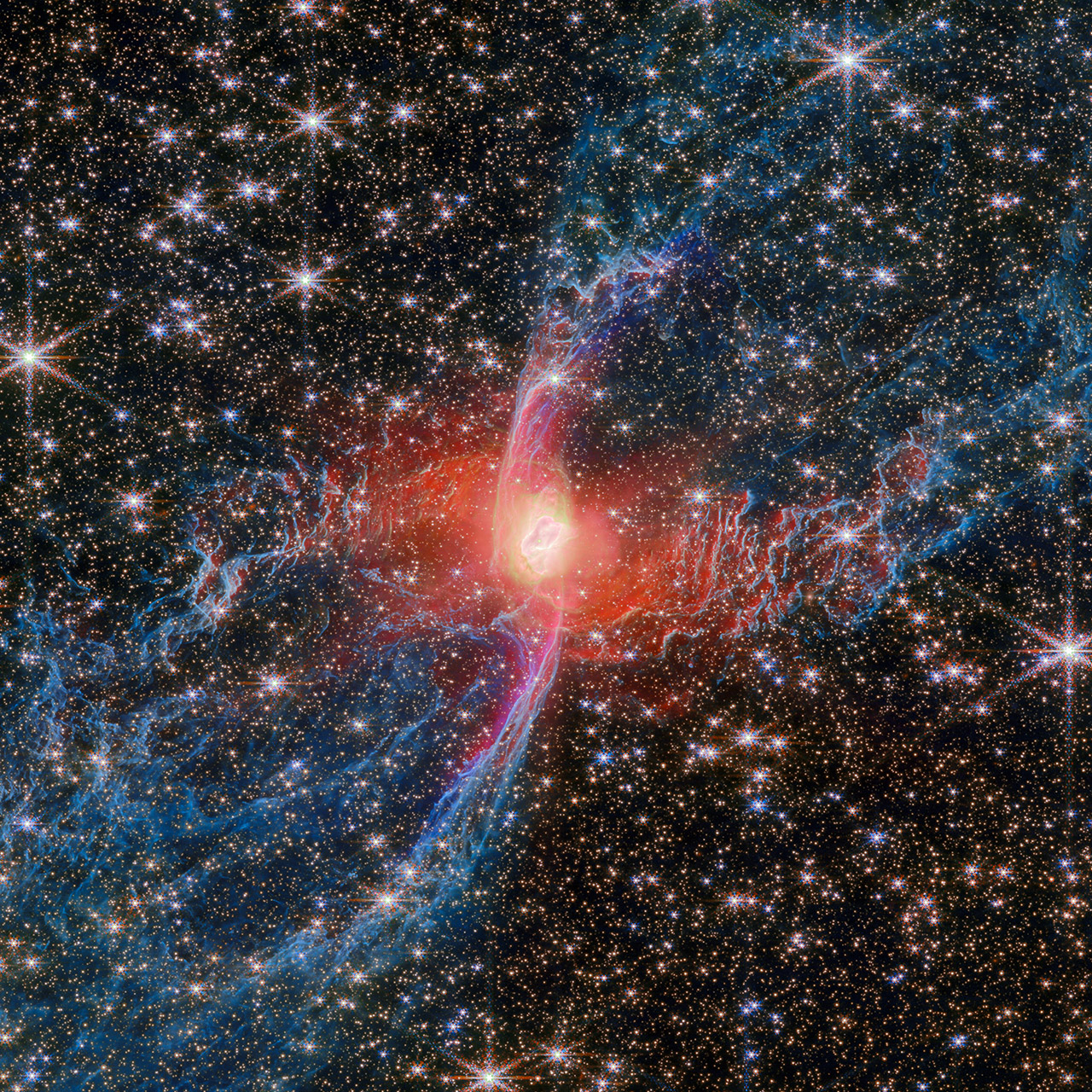
The nebula itself is a thin waist pinched in the middle with broad lobes on either side. Which in itself is a pretty interesting shape – its starts to look a bit like an hourglass – and the implication is that there might be a second star in there somewhere. Now, the photos don’t show a second star – but there could be one hidden away in the dust. And if there is it could explain why the nebula has such a symmetrical shape. Sometimes when we see these kind of hourglasses in planetary nebulas there is actually a pair of stars – and that gravity from the companion star can sculpt the material that the dying star has chucked out into just the right shape. If there is a second star here it is hidden away in a cloud of dust – and you can only sense its existence by looking at the curves of the nebula.
Fast moving jets are shooting out of the center, leaving a purple S-shaped trail. The jets are carrying ionized iron which is colliding with older gas and creating ripples throughout the structure. Each collision is carving new features into the surface of the nebula. That’s how the waves and knots in the image are made. In five billion years, our Sun will run out of hydrogen and expand. Mercury and Venus will be devoured by their outer layers. Earth could endure, scorched and barren, orbiting a bloated star. The Sun will then shed its envelope, revealing a white dwarf surrounded by a blazing shell. The image will resemble this nebula, with gas drifting in multicolored arcs around a fading core.
The nebula is a record of change written in light and gas. New stars will form from the scattered material. Carbon, oxygen and nitrogen which were formed in the center of the star will seed the next generation. The white dwarf will cool over billions of years and eventually turn black. For the time being, the Red Spider shines brightly, its legs stretching into the darkness. The telescope is watching and gathering data to help us comprehend star death. Each observation contributes to the understanding of how stars die and what remains behind.