
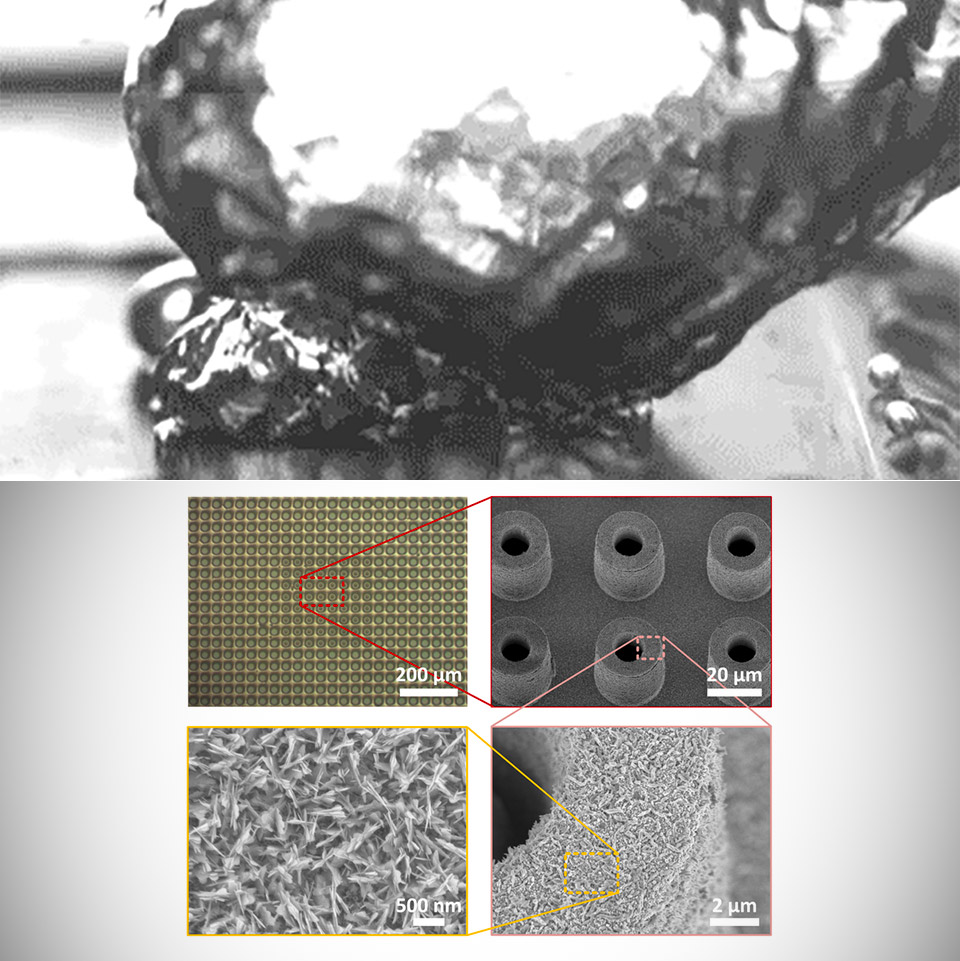

MIT engineers have developed energy efficient surfaces that make water boil quicker using a combination of three different kinds of surface modifications, at different size scales. Heat transfer coefficient (HTC) and the critical heat flux (CHF) are the two main parameters that describe the boiling process. These new surfaces improve upon both of them.
To accomplish this, cavities were made in the centers of a series of pillars on the material’s surface, which when combined with nanostructures, promote wicking of liquid from the base to their tops, thus enhancing the boiling process by providing more surface area exposed to the water. The three “tiers” of the surface texture — the cavity separation, the posts, and the nanoscale texturing — then provide a greatly enhanced efficiency for the boiling process in combination with this. Practical applications include the thermal management of electronic devices, which is very important for semiconductors. If this is a bit too technical for your taste, you can always watch a hydraulic press crush lava.

- YOUR DREAM TUMBLER: Whichever way your day flows, the H2.0 FlowState tumbler keeps you refreshed with fewer refills. Double wall vacuum insulation...
- ADVANCED LID CONSTRUCTION: Whether you prefer small sips or maximum thirst quenching, Stanley has developed an advanced FlowState lid, featuring a...
- EARTH-FRIENDLY DURABILITY: Constructed of 90% recycled BPA free stainless steel for sustainable sipping, the Stanley Quencher H2.0 has the durability...
Both parameters are important, but enhancing both parameters together is kind of tricky because they have intrinsic trade off…because if we have lots of bubbles on the boiling surface, that means boiling is very efficient, but if we have too many bubbles on the surface, they can coalesce together, which can form a vapor film over the boiling surface,” said Youngsup Song, MIT Graduate PhD ’21, Ford Professor of Engineering.


