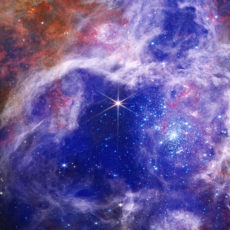
NASA’s Chandra X-Ray Observatory has captured spectacular new images that it observed in light invisible to human eyes, including X-rays, radio and infrared. First up, we have the Galactic Center, located 26,000 light-years from Earth. Chandra’s instruments are able to differentiate between the orange, green, blue and purple colors from the superheated clouds of gas.
Kepler’s Supernova Remnant

What you’re looking at here is the remnants of a white dwarf after undergoing a thermonuclear explosion. Chandra managed to capture the powerful blast wave in blue that ripped through space after it exploded, while infrared data (red) from NASA’s Spitzer as well as Hubble (cyan and yellow) showcase the debris.

- Feed a passion for science and technology – Kids can learn more about the challenges of space exploration with this LEGO Technic NASA Mars Rover...
- Conduct a test flight – This advanced building kit for kids ages 10 and up includes a buildable toy version of NASA’s Ingenuity helicopter, which...
- AR brings the mission to life – The accompanying augmented reality app experience lets kids dive into the details of the rover and its mission
ESO 137-001

ESO 137-001 is a galaxy that is moving through space at 1.5 million miles per hour, leaving two tails in its wake. These tails are made of superheated gas that Chandra detects in X-rays (blue). ESO’s Very Large Telescope (VLT) depicts the light from hydrogen atoms in red, along with optical and infrared data from the Hubble Space Telescope (orange and cyan).
NGC 1365

Similar to our own Milky Way, the center of spiral galaxy NGC 1365 contains a supermassive black hole that is being fed by a steady stream of material. Chandra’s X-ray image (purple) captured hot gas that will eventually be pulled back into the black hole. This image has been combined with data from the James Webb Space Telescope (red, green, and blue).
Vela Pulsar

Chandra’s data (purle) has been combined with information from NASA’s Imaging X-ray Polarimetry Explorer (light blue) as well as the Hubble Space Telescope (yellow) to provide astronomers with an unprecedented view of Vela, the aftermath of a star that collapsed and then exploded.