
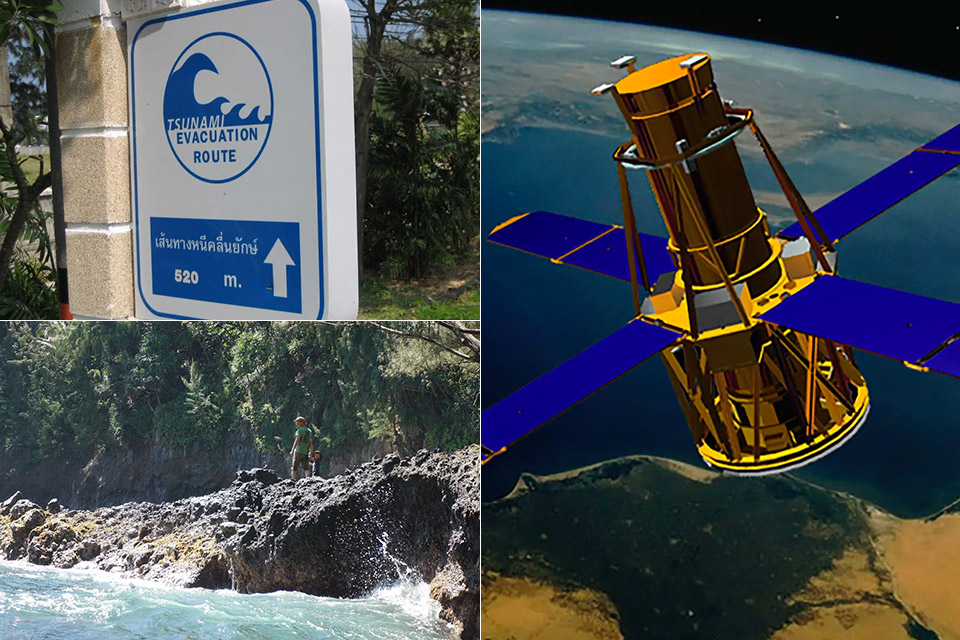
NASA’s GUARDIAN (GNSS Upper Atmospheric Real-Time Disaster Information and Alert Network) can detect tsunamis by how they rumble in the atmosphere by using GPS signals over the Pacific Ring of Fire. The ultimate goal is to complement early warning systems and use them as potentially a lifesaving alarm bell.
How does it work? It taps into data from clusters of GPS and other wayfinding satellites orbiting Earth, also known as global navigational satellite systems (GNSS). Their radio signals are transmitted to hundreds of scientific ground stations around the world and then processed by JPL’s Global Differential GPS (GDGPS) network. GUARDIAN analyzes these signals for clues that a tsunami is occurring somewhere around the globe. It can do this because when a tsunami happens, many square miles of the ocean surface can rise and fall nearly in unison, displacing a significant amount of air above it. This displaced air ripples in all directions in the form of low-frequency sound and gravity waves, both of which reach the ionosphere in minutes.

- BRIGHT, SHARP VIEWS ANYWHERE: Unlike many beginner telescopes, this quality refractor features fully coated glass lenses and a 70mm aperture for...
- PERFECT FIRST TELESCOPE FOR BEGINNERS: Designed for adults and kids to enjoy together, this beginner-friendly telescope sets up in minutes and...
- EASY NO-TOOL SETUP: No complicated assembly or tools needed. The full-height tripod and telescope tube set up in seconds and pack neatly into the...

When there is a large earthquake near the ocean, we want to quickly know the magnitude and characteristics of the earthquake to understand the likelihood that a tsunami will be generated, and we want to know if a tsunami was indeed generated. Today there are two ways to know if a tsunami was generated before it makes landfall – NOAA’s DART buoys and GNSS-ionosphere observations. There is a limited number of buoys and they are very expensive, so systems like GUARDIAN have the potential to complement current warning systems,” said Gerald Bawden, Program Scientist for Earth’s Surface and Interior at NASA.


