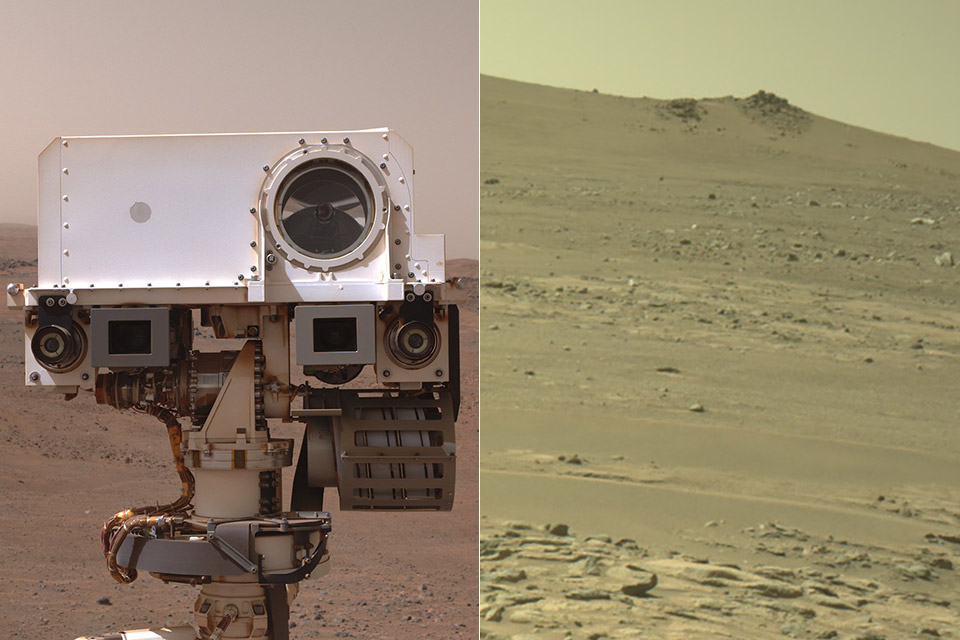
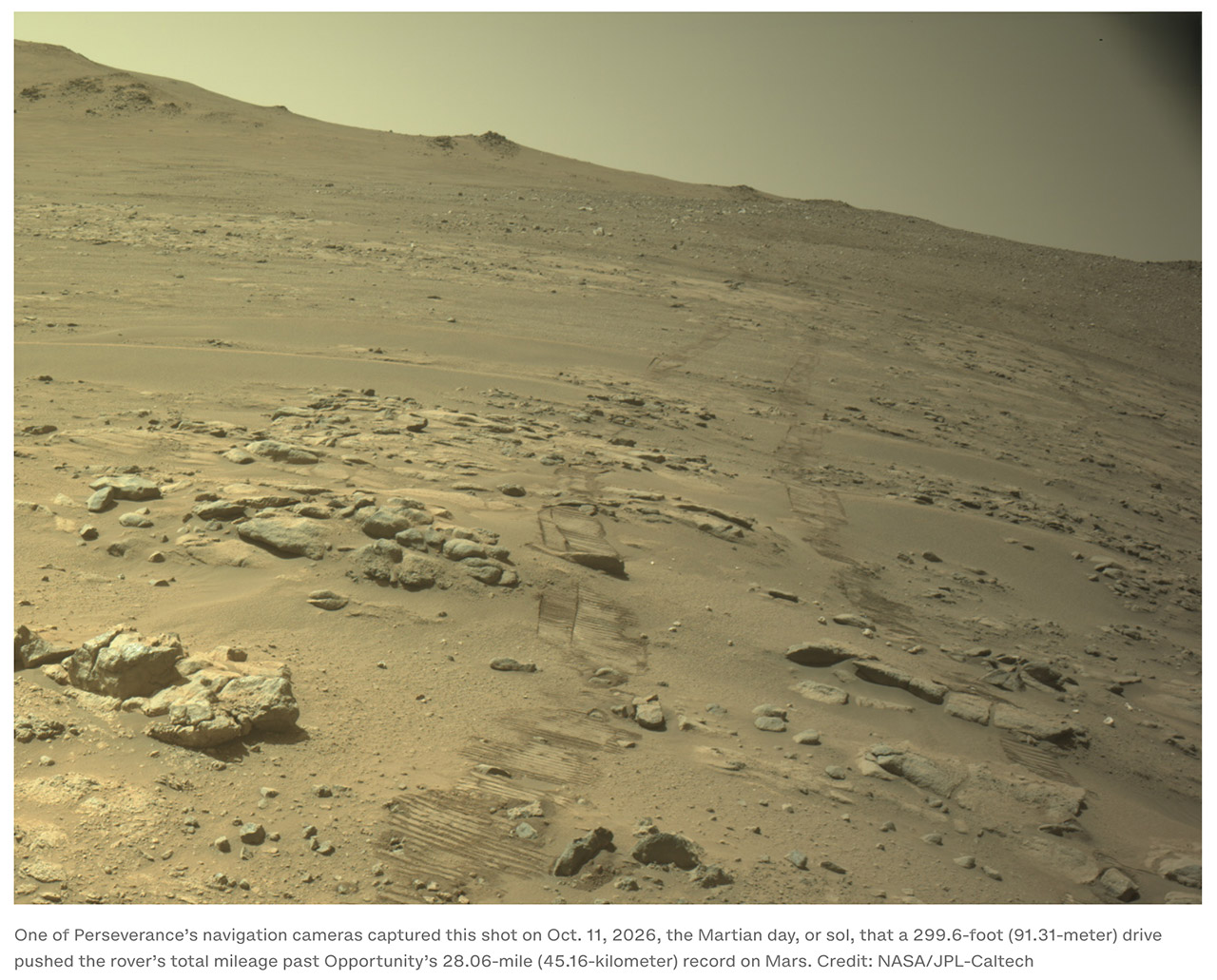
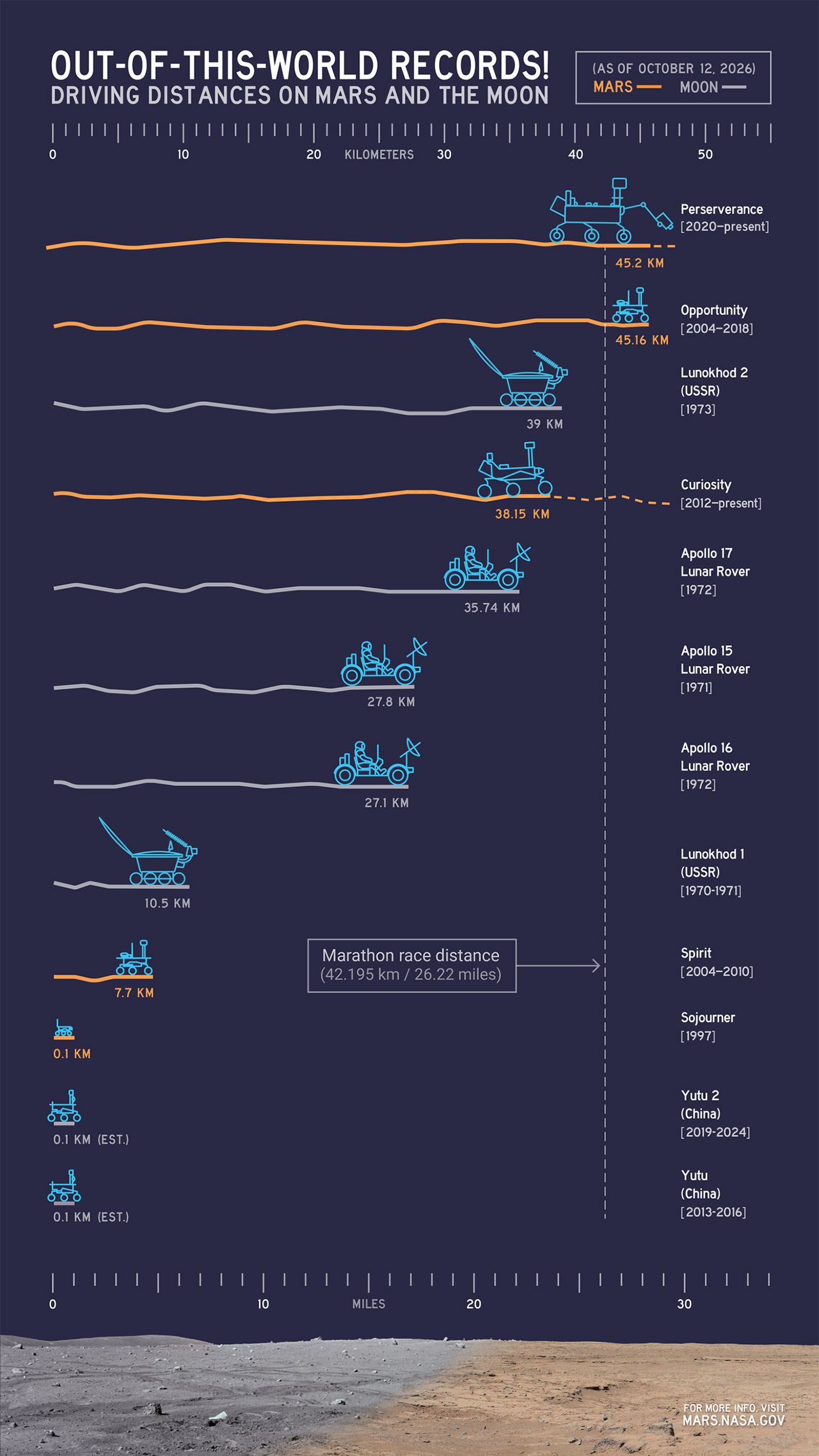
NASA’s Perseverance rover crossed 28.10 miles on the surface of Mars on October 11, 2026. That figure edged past the 28.06 miles logged by the Opportunity rover, which explored the planet from 2004 until 2018. Perseverance reached the mark on its 2,006th Martian day after roughly five and a half years of operations. Opportunity required nearly fifteen years to cover the same ground.
A single 299.6-foot drive pushed the odometer over the previous total. Perseverance is currently en route to Idubi, passing via the Lac de Charmes on the western rim of Jezero Crater. Scientists believe that the rocks there are among the oldest landscape ever observed by a satellite in our solar system. Back on Earth, we lose this stuff due to regular erosion and tectonic plate movement; on Mars, it remains exposed since there are no tectonic plates. The team hopes that this location has preserved evidence of ancient hydrothermal networks that once carried warm water through the crust.

- Feed a passion for science and technology – Kids can learn more about the challenges of space exploration with this LEGO Technic NASA Mars Rover...
- Conduct a test flight – This advanced building kit for kids ages 10 and up includes a buildable toy version of NASA’s Ingenuity helicopter, which...
- AR brings the mission to life – The accompanying augmented reality app experience lets kids dive into the details of the rover and its mission
Perseverance landed at Jezero Crater in February 2021, with initial mission plans indicating that it would not travel more than 12 and a half miles. But the good news is that all mobility systems are still in excellent condition, and ground testing of the hardware indicate that the rover will be able to continue operating for many years. According to project manager Steven Lee, the original limit has already been exceeded, and it is expected that Perseverance will continue to establish new marks. Newer software allows the rover to drive and check its position against those orbital maps with greater ease, and engineers have even explored the prospect of reaching 100 kilometers throughout the motors’ entire lifetime.
Autonomous navigation accounts for more than 90 percent of the distance Perseverance has traveled. As it moves, the system develops a three-dimensional map of risks, which it then uses to plot a path between the waypoints set by the Earth team. Older rovers used to spend a lot of time waiting for an order to come through. Sojourner, the first to employ any type of auto guidance, would look at about twenty measurement points every now and again, whereas Perseverance handles 600,000 in the same amount of time. That allows it to cover up to 1351 feet in a single Martian day when conditions are favorable.
Earlier rovers had lower mileage, which Perseverance has now completely surpassed. In 1997, Sojourner managed roughly 330 feet. Spirit traveled a respectable 4.8 kilometers before stopping in 2010. Curiosity, which is still operating in Gale Crater, has traveled more than 23 and a half kilometers since its landing in 2012. Then there are the early Moon missions, with Apollo 17’s astronauts traveling 22.2 miles on the lunar rover and Lunokhod 2 reaching 24.2 miles. Perseverance has also surpassed both of the
NASA has just approved an extension that will allow Perseverance to continue exploring the crater rim through the end of 2028. After Lac de Charmes, we’ll head to Rainbow Falls, a 328-foot-wide slab of old crust that was lifted when the collision that produced Jezero occurred. Along the way, it collected rock and soil samples from the crater floor, a river delta, and the rim. The distance record is simply one of several measurable milestones for a mission that is accomplishing far more than its original design objectives.
[Source]