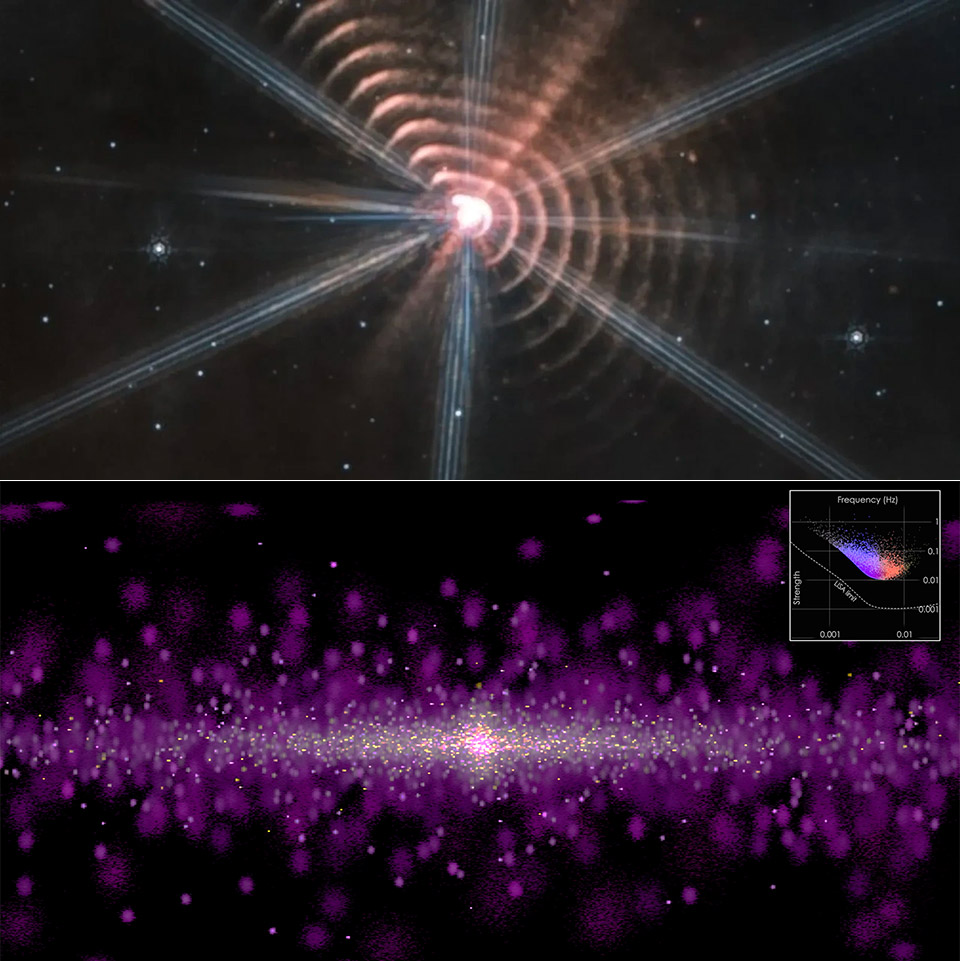
Astronomers at NASA and other agencies used simulated data to show what the sky would look like in gravitational waves, which are cosmic ripples in space-time caused by orbiting objects. Space-based gravitational wave observatories are set to launch in the next decade and will help researchers better understand the Milky Way galaxy.
What you’re looking at in the video are gravitational waves from a simulated population of compact binary systems combined into a synthetic map of the entire sky. These types of systems contain white dwarfs, neutron stars, or black holes in tight orbits. As space-based gravitational wave observatories, like LISA (Laser Interferometer Space Antenna), become active in the next decade, maps like this using real data will be commonplace. The brighter spots you see depict sources with stronger signals and lighter colors indicate those with higher frequencies.

- Feed a passion for science and technology – Kids can learn more about the challenges of space exploration with this LEGO Technic NASA Mars Rover...
- Conduct a test flight – This advanced building kit for kids ages 10 and up includes a buildable toy version of NASA’s Ingenuity helicopter, which...
- AR brings the mission to life – The accompanying augmented reality app experience lets kids dive into the details of the rover and its mission
Binary systems also fill the Milky Way, and we expect many of them to contain compact objects like white dwarfs, neutron stars, and black holes in tight orbits. But we need a space observatory to ‘hear’ them because their gravitational waves hum at frequencies too low for ground-based detectors,” said Cecilia Chirenti, a researcher at the University of Maryland, College Park.