Photo credit: NASA / Lori Losey
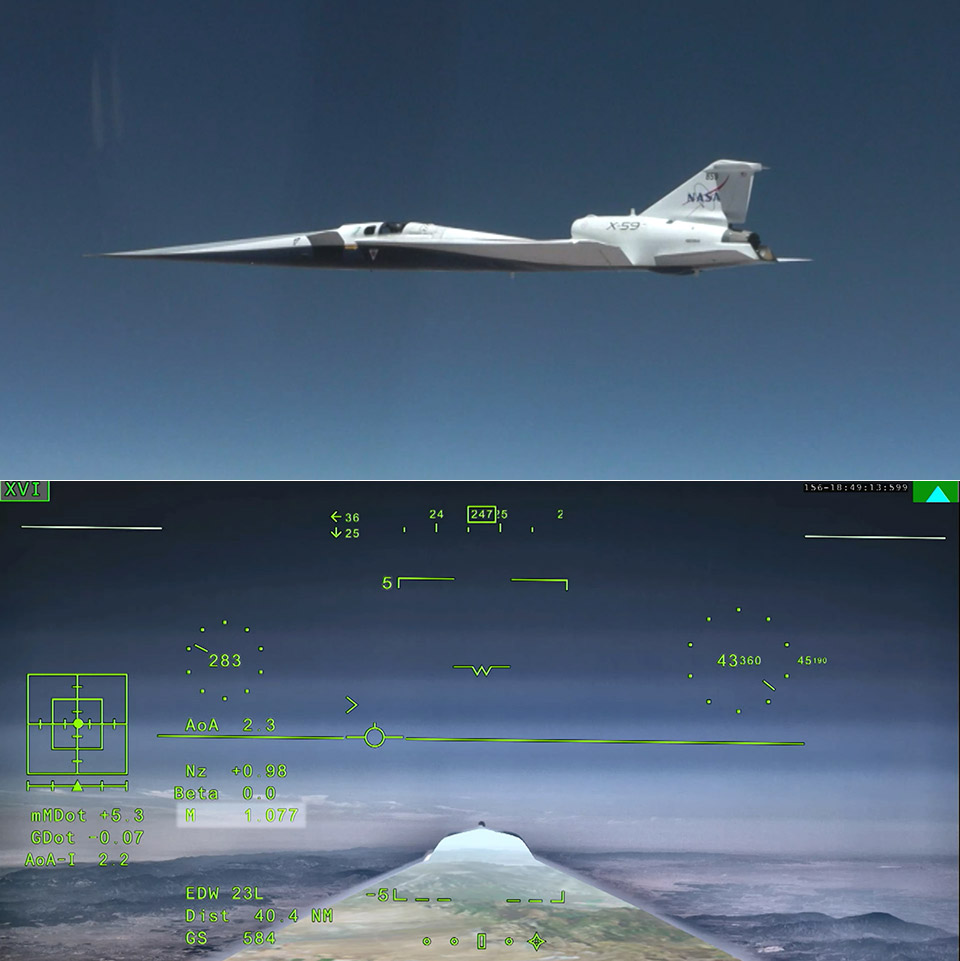
Lifting off from Edwards Air Force Base at 11:08 a.m. PDT on June 5, NASA test pilot Jim “Clue” Less guided the X-59 into the skies above the Mojave Desert. Eighty-one minutes later the aircraft returned to the runway after crossing the speed of sound for the first time.
At 43,400 feet, the aircraft briefly broke through the sound barrier, hitting Mach 1.077 and nearly Mach 1.1, or approximately 713 mph. An F-15 chase plane flew beside the X-59 throughout the mission, keeping an eye on things and gathering data for NASA. Unfortunately, the sonic boom it generated along the way completely drowned out any sound from the X-59, thus they were unable to get the vital acoustic profile during this inaugural flight. The flight effectively marked the conclusion of the subsonic stage and the start of some serious supersonic testing. We’d conducted 16 test flights since the X-59’s debut in October, and as a result, we’d been slowly pushing the flying envelope at lower speeds, but today’s mission verified what engineers had suspected: the X-59 handles itself fairly well once it reaches speeds sufficient to break the sound barrier.

- 2 AVIATION LEGENDS, 1 BUILD – Recreate the iconic Boeing 747 and NASA Space Shuttle Enterprise with the LEGO Icons Shuttle Carrier Aircraft...
- DEPLOY LANDING GEAR – Turn the dial to extend the massive 18-wheel landing system on your airplane model, just like real flight operations
- AUTHENTIC FEATURES & DETAILS – Remove the tail cone, engines, and landing gear from the NASA shuttle and stow them in the cargo bay during flight
Engineers designed the X-59 with a long, streamlined fuselage and a distinctive sharp nose. The goal of this design was to spread out the shock waves generated when a plane flew faster than sound. When an airplane reaches supersonic speeds, the waves begin to converge and eventually contact the ground as a big pressure spike that sounds like a loud boom. However, with the X-59, the waves are spread out over a longer length of time. So, instead of hearing a loud bang, you’ll hear a mild thud, similar to closing a car door in a calm neighborhood several houses away.
The Quesst mission’s ultimate goal is to collect flight data and community feedback to help engineers establish new noise limits. We’re talking about obsolete laws that were last modified in 1973 and state that commercial supersonic flights over land in the United States are prohibited due to sonic boom disturbances. If you can build something substantially quieter than a normal sonic boom, you might be able to get the faster passenger routes we all desire without the loud blast.
NASA was highly involved with this project, but they also collaborated closely with Lockheed Martin Skunk Works, which designed and produced the X-59. The aircraft incorporates an external vision system that helps the pilot maintain a clear forward view despite the towering nose that blocks a straight line of sight. Every time they fly the X-59, they collect a little more data and gain a better understanding of aerodynamics and performance. This knowledge will be used to develop innovative aircraft designs in the future. The next flight is likely to be within a few days. And that one will drive the plane to Mach 1.4 at about 55,000 feet. That is closer to what you want for potential commercial routes. As a result of a shock-sensing probe on the pursuit and ground microphones, we’ll be able to witness the X-59’s own acoustic signature.