A big pendulum hangs in Tom Stanton’s workshop, ready to go. He heaves the weighted arm to one side, lets it go, and watches it swing for a long time thanks to the low friction bearings. This is a simple device for storing energy, as gravity converts potential energy into kinetic energy with each pass, then back the other way again. Most people store electricity in batteries, but Stanton took a different approach, storing it mechanically and then converting it back to electricity on demand.
He begins with a basic experiment involving a magnet dangling from a piece of rope and swinging over a solid copper block. As the magnet passes past the copper, the moving magnetic field induces a current in the copper, and those currents form their own opposing fields, slowing the magnet and converting its motion into heat, but Stanton noticed something interesting. Instead of letting the heat triumph, he reasoned, why not replace the copper block with a coil of wire? When the magnet swings by, the current passes through the wire rather than being dissipated as heat.

- 【HOME & OUTDOOR NECESSARY】As reported, we used to experience several times natural disasters per year like hurricanes"Harvey", Wildfire, and so...
- 【2000mAh PHONE CHARGER】When we are trapped in an emergency,This emergency radio with a 2000mAh emergency power bank may be our life-saving tool...
- 【3-WAY POWER SOURCES】The solar crank radios with multiple power backup options are the best choice in the emergency package. 3 Power Source...
Stanton began with some fairly basic versions and obtained alternating current that would light an LED for a moment or two during its swing, but to make the output more useful for devices that require a steady supply, he added a full-bridge rectifier, which is four diodes arranged to allow current to flow in only one direction. He also used a capacitor to smooth out the pulses and provide a steady voltage. Even with small swings, the capacitor would now charge sufficiently to keep the LED light between swings.
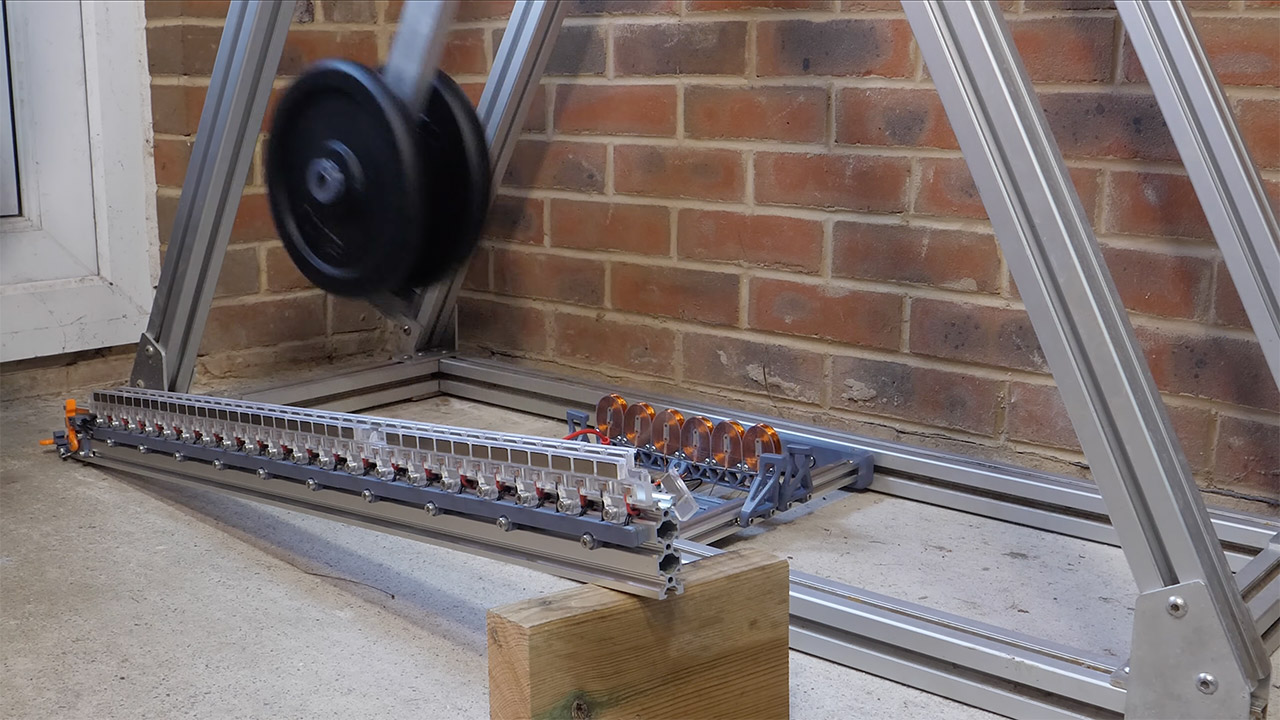
Then he got to have some fun by scaling everything up. He used an existing triangular frame from a prior trebuchet build as the foundation. He mounted an aluminum arm on precision bearings and then installed many powerful magnets along the arm in an alternating pole pattern. He also added several small magnets that rotated between the bigger ones to make a Halbach array, which directed the magnetic field strongly in one direction. To strengthen the field even further, he attached a mild steel plate behind the magnets, which focused the field by creating a convenient return path for the magnetic field lines.
The coils came next, with thick enameled copper wire twisted onto 3D-printed shapes to make six pickup coils. Each pair of coils is connected to its own rectifier on a small circuit board. To store the rectified energy, he used two enormous capacitor banks totaling 100,000 microfarads.
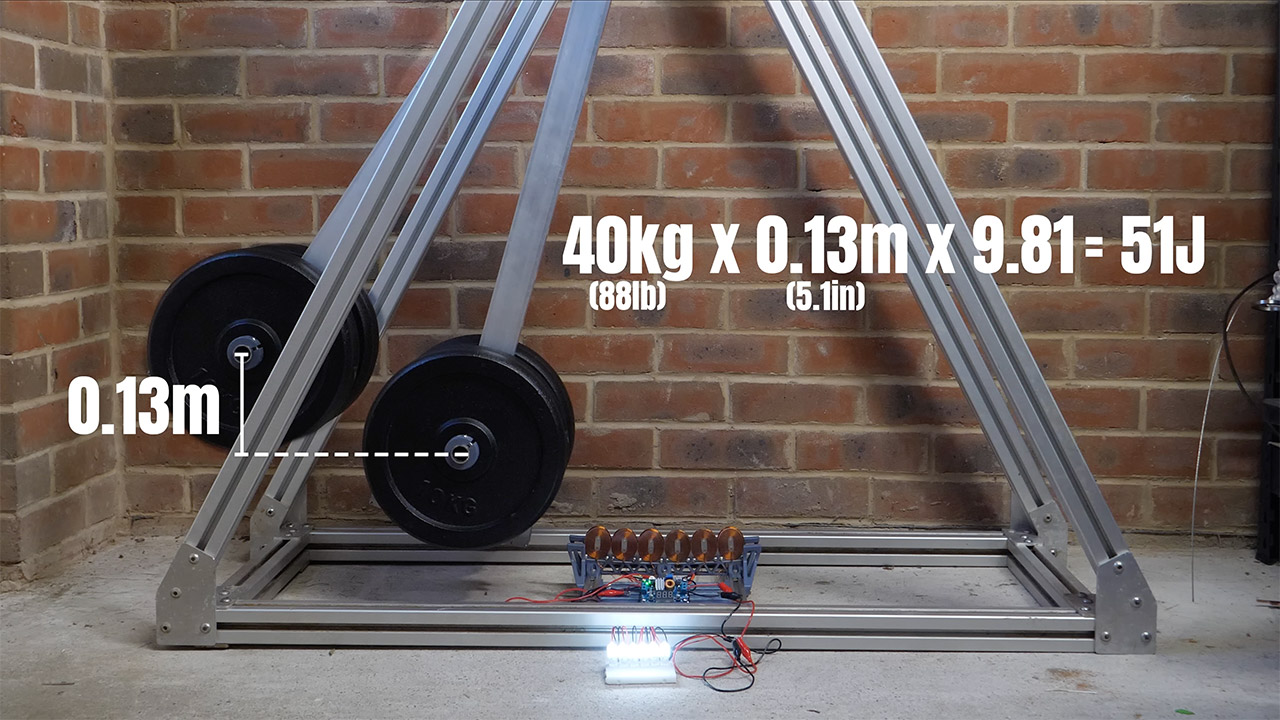
Energy calculations demonstrate how limited it is. With a 40-kilogram weight lifted 18 centimeters, the pendulum can carry around 51 joules, which is comparable to 0.014 watt-hour. That amount of energy is sufficient to power six LEDs at an average of 0.28 watts for three minutes, while the swing height decreases by 13 centimeters. However, higher swings provide a higher voltage because the speed of the swing is more important than the height in induction, but they also reduce the amount of time you can use the energy. Getting the appropriate combination of swing height and weight produces more stable power.
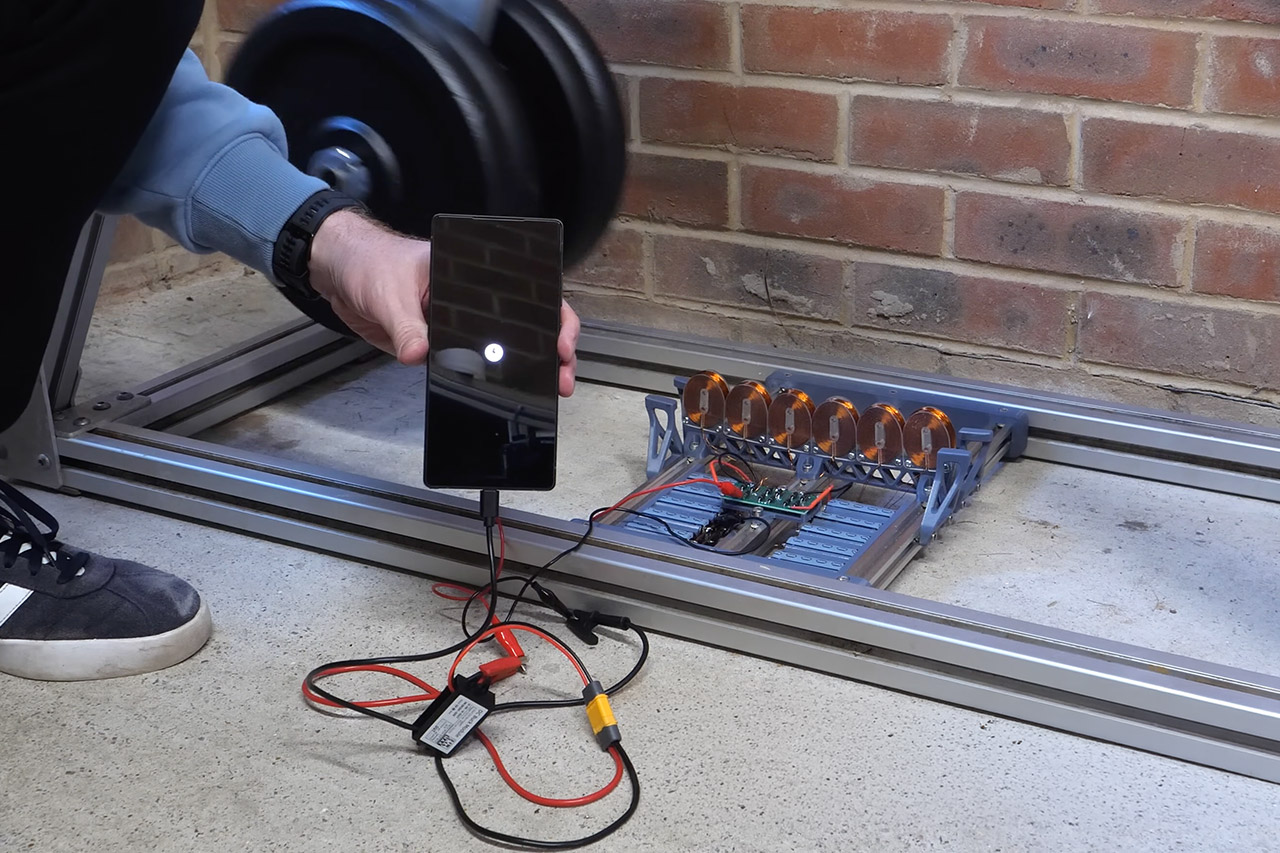
So he put it all to the test by shorting the coils, which caused the pendulum to come to a halt in a single swing due to the magnetic field’s enormous braking effect. An oscilloscope revealed that the peaks of the AC voltage mid-swing were around 80 volts, but after rectification, it settled down to roughly 30 volts DC. The stored charge is sufficient to operate a small fan for a short period of time, as well as an electromagnetic launcher that propels a paper plane across the room with a single swing. Phone charging is a sluggish process; a normal battery would only last about a thousand full cycles because its energy density is not as high as that of lithium batteries.
[Source]